

Pfizer stock (NYSE: PFE) closed near $28.46 on November 24, 2026, after a 4% one-day gain. Six days earlier, Pfizer paid $330 million upfront for three experimental therapies from Starna Therapeutics of Jiangsu, China. The detail that matters sits deeper in the release. Pfizer plans to make the finished drug for early trials at its own U.S. sites. Pfizer is quietly turning Chinese science into American-made medicine.
Today, that pattern runs through Pfizer’s pipeline. Chinese labs supply molecules. Pfizer supplies Western trials, FDA know-how, U.S. factories, and shelter from tariffs. Meanwhile, Washington is tightening biotech rules, and the FDA has raised its evidence bar for China-originated drugs. Pfizer’s own pandemic technology also faces patent attacks. This analysis connects those threads, which the patent-cliff headlines usually miss.
Pfizer Stock at a Glance
| Indicator | Figure |
|---|---|
| Close, November 24, 2026 | About $28.46 |
| 52-week range | $23.62 to $31.44 |
| Market value | About $162 billion |
| Forward P/E (2026 adjusted EPS) | About 9.5 times |
| Annual dividend | $1.72 (yield about 6%) |
| Q3 2026 revenue | $16.6 billion, flat year over year |
| 2026 revenue guidance | $62.0 to $64.0 billion (raised) |
| 2026 adjusted EPS guidance | $2.95 to $3.05 |
Sources: Pfizer Q3 2026 release; Stock Analysis; TradingKey.
The Untold Story: Pfizer as America’s Front Door for Chinese Science
At first glance, Pfizer’s China strategy looks like a series of separate deals. Together, they form a system. In May 2025, Pfizer licensed SSGJ-707, a PD-1 and VEGF bispecific antibody, from 3SBio. It paid $1.25 billion upfront and agreed to buy $100 million of 3SBio stock.
The 3SBio release includes a line most investors skipped. Pfizer will make the drug substance in Sanford, North Carolina, and the drug product in McPherson, Kansas. In other words, a molecule discovered in China will reach American patients from American plants.
Then, in May 2026, Pfizer signed a 12-program deal with Innovent Biologics for antibody-drug conjugates and multispecific antibodies. It paid $650 million upfront, with up to $9.85 billion in milestones. Finally, the Starna deal added in vivo CAR-T therapy for autoimmune diseases.
| China-originated deal | Date | Upfront | Potential milestones | Notable term |
|---|---|---|---|---|
| 3SBio (PD-1 x VEGF, tivunatamig) | May 2025 | $1.25B plus $100M equity | Up to $4.8B | U.S. manufacturing in NC and Kansas |
| Innovent (12 ADC and multispecific programs) | May 2026 | $650M | Up to $9.85B | Global and ex-China rights mix |
| Starna (in vivo CAR-T) | Nov 2026 | $330M | Up to $2.3B | Early-trial drug made at U.S. sites |
Pfizer now buys discovery from China and sells credibility, manufacturing and market access in return. That model costs less than building internal discovery. However, it concentrates risk in Washington’s view of China. China’s leverage in other industries, covered in our clean-tech windfall analysis, shows how fast that view can shift.
Geostrategy: Why U.S. Plants Became Pfizer Stock’s Political Shield
The manufacturing choice ties directly to a 2025 bargain with the White House. On September 30, 2025, Pfizer agreed to offer most-favored-nation prices to Medicaid. It also pledged to price new launches at parity with other developed markets. In addition, it committed $70 billion to U.S. research and capital projects.
In return, Pfizer received a three-year grace period from potential Section 232 pharmaceutical tariffs. That reprieve depends on further U.S. manufacturing investment. Therefore, producing licensed Chinese drugs in Kansas and North Carolina serves two purposes at once. It supports the tariff deal and keeps the supply chain outside Chinese contract manufacturers.
The BIOSECURE Act adds urgency. The federal government must publish its first list of “biotechnology companies of concern” by December 18, 2026. According to Holland & Knight, the law’s prohibitions may not take effect until mid to late 2028. In November, the Pentagon also removed WuXi AppTec from its Chinese military company list, “without prejudice to relisting.”
Cash Licensing Sits Outside Most Rules, for Now
Notably, pure cash licensing deals appear to fall outside a proposed Treasury rule announced in October 2026. Deals that give Chinese partners equity face more scrutiny. Pfizer’s $100 million stake in 3SBio sits closer to that line. In addition, a pending Senate bill could capture licensing-only deals if Congress ever acts. The legal ground under Pfizer’s China strategy looks stable today, but it remains political ground. Similar exposure appears at Genmab and SELLAS.
The Science: The FDA’s New Survival Bar
Geopolitics also reaches the FDA. On November 15, the agency rejected Summit Therapeutics’ ivonescimab, the first PD-1 and VEGF bispecific filed in the U.S. Akeso discovered the drug in China. According to Fierce Pharma, the FDA said progression-free survival without a significant overall survival gain could not support approval. At the primary analysis, the Western subgroup’s survival hazard ratio was 0.98.
As a result, that decision lands directly on Pfizer’s pipeline. Tivunatamig, the 3SBio asset, belongs to the same class and is entering global Phase 3 trials. Consequently, Pfizer must prove survival benefit in Western patients, not only tumor shrinkage in Chinese trials.
Here Pfizer’s scale becomes the value it adds. Large multi-regional survival trials cost billions and take years. Few Chinese biotechs can run them alone. The FDA’s tougher bar raises the price of entry, and Pfizer owns one of the biggest trial machines in the industry. Still, the bar cuts both ways, because a failed survival trial would erase the $1.25 billion bet.
In Vivo CAR-T and the RNA Dividend
Next, Starna’s science explains why RNA experience matters. Conventional CAR-T therapy removes a patient’s T cells, engineers them in a lab, then reinfuses them. In vivo CAR-T skips that step. Lipid nanoparticles carry RNA instructions directly to T cells inside the body. In theory, that turns a bespoke cell therapy into an off-the-shelf injection.
According to its Starna release, Pfizer brings “significant experience in developing and manufacturing RNA-based medicines globally.” That experience came from Comirnaty. In effect, the pandemic left Pfizer with RNA and lipid nanoparticle know-how it can now redeploy.
Pfizer Stock and the mRNA Patent Siege
The same technology, however, carries legal baggage. Arbutus and Genevant have sued Pfizer and BioNTech in New Jersey since 2023 over lipid nanoparticle patents. In July 2026, they expanded the fight to Canada and Europe’s Unified Patent Court. Moderna settled similar claims in March 2026 for up to $2.25 billion.
Meanwhile, GSK adds a second front. In November 2026, GSK won an injunction against Pfizer and BioNTech at the Unified Patent Court, per MLex. However, the court delayed enforcement. GSK’s European patent covers lipids with properties suited to RNA delivery.
| LNP and mRNA patent dispute | Venue | Status (November 2026) |
|---|---|---|
| Arbutus and Genevant v. Pfizer/BioNTech | New Jersey federal court | Pending since 2023 |
| Arbutus and Genevant v. Pfizer/BioNTech | Canada and UPC | Filed July 2026 |
| GSK v. Pfizer/BioNTech | UPC, The Hague | Injunction granted, enforcement delayed |
| Arbutus and Genevant v. Moderna | Global | Settled March 2026 for up to $2.25B |
Pfizer has not disclosed how it splits Comirnaty liabilities with BioNTech. As a result, investors cannot size the exposure precisely. In our view, these cases matter beyond COVID revenue. Any settlement could shape the licensing cost of Pfizer’s next-generation RNA medicines, including in vivo CAR-T.
Pfizer Stock Patents: Borrowed Foundations and Court Losses
Similarly, Pfizer’s patent estate tells a quieter story about where its science originated. Tafamidis, sold as Vyndaqel and Vyndamax, came from Scripps Research professors Jeffery Kelly and Evan Powers. In April 2026, settlements with Dexcel, Hikma and Cipla pushed U.S. generic entry to June 1, 2031. Pfizer had expected 2028. Other litigation remains pending.
Seagen, the $43 billion acquisition, has fared worse in court. In December 2025, the Federal Circuit erased Seagen’s $41.8 million verdict against Daiichi Sankyo over an antibody-drug conjugate patent. By contrast, Pfizer defended Paxlovid in June 2026, when the same court affirmed the invalidity of Enanta’s patent.
| Patent battle | Outcome | What it means |
|---|---|---|
| Vyndamax settlements (April 2026) | Generic entry delayed to June 2031 | Protects a franchise near $6.4B in annual sales |
| Seagen v. Daiichi Sankyo (Dec 2025) | $41.8M verdict reversed | Weakens Seagen’s ADC platform leverage |
| Enanta v. Pfizer (June 2026) | Pfizer win affirmed | Removes a Paxlovid royalty threat |
| Arbutus, GSK LNP cases | Pending or adverse | Contingent cost on RNA products |
Why Borrowed Science Shapes the Valuation
In our view, Pfizer’s moat increasingly rests on development, manufacturing and regulatory execution, not original discovery. Tafamidis came from Scripps, Padcev from Seagen and Astellas, and the newest pipeline from China. That approach works, but it shares value with licensors through royalties and milestones. For Pfizer stock, execution now carries more weight than invention.
Supply Chain: The Flood That Proved the Point
Offshore fragility, by contrast, showed up in July. On July 23, 2026, monsoon rains flooded Zydus Hospira Oncology, a Pfizer joint venture plant in Gujarat, India. The site makes injectable chemotherapy, and shortages of cytarabine, irinotecan, and bleomycin followed. According to CancerNetwork, new supply may not arrive until mid-to-late 2028.
That episode strengthens Washington’s case for domestic production. It also supports Pfizer’s political argument for building in America. Investors comparing healthcare deal strategies can also review our Abbott and Exact Sciences analysis.
The Financial Bridge Behind Pfizer Stock
For now, third-quarter results show the transition in progress. Revenue held flat at $16.6 billion, yet sales excluding COVID products grew 7% operationally. Launched and acquired products grew 32%. Meanwhile, Paxlovid fell 63%, and Comirnaty fell 29%.
| Q3 2026 product line | Operational change |
|---|---|
| Eliquis | Up 25% |
| Vyndaqel family | Up 12% |
| Padcev | Up 55% |
| Prevnar family | Down 10% |
| Comirnaty | Down 29% |
| Paxlovid | Down 63% |
Management raised 2026 revenue guidance to $62 to $64 billion. That forecast includes a $650 million charge for the Innovent deal. Insiders also bought in August. CEO Albert Bourla purchased 38,000 shares at $26.34, worth about $1 million.
The Dividend’s Narrow Margin
The dividend explains why Pfizer stock trades like a bond proxy. Pfizer pays $1.72 per share a year, and the quarterly rate has stayed at $0.43 through 2026. According to the research inputs, nine-month free cash flow roughly matched dividend payments. Consequently, Pfizer has little room to raise the payout or buy back shares. Every dollar spent on China licensing competes with the dividend for the same cash. That tension explains why Pfizer prefers modest upfronts and large, contingent milestones.
Scenarios for Pfizer Stock
The scenarios below reflect our judgment, not forecasts.
| Scenario | What happens | Implication |
|---|---|---|
| Bull | Tivunatamig shows survival benefit, BIOSECURE spares partners, LNP cases settle modestly | Market rewards Pfizer as a global development platform |
| Base | Mixed trial results, steady cost cuts, gradual LNP settlements | Shares trade on dividend and cash flow |
| Bear | Survival trials fail, rules capture licensing, large LNP damages | Valuation stays compressed through the patent cliff |
In addition, rates matter for an income stock. The Federal Reserve held its range at 3.75% to 4.00% on October 28. Regulatory shocks can also reprice healthcare quickly, as our coverage of uniQure’s FDA reversal showed. Broader geopolitical market risk also shapes defensive flows.
Key Risks for Pfizer Stock
- China policy. BIOSECURE lists or new rules could reach Pfizer’s partners.
- FDA bar. China-originated drugs now need Western survival data.
- LNP litigation. Arbutus, Genevant and GSK cases remain unresolved.
- Patent cliff. Several blockbusters lose U.S. protection between 2026 and 2028.
- Supply. The Gujarat flood shows offshore plants carry real risk.
- Tariffs. The three-year grace period depends on continued U.S. investment.
- Dividend. Flat payouts signal limited room for error.
Closing Thoughts
Pfizer’s turnaround depends on more than replacing expiring drugs. The company is building a bridge that carries Chinese discoveries through Western trials and U.S. factories. That bridge uses pandemic-era RNA skills and a tariff bargain with Washington. Yet it rests on contested patents, shifting China policy and a stricter FDA. For Pfizer stock, the bridge itself has become the investment case.
Sources
- Pfizer: Third quarter 2026 results (via Finviz)
- Pfizer: Exclusive licensing agreement with 3SBio
- Pfizer: Exclusive licensing agreement with Starna
- Pfizer: Global strategic collaboration with Innovent Biologics
- Fierce Biotech: Pfizer’s $2.6B in vivo CAR-T deal with China’s Starna
- Pharma Manufacturing: Pfizer’s three-year tariff grace period
- BioPharma Dive: Pfizer’s most-favored-nation pricing deal
- Holland & Knight: WuXi walks off the Pentagon list
- Fierce Pharma: FDA rejects ivonescimab
- JUVE Patent: The mRNA wars escalate with new Arbutus claims
- JUVE Patent: The Hague local division and GSK’s mRNA cases
- IAM: GSK wins UPC injunction against Pfizer/BioNTech
- MLex: This week at the UPC, November 6 to 12
- BioPharma Dive: Vyndamax settlements extend exclusivity
- Scripps Research: Tafamidis approval for cardiomyopathy
- Fierce Pharma: Daiichi Sankyo flips Seagen’s $41.8M verdict
- IPWatchdog: CAFC affirms Enanta patent invalid
- CancerNetwork: Flood-damaged plant may prolong chemotherapy shortages
- TIKR: Bourla’s $1 million share purchase
- Stock Analysis: PFE market data
- TradingKey: PFE gains 4.18% on November 24
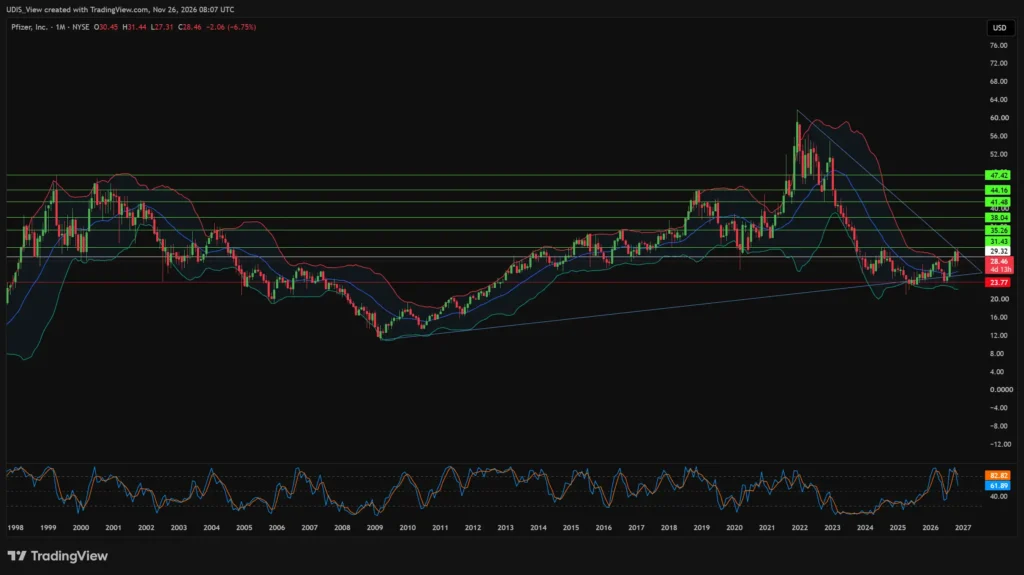
Pfizer Long (Buy)
Enter At: 29.32
T.P_1: 31.43
T.P_2: 35.26
T.P_3: 38.04
T.P_4: 41.48
T.P_5: 44.16
T.P_6: 47.42
S.L: 23.77