

A multi-domain deep dive: the $2.44B war chest, the SyNTase in vivo pivot, the Broad patent overhang, and the geopolitics of genomic data.
A Historic Turning Point
The biotechnology sector watches CRISPR Therapeutics with unusual intensity in 2026. The company successfully commercialized the world’s first CRISPR-based gene-editing therapy, Casgevy, a milestone that validates the foundational science completely and re-rates the entire gene-editing sector. Investors now evaluate a complex matrix of severe risks and outsized rewards across multiple analytical dimensions: geopolitics, patent law, in vivo platform technology, and cyberbiosecurity.
Geopolitical tensions are complicating global biotech supply chains. Persistent patent litigation threatens future operating margins. Escalating cyberbiosecurity risks shadow proprietary genomic data. Yet platform-based therapies promise dramatically faster development timelines, and CRISPR Therapeutics’ pivot from ex vivo cell therapy to in vivo gene correction marks a structural shift in biopharma economics, replacing perpetual disease management with singular, permanent architectural corrections.
This report dissects the fundamental drivers shaping CRISPR Therapeutics today, across the financial, scientific, legal, geopolitical, and digital-security domains that will define the stock through 2026 and beyond.
Macroeconomic Drivers and Financial Health
Q1 2026 Earnings: A Calibrated Loss, A Strengthening Balance Sheet
On May 4, 2026, CRISPR Therapeutics released its Q1 2026 financial results. Total quarterly revenue reached $1.46 million, up 68.5% year-over-year from $0.865 million in Q1 2025, though the figure missed the Zacks Consensus Estimate of $8.39 million. Net loss came in at $122.9 million, or $1.28 per diluted share.
Internal profitability metrics improved year-over-year. Net loss narrowed from $136.0 million in Q1 2025. Total operating expenses fell to $131.7 million, with collaboration expenses dropping to $45.9 million from $57.5 million. R&D fell 5.4% YoY to $68.6 million; G&A declined 11% to $17.2 million. The collaboration-expense decline reflects CRISPR Therapeutics recording a larger share of Casgevy revenue under the amended Vertex agreement economics now booked as an adjustment to collaboration expenses rather than top-line revenue, aggressively insulating cash burn while the partnership scales toward what analysts model as a $1B+ annual cash-flow stream.
Table 1: Q1 2026 Financial Snapshot
| Financial Metric | Q1 2026 | Q1 2025 | Year-Over-Year Change |
| Total Revenue | $1.46M | $0.865M | +68.5% |
| Net Loss | $(122.9)M | $(136.0)M | Improved by $13.1M |
| Diluted Loss Per Share | $(1.28) | $(1.58) | Improved by $0.30 |
| Operating Expenses | $131.7M | $149.3M | -$17.6M |
| Collaboration Expense | $45.9M | $57.5M | -$11.6M |
| R&D Expense | $68.6M | $72.5M | -5.4% |
| G&A Expense | $17.2M | $19.3M | -11% |
| Total Cash & Securities | $2.44B | — | +$464M sequential |
Cash Flow and Operational Runway
Liquidity is the ultimate weapon in clinical-stage biotechnology, and CRISPR operates from a fortress balance sheet. Total cash, equivalents, and marketable securities reached $2.44 billion as of March 31, 2026, up from $1.98 billion at year-end 2025. Management’s $600 million convertible senior notes offering (maturing 2031, 1.7308% coupon) delivered $585.4 million in net proceeds, securing a multi-year operational runway. Working capital rose to $2.31 billion alongside total assets of $2.73 billion. The company is effectively inoculated against near-term equity dilution while smaller rivals struggle for favorable financing terms.
Exchange-Traded Fund Market Dynamics
Institutional flows heavily dictate daily biotech price action. Several major ETFs anchor positions in CRISPR Therapeutics, including Cathie Wood’s ARK Genomic Revolution ETF, the Global X Genomics & Biotechnology ETF, and the WisdomTree BioRevolution Fund. These flows provide vital price support, but ETF concentration introduces structural volatility. Quarterly rebalancing events can trigger sudden price swings irrespective of fundamentals, and the market heavily penalizes any unexpected clinical setbacks.
Microeconomics: The Burden of Rare Diseases
The Economic Cost of Genetic Disorders
Rare genetic diseases inflict massive economic damage. Over 400 million people globally live with rare genetic diseases, and the burden in the United States alone is staggering: rare diseases cost the US economy nearly $1 trillion annually, with $449 billion in direct healthcare costs and $437 billion in lost workforce productivity. Traditional pharmacology manages this biological decay downstream; platform-based genomic editing structurally eliminates the underlying genetic deficit at its root.
Platform-Based Therapeutic Revolution
Gene editing is transitioning to a reusable platform model. Developers no longer build unique therapies from scratch; they use modular architectures of pre-approved biological components, swapping only the disease-specific guide RNA. Traditional personalized medicines take up to 24 months to develop; platform models can yield bespoke therapies in roughly six months. The FDA’s Platform Technology Designation Program, launched in 2024, lets companies reuse safety data across programs and eliminates redundant animal safety testing, a structural tailwind for any developer with a true platform.
The Casgevy Commercial Rollout
Revenue Generation and Patient Adoption
Casgevy, the world’s first approved CRISPR-based therapeutic, generated $43 million in direct product revenue in Q1 2026, up from $14.2 million in Q1 2025. The treatment targets sickle cell disease and transfusion-dependent beta-thalassemia. The global eligible patient pool exceeds 60,000 individuals; over 500 patients have been initiated globally by Q1 2026. The ex vivo administration process cell collection, external editing, and reimplantation, remains complex, but Vertex recently secured a Germany pricing agreement, and analysts model peak sales above $1 billion annually.
Pediatric Label Expansion Strategy
Vertex’s maneuver to use a rare National Priority Review Voucher for Casgevy’s pediatric label expansion (ages 5 to 11) is a regulatory masterstroke. A potential two-month FDA review compression unlocks a highly motivated patient demographic and prevents catastrophic long-term organ damage. A successful label extension drives sustained revenue growth through 2030 and cements Vertex–CRISPR Therapeutics market dominance ahead of any competing in-class entrants.
Table 2: Casgevy Commercial Performance and Pipeline Catalysts
| Casgevy Metric | Status | Strategic Implication |
| Q1 2026 Product Revenue | $43M | +203% YoY from $14.2M |
| Patients Initiated | 500+ globally | Strong commercial momentum |
| Eligible Patient Pool | 60,000+ globally | Multi-year revenue runway |
| Pediatric Expansion (Ages 5–11) | FDA filing under priority review | Decision possible within ~2 months |
| Germany Pricing Agreement | Secured Q1 2026 | European reimbursement expansion |
| Analyst Peak Sales Target | >$1B annually | Major recurring cash-flow stream |
The Autoimmune Market Opportunity
Targeting B-Cell Depletion
Following the GLP-1 weight-loss craze, autoimmune diseases have emerged as biotech’s next major growth vector the global autoimmune market is projected to reach $223 billion by 2034. Traditional treatments suppress the entire immune system bluntly, causing severe side effects and opportunistic infections. CRISPR Therapeutics deploys CAR-T therapy with CRISPR-edited donor cells that hunt malfunctioning B-cells precisely, resetting the immune system without broad suppression.
Zugo-cel Clinical Progress
Zugocaptagene geleucel (zugo-cel) is navigating Phase 1 trials targeting systemic lupus erythematosus, systemic sclerosis, and inflammatory myositis. Early data: four patients treated with 100 million cells achieved 100% sustained B-cell depletion at 28 days, and every patient exhibited measurable clinical improvement. Trials recently expanded to include warm autoimmune hemolytic anemia. If zugo-cel translates, it could become a blockbuster that disrupts the entire conventional autoimmune drug market.
In Vivo Editing Technologies and the SyNTase Platform
The Ex Vivo Bottleneck
First-generation CRISPR therapies like Casgevy rely entirely on ex vivo editing, cells extracted, edited externally, then reimplanted. The protocol requires toxic conditioning regimens and limits commercial scalability. CRISPR Therapeutics is now pivoting aggressively to in vivo programs that edit the patient’s genes directly inside the body, eliminating external cellular manufacturing entirely and dramatically lowering cost of goods. The lead in vivo liver program, CTX310 (targeting ANGPTL3 for cardiovascular disease), is already in Phase 1.
The SyNTase Platform and AI-Guided Design
In October 2025, CRISPR Therapeutics unveiled its proprietary SyNTase editing platform. SyNTase combines highly compact Cas9 proteins with novel engineered polymerases and synthetic nucleotide templates. AI guided the structural modeling of the polymerases, maximizing chemical stability and target correction efficiency. The platform is a substantial technical advance over basic prime editing and supports scalable commercial manufacturing, solving one of the biggest bottlenecks in modern genetic medicine.
LNP Delivery and CTX460 Preclinical Success
Delivery is the greatest technical challenge in in vivo editing. SyNTase utilizes advanced Lipid Nanoparticles (LNPs), which exhibit very low immunogenicity compared to viral vectors and deliver payloads directly to the liver. Lead candidate CTX460, targeting Alpha-1 Antitrypsin Deficiency, achieved >90% mRNA correction from a single intravenous dose in preclinical studies, with a 5-fold increase in functional AAT levels and durability up to 7–9 weeks in rodent models. Off-target editing was virtually zero. Clinical trials for CTX460 are expected to begin globally in mid-2026; CTX340 (refractory hypertension) and CTX450 (acute hepatic porphyria) follow in the in vivo liver pipeline.
Table 3: Pipeline Candidates and Clinical Progress
| Candidate | Approach | Target Disease | Clinical Status |
| Casgevy | Ex Vivo CRISPR/Cas9 | Sickle Cell, Beta-Thalassemia | Approved & Commercial |
| Zugo-cel | Ex Vivo CAR-T | Lupus, Systemic Sclerosis, Myositis | Phase 1 (positive data) |
| CTX310 | In Vivo LNP | Cardiovascular (ANGPTL3) | Phase 1 ongoing |
| CTX460 | In Vivo SyNTase + LNP | Alpha-1 Antitrypsin (AATD) | Clinical start mid-2026 |
| CTX340 | In Vivo LNP | Refractory Hypertension (AGT) | IND H1 2026 |
| CTX450 | In Vivo LNP | Acute Hepatic Porphyria (ALAS1) | Preclinical |
| CRISPR-X | Gene Writing / All-RNA | Complex Polygenic Disorders | Preclinical |
CRISPR-X and the Move to Gene Writing
Beyond standard Cas9 cuts, CRISPR-X is advancing all-RNA gene correction methods and non-viral delivery systems for massive DNA payloads, transitioning the sector from gene cutting to gene writing. While still preclinical, this modular, AI-integrated architecture provides a long-term technological moat. Competitors without comparable platform investment risk rapid obsolescence as the curative paradigm consolidates around in vivo delivery.
Patent Analysis: The Foundational Dispute
Broad Institute vs. CVC Group
The foundational CRISPR-Cas9 patents remain contested. The dispute pits the Broad Institute against the CVC group, the University of California, the University of Vienna, and CRISPR Therapeutics co-founder Emmanuelle Charpentier. On March 27, 2026, the Patent Trial and Appeal Board (PTAB) reaffirmed priority inventorship for the Broad Institute in eukaryotic cells, blocking 14 CVC patent applications. The ruling marks the PTAB’s third favorable decision for Broad. CVC retains the right to appeal to the Court of Appeals for the Federal Circuit (CAFC).
Financial Implications of the Patent Defeat
Because CRISPR Therapeutics relies heavily on the CVC patent estate, the ruling injects material financial uncertainty. Editas Medicine holds exclusive licenses to the relevant Broad patents, and Broad-Institute patents now dominate human therapeutic applications. CRISPR Therapeutics may need to negotiate sublicenses, and royalties to rivals would permanently impair operating margins. However, more than 60 US and 40 non-US CVC patents remain unaffected by the PTAB decision, providing a meaningful defensive cushion for ongoing programs.
The Inclusive Innovation Licensing Model
Despite the legal victory, the Broad Institute promotes broad technological access through its “Inclusive Innovation” licensing model, which prevents any single company from monopolizing all treatments. The Broad has executed over 200 non-exclusive licenses to date. This offers CRISPR Therapeutics a viable pathway to operational rights; total blockage appears unlikely, and complex settlement remains the probable end-state.
Table 4: Patent Dispute Outcomes and Financial Implications
| Patent Outcome | Beneficiary | Financial Impact on CRISPR Therapeutics |
| PTAB March 27, 2026 ruling | Broad Institute | Potential royalty demands on therapeutic licenses |
| Editas Medicine exclusive license | Editas | Direct competitive licensing position |
| CAFC appeal pending (CVC) | Uncertain | Multi-year legal overhang on margins |
| 60+ unaffected CVC US patents | CRISPR Therapeutics | Defensive cushion for current programs |
| Broad “Inclusive Innovation” model | Industry-wide | Viable pathway to negotiate sublicenses |
| 200+ Broad non-exclusive licenses | Multiple firms | Suggests total blockage unlikely |
Geopolitics: Genomic Data as a Strategic Asset
The BIOSECURE Act of 2025
Gene editing is no longer purely scientific; it is a theater of global geopolitical competition. Human biological data has joined semiconductors and AI as a strategic national asset. After two years of legislative back-and-forth, President Trump signed the BIOSECURE Act into law on December 18, 2025, as Section 851 of the FY26 National Defense Authorization Act. The legislation protects American genomic data from foreign adversaries and recasts data governance as a measure of geopolitical trustworthiness.
Global Supply Chain Reconfigurations
The act imposes restrictions on federal procurement involving designated “biotechnology companies of concern” (BCCs), including Chinese contract manufacturers like WuXi AppTec and BGI. US agencies cannot buy equipment or services from designated BCCs, and companies using BCC equipment lose access to federal funding. Western biopharma firms must audit their contract manufacturing organizations and purge non-compliant foreign hardware. Competitors relying on cheap foreign manufacturing face severe operational pressure, while domestic capacity becomes a competitive moat in itself, the same Western re-shoring dynamic now driving GlobalFoundries’ re-rating across the semiconductor sector.
The Framingham Manufacturing Advantage
CRISPR Therapeutics’ award-winning Framingham, Massachusetts facility, 113,000+ square feet of clean rooms, ISPE Facility of the Year (2022), handles both clinical and commercial production. The company does not rely on Chinese contractors targeted by BIOSECURE. The geostrategic shield positions CRISPR Therapeutics as a BIOSECURE-compliant strategic partner while less prepared competitors scramble for new vendors and absorb relocation costs. The strategic logic is identical to the one re-rating Intel’s domestic foundry buildout under the CHIPS Act: when government procurement is gated by domestic capacity, the incumbents with pre-built US infrastructure capture asymmetric value.
Cyberbiosecurity: The Digital Threat Landscape
Cyber Threats and AI-Driven Attacks
The rapid digitalization of biology creates unprecedented security vulnerabilities at the intersection of cybersecurity, physical systems, and biological data. State-sponsored hackers actively target proprietary drug development and clinical trial data. AI weaponizes these threats, deepfake spear phishing, synthetic voice impersonation, and chat-based social engineering, routinely bypassing standard security firewalls. CRISPR Therapeutics explicitly warns investors that security breaches could result in significant financial and reputational harm.
Table 5: Cyber Threat Categories and Potential Impacts
| Cyber Threat Category | Attack Vector | Target Asset | Potential Impact |
| Intellectual Property Theft | Network Intrusion | Proprietary Clinical Data | Loss of Competitive Moat |
| Ransomware | Phishing / Malware | Manufacturing Systems | Total Operational Halt |
| Supply Chain Hack | Third-Party Vendors | Bioinformatics Databases | Covert Data Exfiltration |
| Deepfake Spear Phishing | Social Engineering | Employee Credentials | Unauthorized Access |
| State-Sponsored Espionage | Advanced Persistent Threats | Drug Pipeline IP | Multi-Billion Asset Loss |
Regulatory Compliance Mandates
GDPR requires explicit consent for processing sensitive genetic and biometric data; navigating it during international clinical trials is costly. HIPAA mandates secure handling of patient records, and the Trump administration recently proposed sweeping modernizations to the HIPAA Security Rule, demanding comprehensive technology asset inventories, network mapping, annual penetration testing, and formal disaster-recovery capabilities. Compliance is no longer optional infrastructure; it is mandatory investment for any sustainable biotech operation.
Investment Outlook and Risk Assessment
Bull Case Catalysts
- Casgevy product revenue ramp ($43M in Q1 2026 → analyst-projected $1B+ peak).
- 500+ patients initiated globally, with pediatric label expansion pending.
- $2.44B cash, equivalents, and securities fund the deep pipeline without dilution.
- Zugo-cel achieving 100% B-cell depletion in early Phase 1 patients across multiple indications.
- SyNTase platform delivering >90% mRNA correction with CTX460 in preclinical models.
- CTX460 clinical start in mid-2026 as a major binary catalyst.
- Piper Sandler price target of $110 per share; consensus skewed bullish among covering analysts.
Bear Case Headwinds
- PTAB Broad Institute ruling (March 27, 2026) and potential royalty exposure to rivals.
- Persistent net losses ($122.9M in Q1 2026) despite improving operating discipline.
- Casgevy’s complex ex vivo administration constrains the rate of peak-sales realization.
- Cyberbiosecurity threats targeting clinical trial data and manufacturing systems.
- BIOSECURE Act supply-chain disruption pressure across the broader sector.
- ETF concentration creating amplified volatility on biotech sentiment shifts.
- Direct competition from Beam Therapeutics in base editing and other next-generation platforms.
Conclusion: The 2026 Verdict
CRISPR Therapeutics is positioned as the pioneering titan of the genetic revolution. The technological moat, Casgevy commercial validation, the SyNTase in vivo platform, the Framingham manufacturing shield, and the $2.44B war chest are exceptionally wide. CEO Samarth Kulkarni has described 2026 as a “defining year,” with the CTX460 clinical start in mid-2026 serving as the definitive binary catalyst. If the LNP-delivered SyNTase platform mirrors its preclinical 90% mRNA correction in human subjects, it will re-rate the company’s valuation by proving in vivo mass-market viability.
The patent overhang and geopolitical headwinds cannot be dismissed. The stock demands a high-risk tolerance and a long-horizon thesis; volatility will remain extreme as clinical readouts and patent appeals collide. The underlying science, however, is too foundational to be derailed by any single legal or geopolitical event. For portfolios seeking exposure to revolutionary healthcare disruption, the asset warrants serious consideration, sized to the volatility, framed by the catalysts, and stress-tested against the legal scenarios.
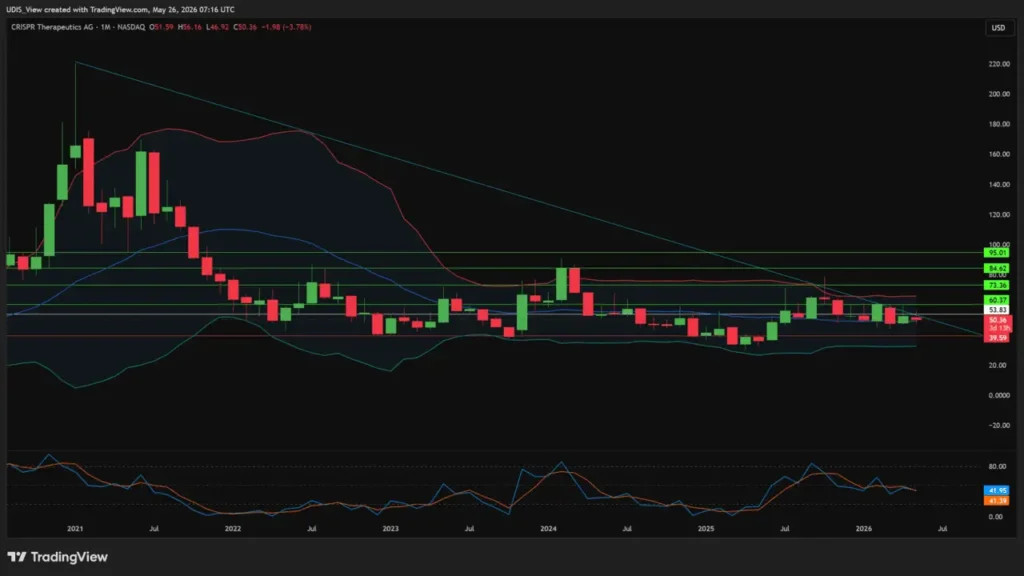
CRISPR Therapeutics Long (Buy)
Enter At: 53.83
T.P_1: 60.37
T.P_2: 73.36
T.P_3: 84.62
T.P_4: 95.01
S.L: 39.59