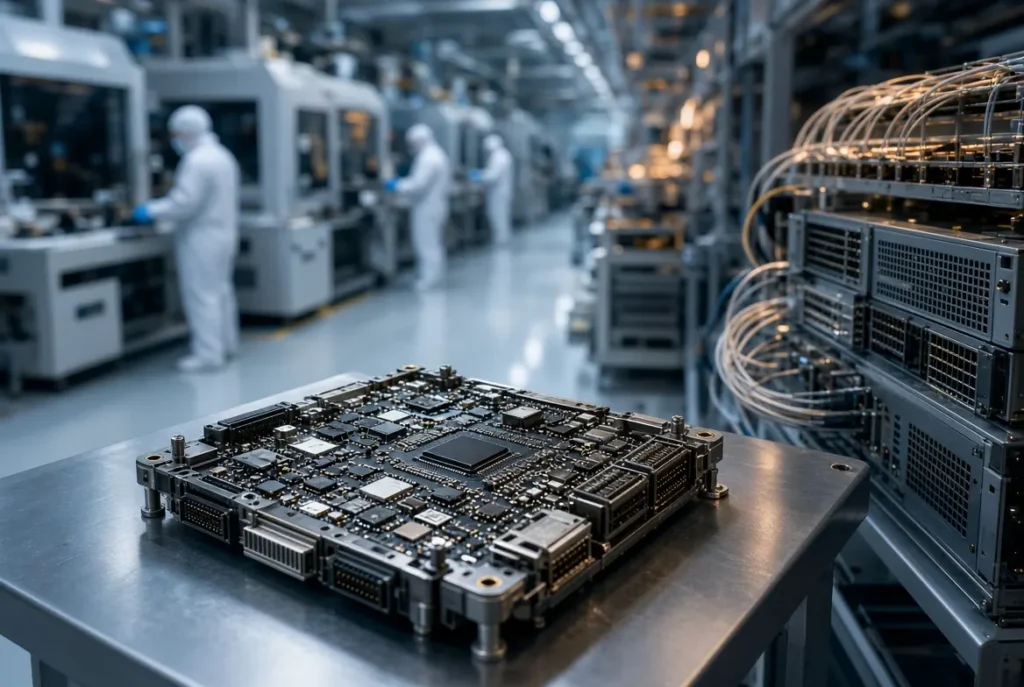


Corning stock fell as much as 20% in a single session on July 28, even though the company had just beaten second-quarter expectations and reaffirmed a plan to double its sales run rate to $40 billion by 2030. Since then, Nvidia, Amazon, AT&T and Verizon have all signed or expanded multi-year supply deals.
In our view, Corning operates as a fortified materials science monopoly, controlling the physical layer that AI, telecom networks and smartphones depend on. The real question is timing. Today’s growth comes from fiber and connectivity sold under signed multi-year contracts. The next leg, glass core substrates and co-packaged optics, is not yet contracted, and the market may already be pricing it in. This analysis examines that gap.
The Quarter Behind the Corning Stock Selloff
Start with the numbers, because they were strong.
Corning reported on July 28 that second-quarter core sales grew 17% to $4.74 billion, its ninth consecutive quarter of year-over-year growth. Core earnings per share rose 30% to $0.78, ahead of the roughly $0.76 consensus. Core operating margin expanded 190 basis points to 20.9%.
| Corning Q2 2026 | Result |
|---|---|
| Core sales | $4.74 billion, up 17% |
| Core EPS | $0.78, up 30% |
| Core gross margin | 39.6%, up 120 bps |
| Core operating margin | 20.9%, up 190 bps |
| GAAP sales | $4.51 billion |
| Operating cash flow | $1.72 billion |
| Adjusted free cash flow | $1.42 billion |
| Optical Communications sales | $2.07 billion, up 32% |
A few segments drove the growth. Enterprise Networks sales rose 65% and Solar grew 90%, while Glass Innovations, which includes display, rose just 1% to $1.46 billion. The selloff came from guidance: management guided third-quarter core sales to $4.9 billion to $5.0 billion and core EPS to $0.85 to $0.89, roughly in line with what analysts expected rather than above it.
Springboard: The Contracted Engine Behind Corning Stock
The growth plan behind Corning stock is unusually explicit, and signed agreements back much of it.
Corning’s upgraded Springboard Plan targets an annualized sales run rate of $20 billion by the end of 2026, $30 billion by the end of 2028, and $40 billion by the end of 2030, implying about 19% compound annual sales growth from late 2026. Management said the third-quarter guide implies reaching the $20 billion rate a quarter early.
| Customer agreement | Announced | Key terms |
|---|---|---|
| Meta | January 2026 | Up to $6 billion; Hickory, NC expansion, about 1,000 jobs |
| Nvidia | May 6, 2026 | Warrants worth up to $3.2 billion in Corning equity; three new plants |
| Amazon | June 8, 2026 | Multibillion-dollar; 1,000 jobs in North Carolina |
| Verizon | September 8, 2026 | 80+ million miles of fiber, 2027 to 2032 |
| AT&T | September 29, 2026 | More than $3 billion, through 2030 |
The Nvidia deal is often misreported. Nvidia did not commit $3.2 billion to factories. It prefunded $500 million of warrants for 3 million Corning shares and received warrants for 15 million more at $180 per share. Corning, for its part, will build three plants in North Carolina and Texas, raising its US optical connectivity capacity tenfold and US fiber capacity by more than 50%. Two more hyperscalers have signed agreements similar in size and length to Meta’s, and Amazon’s agreement adds a fiber-technician training program in North Carolina.
Telecom and Consumer Glass Are Contracted Too
Telecom carriers are locking in supply too, a shift we examined in Verizon’s dark fiber push and AT&T’s fight with Starlink. Consumer glass is contracted as well. Apple committed $2.5 billion in 2025 so that all iPhone and Apple Watch cover glass will be made at Corning’s Harrodsburg, Kentucky plant.
Geopolitics: Polysilicon, Solar and the CHIPS Act
Corning also holds a strategic position in America’s semiconductor supply chain.
It has owned 80.5% of Hemlock Semiconductor since 2020, with Japan’s Shin-Etsu holding the rest. Hemlock is the only US-headquartered maker of hyper-pure polysilicon, the base material for chip wafers. The Commerce Department finalized a CHIPS Act award of up to $325 million in January 2025 to build a new facility there, and Michigan added $40 million.
Solar extends the strategy. Corning partners with Suniva and Heliene to make solar modules using American polysilicon, and its solar sales grew 90% in the second quarter. The 2025 reconciliation law raised the advanced manufacturing investment tax credit for semiconductors to 35%, which supports Hemlock’s expansion.
The company’s footprint has shifted elsewhere. In May 2023, Corning closed its Airport City development center in Israel, built on its 2011 acquisition of MobileAccess, citing cost adjustments. Corning continues to sell its products in Israel.
The Board Behind Corning Stock
Corning’s board carries deep policy experience.
Shareholders re-elected Roger W. Ferguson Jr., former Vice Chairman of the Federal Reserve, and Kevin J. Martin, former Chairman of the Federal Communications Commission, at the April 30 annual meeting. Chairman, chief executive, and president Wendell Weeks holds all three top roles, and shareholders voted at the same meeting on a proposal to require an independent chair.
In our view, that depth of regulatory experience is a strategic asset for a company whose growth now runs through federal subsidies, broadband policy and national supply-chain priorities.
Glass Core Substrates: The Next Engine
The glass substrate opportunity is where the timeline question for Corning stock begins.
AI accelerators generate heat that warps traditional organic packaging substrates, which damages ultra-fine interconnects. Glass offers better dimensional stability and a thermal expansion that manufacturers can tune to match silicon, making finer routing possible across larger packages.
On May 20, Corning and BOE, China’s largest display panel maker, signed a three-year memorandum of understanding covering glass core substrate packaging, foldable glass, perovskite glass substrates and optical interconnects. BOE has opened a glass substrate pilot line with capacity of about 1,000 wafers per month. Competitors including AGC, SCHOTT and Absolics are pursuing the same market, and equipment makers such as Schmid Group are building the production lines.
This business is promising but early. A memorandum of understanding and pilot lines are not production contracts, and glass substrates do not yet contribute meaningful revenue.
Co-Packaged Optics and the Copper Transition
Inside AI racks, the physics is moving from copper toward light, the same shift driving POET Technologies and Applied Optoelectronics.
On March 11, Corning became a licensee of US Conec’s PRIZM TMT optical ferrule technology. It uses precision microlenses instead of direct fiber-to-fiber contact, improving resistance to dust and speeding installation. Corning expects short-reach copper links in the scale-up portion of AI networks to be replaced increasingly by optical links, driving fiber counts into the thousands per server rack.
Corning’s patent estate supports this direction. US Patent 10,627,588 B2, assigned to Corning Optical Communications, covers optical interconnection assemblies and glass interconnection substrates.
| Technology | Status | Timing |
|---|---|---|
| Data center fiber and cable | Shipping under contracts | Now |
| PRIZM TMT connectivity | Licensed, launched at OFC 2026 | Now |
| Co-packaged optics | Industry ramp underway | Late 2020s |
| Glass core substrates | MoU with BOE, pilot lines | Late 2020s |
The Timeline Disconnect
Here is the central risk, in our view.
Corning stock has risen sharply on AI enthusiasm, and the market increasingly values the post-2028 story of glass substrates and co-packaged optics. That part of the plan is not contracted. If adoption slips, or if hyperscalers pause capital spending, a risk we flagged in Meta’s AI capex, the gap between expectations and reported revenue could widen even while the fiber business performs well.
Recent signals show investors already testing that gap. Bernstein initiated coverage on September 30 with a Market Perform rating and a $140 target, arguing much of the AT&T opportunity is already priced in. Corning also put in place an at-the-market program to sell up to $2.0 billion of stock through Goldman Sachs, a potential source of dilution. And Nvidia’s warrants are struck at $180, above the current share price.
Aerospace, Remote Sensing and Carbon Capture
Smaller businesses round out the portfolio and show the breadth of Corning’s materials science.
| Business | Product | Verified detail |
|---|---|---|
| Missile radomes | Pyroceram 9606 | Radar-transparent, stable dielectric constant from 20 to 700°C |
| Remote sensing | Hyperspectral sensors | 400 to 2,500 nm on Orbital Sidekick satellites |
| Carbon capture | Ceramic substrates | Partnership with Aircapture, March 2026 |
Pyroceram, produced by Corning since the 1950s after Dr. S. D. Stookey’s 1952 discovery, absorbs no measurable water and is used in tactical missile nose cones and antenna windows. Corning’s hyperspectral sensors, built in Keene, New Hampshire, fly on Orbital Sidekick’s GHOSt satellites to detect methane and pipeline leaks. In carbon capture, Corning supplies honeycomb ceramic substrates for Aircapture’s direct air capture modules.
Valuing Corning Stock
| Valuation marker | Figure |
|---|---|
| Share price, October 5 | ~$160 |
| Consensus target | ~$174 to $190 |
| Bernstein (Market Perform) | $140 |
| UBS (Buy) | $201 |
| Nvidia warrant strike | $180 |
| Third-quarter results | October 27 |
The bull case is record growth, expanding margins, multi-year contracts with the largest buyers in AI and telecom, federal support through Hemlock and solar, and long-term options in glass substrates and co-packaged optics.
The bear case is that the stock already reflects much of that, guidance merely met expectations, a $2 billion share-sale program could dilute holders, and the newest technologies remain years from material revenue.
The Risks That Matter
- Timeline risk. Glass substrates and co-packaged optics may scale more slowly than the valuation assumes.
- Hyperscaler spending. A pause in AI data center capital spending would hit the fastest-growing segment first.
- Dilution. The $2.0 billion at-the-market program and Nvidia’s warrants could add shares.
- Expectations. A 20% intraday drop on in-line guidance shows how little room there is for disappointment.
- Competition. Prysmian, CommScope and Fujikura compete in fiber, and AGC, SCHOTT and Absolics in glass substrates.
- Policy exposure. Solar and polysilicon economics depend partly on federal tax credits and trade policy.
- Governance. The combined chair and chief executive role drew a shareholder vote on an independent chair.
Closing Thoughts
Corning stock has rarely rested on a stronger business. Fiber and connectivity sales are growing under multi-year contracts with Meta, Nvidia, Amazon, AT&T and Verizon, margins are expanding, Hemlock anchors domestic polysilicon, and Apple has committed $2.5 billion to make all its iPhone and Apple Watch cover glass in Kentucky.
The verdict rests on one question: can the uncontracted technologies, glass core substrates and co-packaged optics, arrive in time to justify what the market is already paying? Watch four markers: third-quarter results on October 27, progress toward the $20 billion run rate, use of the $2 billion share-sale program, and any production contract for glass substrates. In our view, Corning is a vital geopolitical asset masquerading as a corporation. The open question is not its importance, but its timing.
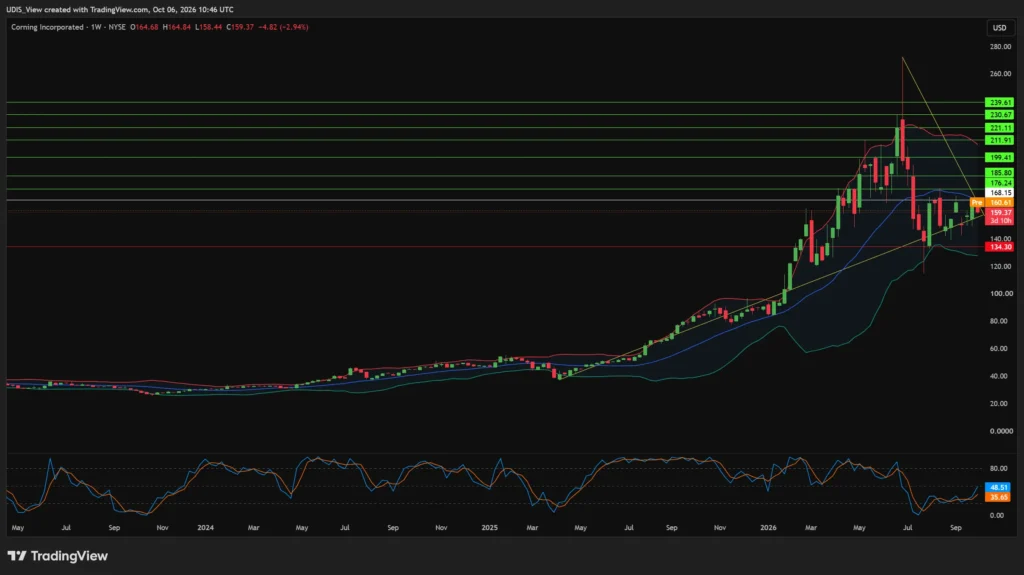
Corning Long (Buy)
Enter At: 168.15
T.P_1: 176.24
T.P_2: 185.80
T.P_3: 199.41
T.P_4: 211.91
T.P_5: 221.11
T.P_6: 230.67
T.P_7: 239.61
S.L: 134.30