

Voyager Technologies sits in the “space stocks” bucket on most screens, and that label misses the real story. The company now earns its momentum from missiles, interceptors and secure satellite links, not space tourism. It still burns cash at a startup pace. Yet in the past week it raised $402.5 million at zero interest and formalized a production partnership with Anduril.
So which Voyager should investors price: the space-station developer or the emerging defense supplier? This analysis works through both, starting with numbers that are more mixed than the headlines suggest.
Voyager Technologies at a Glance
Voyager runs from Denver and trades on the NYSE under VOYG. It reports two segments: Defense and Space Technologies, covering propulsion, energetics, electronics and spectrum systems, and Starlab Space Stations.
| Metric | Value |
|---|---|
| Ticker | NYSE: VOYG |
| Headquarters | Denver, Colorado |
| Recent share price | ~$33 (September 29 close near $33.18) |
| Market capitalization | ~$2 billion |
| Shares outstanding | ~59.1 million (Class A and Class B) |
| Reportable segments | Defense and Space Technologies; Starlab Space Stations |
| Flagship joint venture | Starlab Space |
| 2026 revenue guidance | $275 million to $305 million |
The Numbers: Growth Arrives, the Burn Accelerates
Revenue is accelerating sequentially. Second-quarter 2026 net sales reached a record $52.7 million, up about 51% from the first quarter and 15.5% from a year earlier. Bookings hit a record $113.0 million, a 2.1x book-to-bill, and backlog climbed to a record $335.5 million. Management lifted full-year guidance to $275 million to $305 million, implying 66% to 84% growth.
Losses are growing faster than sales, though. The quarterly net loss widened to $46.5 million, or $0.79 per share, from $31.4 million a year earlier. Gross profit fell to $4.5 million from $8.2 million, taking gross margin to about 8% from 18%. Free cash flow was negative $72.8 million in the quarter and negative $139.6 million across the first half. Innovation spend equaled 102% of net sales in the second quarter, and 55% excluding Starlab.
| Period | Net sales | Net loss | Backlog |
|---|---|---|---|
| FY2025 | $166.4M | $(116.1)M | $265.6M |
| Q2 2025 | $45.7M | $(31.4)M | Not disclosed comparably |
| Q1 2026 | $35.2M | $(44.0)M | $275.3M |
| Q2 2026 | $52.7M | $(46.5)M | $335.5M |
How Much of the Voyager Technologies Raise Is Acquired?
The guidance increase deserves a closer look. Voyager completed its acquisition of Astrobotic Technology, the lunar lander developer, during the quarter. Management expects Astrobotic to contribute $40 million to $50 million of revenue over the rest of 2026. The guidance raise was roughly $48 million at the midpoint.
Jefferies analyst Sheila Kahyaoglu put it to management directly that the raise looked like Astrobotic, while noting the core business was performing well. Chief financial officer Phil De Sousa said the record backlog contained no Astrobotic contribution, and that nearly $300 million of NASA lunar delivery awards would be booked in the third quarter. Full-year 2027 guidance arrives at the December 3 Investor Day.
Geopolitics: The Interceptor Crunch
The macro backdrop favors Voyager’s defense arm. A Congressional Budget Office report estimates the U.S. has likely depleted between one-half and two-thirds of its missile interceptors since June of last year. Golden Dome adds further demand, and Voyager booked $84.3 million of Golden Dome awards in the second quarter alone.
Replenishment will take years, and suppliers with qualified propulsion lines hold pricing power, a dynamic that also supports primes such as RTX. Voyager’s divert and attitude control systems sit squarely inside that demand curve. These thrusters give kill vehicles their final course corrections. Few companies can produce them at volume, and the Pentagon knows it.
Geostrategy: Starlab and the ISS Sunset
The International Space Station nears retirement around 2030, China already operates Tiangong, and Starlab aims to fill the gap. Starlab Space is a joint venture among Voyager, Airbus, Mitsubishi Corporation, MDA Space, Palantir Technologies, and Space Applications Services, with Hilton, Journey, Northrop Grumman, and The Ohio State University as strategic partners.
The station completed its Commercial Critical Design Review with NASA in February 2026, supporting the 28th milestone under its NASA agreement. It targets a 2029 single launch on SpaceX’s Starship. The partner roster binds Europe, Japan and Canada to a U.S.-led platform, so Starlab functions as allied infrastructure, not just real estate in orbit.
It also earns nothing yet. The Starlab segment reported zero net sales in the quarter. Voyager had collected $183.2 million of NASA milestone proceeds by the end of 2025, and management put cumulative receipts near $211 million of about $218 million expected on its second-quarter call.
The Anduril Alliance: From Prototype to Production
On September 29, 2026, Anduril and Voyager formalized their partnership. Voyager already holds contracts to supply more than $60 million of critical technologies to Anduril, including solid rocket motors and divert and attitude control systems. The deal converts a supplier relationship into a shared pipeline of future programs, and the shares rose about 6% that day.
Scale defines the thesis. Voyager’s American Defense Complex in Pueblo, Colorado could support roughly 15,000 to 20,000 propulsion systems per month when fully scaled. Voyager says it has invested more than $500 million in propulsion, energetics, and manufacturing capacity. Solid rocket motor capacity is a contested field, with players including Kratos expanding output too.
| Partnership element | Detail |
|---|---|
| Announced | September 29, 2026 |
| Existing contract value | More than $60 million to Anduril |
| Product scope | Solid rocket motors, divert and attitude control systems |
| Voyager production hub | Pueblo, Colorado |
| Full-scale capacity target | 15,000 to 20,000 propulsion systems per month |
| Voyager capital invested | More than $500 million in propulsion and energetics |
Voyager Technologies Capital Structure: Cheap Money, Real Overhang
Voyager Technologies just tapped the convertible market on attractive terms. On September 28 it completed a $402.5 million offering of 0% convertible senior notes due October 15, 2032, including $52.5 million from the full option exercise. Net proceeds came to about $391.6 million, with about $52.5 million funding capped call transactions.
The trade-off sits in the conversion math. The initial conversion rate equals 24.4978 shares per $1,000 principal, or about $40.82 per share, a 30% premium over the $31.40 close on September 23. Full conversion would create roughly 9.86 million shares, about 19% of the float. The capped call offsets that dilution up to $78.50 per share, a 150% premium. Even so, the overhang can cap near-term rallies above $40.
| Convertible term | Value |
|---|---|
| Principal | $402.5 million |
| Coupon | 0% |
| Maturity | October 15, 2032 |
| Conversion price | ~$40.82 |
| Conversion premium | ~30% |
| Capped call cap price | $78.50 |
| Potential new shares | ~9.86 million |
| Net proceeds | ~$391.6 million |
The Second Convertible and the Runway
This is Voyager’s second convertible. In November 2025, it priced $435 million of 0.75% convertible notes due 2030, carried at $448.9 million on the June balance sheet. The new notes add no interest, but the capital structure is not interest-free.
Voyager ended the second quarter with $373.4 million of cash and total liquidity of $585.5 million, including its revolver. Adding net proceeds after the capped call puts pro forma cash near $712 million before third-quarter burn. We see runway comfortably into 2028, even with Starlab spending climbing.
Patent Forensics: Crystals Built for Light
In January 2026, Voyager Technologies secured a patent for microgravity crystal manufacturing. The method keeps seed material in constant motion during ground handling and triggers crystal growth only after reaching microgravity. The patent targets optical communications, not pharmaceuticals or 3D printing. Partners include the New Jersey Institute of Technology, New York University, and the Universities Space Research Association.
On Earth, gravity drives convection and sedimentation, which create defects as crystals grow. Remove gravity, and crystals grow larger and purer. CTO Paul Tilghman ties high-volume production to orbital hubs like Starlab and reliable return-to-Earth services, so downmass, not chemistry, becomes the bottleneck. Adjacent players such as Redwire pursue different microgravity niches.
| Company | IP focus | Target market | Overlap with Voyager |
|---|---|---|---|
| Voyager Technologies | Microgravity optical crystal growth | Data centers, fiber, space networks | n/a |
| Varda Space Industries | Microgravity drug crystallization, reentry | Pharmaceuticals | Low |
| Redwire Space | In-space additive manufacturing, biotech payloads | Hardware fabrication, research | Low to moderate |
IP Moat Rating: 8/10. The claims look narrowly scoped to photonics. Enforceability will depend on the final claim language and on whether station validation delivers measurable purity gains.
Photonics, Pharma and Secure Networks
AI data centers are moving from copper to co-packaged and linear pluggable optics, which demand ultra-clean optical materials. Voyager’s patent positions it as a potential upstream supplier, if orbital production reaches cost parity.
Voyager touches pharma through services, not its own drug IP. On September 24, it added two ISS campaigns for Exobiosphere’s automated drug-screening platform, slated for installation in April 2027, each running thousands of experiments paired with ground controls.
Space Systems Command also awarded Voyager a contract to develop secure space-to-space communication links for a resilient Department of Defense data architecture, including an on-orbit demonstration.
Voyager Technologies Management, Board and Culture
Voyager blends commercial space ambition with national security depth. The board includes four-star Air Force General William Shelton, investor Gabe Finke, planetary scientist Dr. Alan Stern, and Dr. Cheryl Shavers, who served as Under Secretary of Commerce for Technology from 1999 to 2001.
| Leader | Role | Strategic value |
|---|---|---|
| Dylan Taylor | Chairman and CEO | Commercial space capital, prestige |
| Matthew Kuta | President, co-founder | Defense procurement access |
| Phil De Sousa | Chief Financial Officer | Capital markets execution |
| Gen. William Shelton (Ret.) | Director | Former Air Force Space Command chief |
| Dr. Cheryl Shavers | Director | Tech policy, IP and export-control expertise |
Our read: a former Air Force Space Command chief does not join a small-cap board for marketing advice. We interpret Shelton’s presence as a signal of deep alignment with U.S. national security space priorities, and Shavers adds IP and technology-transfer judgment.
Insider Activity: Noise, Not Signal
August 2026 insider sales at $41.55 to $44.03 spooked some retail holders. The Form 4 filings show those trades executed under a Rule 10b5-1 plan adopted in May 2026. Pre-scheduled sales reflect liquidity planning, not a verdict on the business.
The Vision Disconnect
Markets often price Voyager like a high-margin tech platform. Reality looks more like heavy industry in orbit, with gross margin near 8% last quarter. Launch costs, radiation, reentry logistics, and physics all impose friction, a pattern familiar across space-and-defense hybrids such as Rocket Lab. If Starlab slips materially beyond its 2029 target, funding pressure could intensify before orbital manufacturing scales.
Key Risks for Voyager Technologies
- Widening losses. The quarterly net loss grew about 48% year over year while revenue grew 15.5%.
- Cash burn. Free cash flow was negative $139.6 million in the first half of 2026.
- Acquired growth. The guidance raise roughly matches Astrobotic’s expected contribution.
- Starlab execution. Delays or cost overruns could force new financing on worse terms.
- Stacked convertibles. Two convertible issues could add shares if the stock rallies hard.
- Customer concentration. The U.S. government drives a large share of revenue.
- Launch dependency. Starlab relies on Starship readiness and a single-launch architecture.
- Technology validation. The crystal patent still needs quantified on-orbit results.
Investment Takeaway
Voyager Technologies is evolving from a space holding company into a defense propulsion supplier with an orbital option attached. The Anduril pact, record backlog and zero-coupon funding strengthen the near-term case. Starlab and microgravity photonics offer long-dated upside. Cash burn, acquired growth and conversion overhang remain the price of admission.
The verdict rests on one question: can the defense business reach operating leverage before Starlab’s capital needs peak? Watch four markers: third-quarter organic growth once Astrobotic’s lunar awards book, gross margin recovery from 8%, the December 3 Investor Day guidance for 2027, and Pueblo production rates.
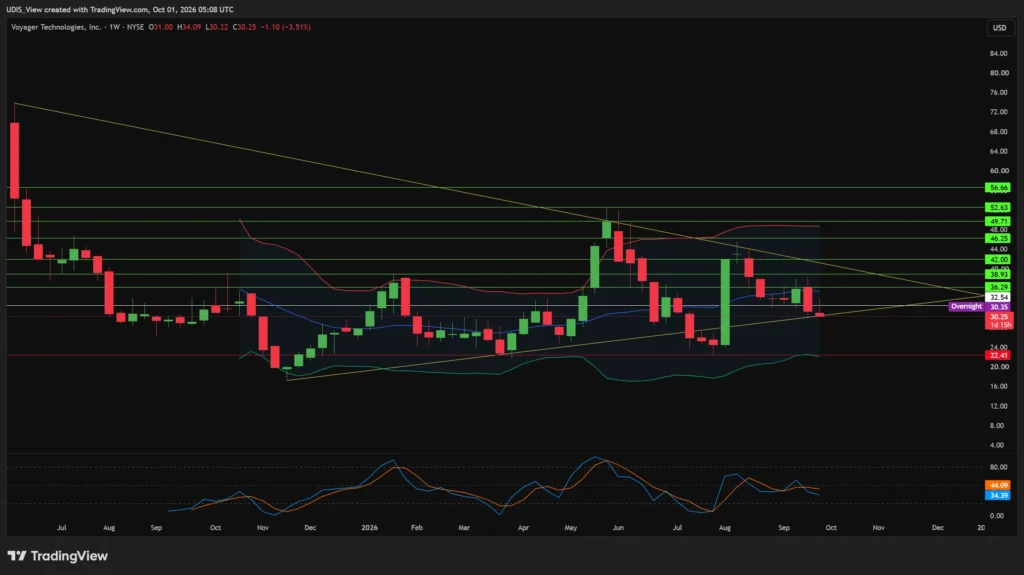
Voyager Long (Buy)
Enter At: 32.54
T.P_1: 36.29
T.P_2: 38.93
T.P_3: 42.00
T.P_4: 46.25
T.P_5: 49.71
T.P_6: 52.63
T.P_7: 56.66
S.L: 22.41