

Global security architectures shattered in early 2026. A coordinated US-Israeli decapitation strike hit Iran. The immediate ballistic retaliation compromised regional allied bases. The closure of the Strait of Hormuz paralyzed global energy supply chains. Traditional manned military platforms suddenly looked structurally vulnerable against autonomous swarms. A massive geostrategic pivot is now underway. Leidos Holdings ($LDOS) is built precisely for this moment.
Against this chaotic backdrop, $LDOS delivers unprecedented asymmetric advantages. The firm sits perfectly positioned to absorb the Pentagon’s $200 billion emergency supplemental defense budget. The market grossly misprices the speed at which autonomous warfare is replacing legacy infrastructure. Q1 2026 numbers already prove it. Revenue hit $9.88 billion, up 4.4% YoY. EPS of $6.14 cleanly beat the $6.03 consensus. The backlog now sits at a commanding $95.7 billion
The Kinetic Moat
Leidos Holdings confronts the vulnerabilities of static defense networks by weaponizing modular autonomy. The company dominates the US Army’s Indirect Fire Protection Capability Increment 2 (IFPC Inc 2). A recent $617 million contract expansion pushes total program value to nearly $1.2 billion. More than 100 launchers are now under contract. The firm delivered the initial test launcher two full months ahead of schedule. That proves it can rapidly manufacture scalable, combat-proven kinetic interceptors. These plug seamlessly into existing command-and-control networks to neutralize hostile UAVs and cruise missiles.
The official USAF combat-ready designation of the AGM-190A Small Cruise Missile redefines offensive standoff capabilities entirely. The 200-pound weapon executes precision strikes on targets beyond 400 nautical miles from a C-130 platform. Warfighters gain immense operational flexibility. Legacy munitions are now technologically obsolete.
The Autonomy Layer
The defense sector’s most disruptive synergy materialized in April 2026. Leidos Holdings forged a critical partnership with autonomy software developer Havoc. The alliance fundamentally alters unmanned combat operations. It merges Havoc’s collaborative autonomy algorithms with Leidos’ proven LAVA (Autonomous Vessel Architecture) maritime hardware. The integration debuted on the Sea Archer surface vessel. A single human operator can now synchronize multi-domain drone formations across air, surface, and sub-surface units. The system holds up inside severely contested electronic warfare environments. Software integration timelines compress from months to weeks. Systems move into active production in days. The alliance accelerates strategic deployment of unmanned fleets and aggressively disrupts legacy incumbents like $HPE.
The Software and Cyber Moat
Hardware wins headlines; software wins the next decade of margin. The US Air Force handed Leidos Holdings a $454.9 million Cloud One contract. The work consolidates fragmented legacy networks into a unified, resilient multi-cloud architecture. This is the sticky, recurring federal IT spend that compounds across budget cycles. It also locks competitors out of the architectural decision layer.
On the cyber side, the Dropzone AI partnership deploys agentic AI directly into federal Security Operations Centers. Threat response accelerates by 90%. Chronic analyst alert fatigue converts into automated triage at machine speed.
Underneath all of it sits an IP fortress that remains structurally underappreciated. The numbers: 1,207 global patents, 743 granted, 493 currently active and enforceable. The USPTO grant rate hits 97.4%. That is engineering rigor that competitors cannot replicate through spending alone. The real signal is in the citations. IBM has cited Leidos patents 55 times in its own filings. Microsoft has leaned on them 30 times. When hyperscalers reference your IP in their own research, you are no longer a contractor. You are foundational infrastructure.
Financial Health and Valuation
Despite profound global market volatility, Leidos Holdings demonstrates formidable financial resilience. Annualized revenues climbed to $17.2 billion by early 2026. The $95.7 billion backlog provides unmatched forward visibility. The stock trades at 1.17 times sales against a historical 20% earnings growth rate. That is a massive dislocation between intrinsic value and its defensive growth profile.
The April 2026 Analogic joint venture divests the $625 million airport security screening division. It eliminates capital-intensive manufacturing obligations. The balance sheet is now free to fund the NorthStar 2030 mandate. Capital is directly fueling the transition toward a pure-play digital defense architect. That insulates the firm from localized hardware sector shocks.
| Metric | Value | Annual Change |
|---|---|---|
| Q1 2026 Revenue | $9.88 Billion | +4.4% YoY |
| Q1 2026 EPS | $6.14 | Beat $6.03 estimate |
| Annualized Revenue | $17.2 Billion | +3.0% |
| Backlog | $95.7 Billion | Forward visibility anchor |
| Earnings Growth Rate | 20.0% | Historical baseline |
| Price-to-Sales | 1.17x | Discounted vs peers |
Risk Factors
Two risks deserve serious attention. First, the global macroeconomic environment faces acute risks of prolonged stagflation. Brent Crude has surged past $120 per barrel. Sustained energy volatility and supply chain disruption span Asia and the Gulf. Hardware manufacturing margins compress if the conflict persists indefinitely.
Second, deploying commercial agentic AI into highly classified federal networks runs straight into the wall of CMMC 2.0. These strict government security standards frequently delay critical software upgrades. Any compliance failure instantly disqualifies contractors from federal work eligibility. The friction between rapid commercial AI deployment and rigid defense bureaucracy constantly threatens pipeline execution.
The Bottom Line
The Q4 2026 multi-domain fleet autonomy test is a monumental valuation catalyst. It will definitively validate the Havoc partnership in a complex, real-world battlespace. Operational success cements $LDOS’s transition from a standard legacy hardware contractor into the foundational architect of sovereign digital defense. Global defense ministries are racing to rebuild shattered military infrastructure. This firm’s combined kinetic, autonomy, software, and IP moat remains structurally impenetrable. Investors ignoring this structural market dislocation will severely underperform the defense sector benchmark moving forward.
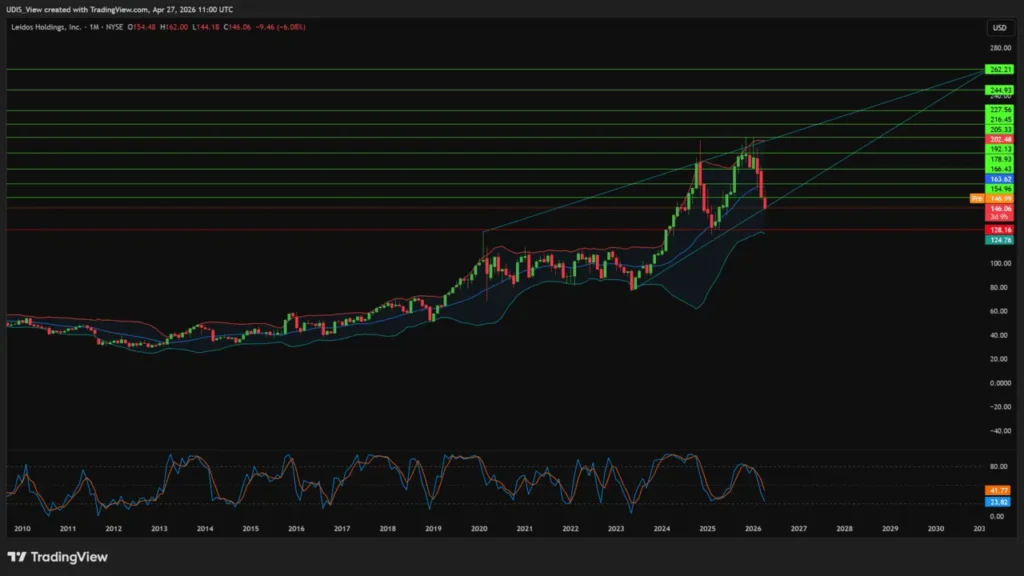
Leidos Holdings Long (Buy)
Enter At: 154.96
T.P_1: 166.43
T.P_2: 178.93
T.P_3: 192.13
T.P_4: 205.33
T.P_5: 216.45
T.P_6: 227.56
T.P_7: 244.93
T.P_8: 262.21
S.L: 128.16