

The global space economy is undergoing a violent and permanent transformation. The era of speculative exploration and billionaire tourism has abruptly ceded ground to a grim new reality: national security. Space is no longer merely a destination for science; it has become the “high ground” for the next century of warfare.
In this hardened domain, the value lies not in the rocket launch, which has become a commoditized utility. The true value lies in the infrastructure that remains in orbit. This is the domain of Redwire Corporation (NYSE: RDW).
Redwire: The Orbital Architect of the Golden Dome Era
Redwire has strategically positioned itself as the indispensable architect of this new orbital reality. The company has evolved far beyond its origins as a collection of component manufacturers. Through a series of aggressive and scientifically coherent acquisitions, it has mutated into a diversified defense prime. Redwire now bridges the critical gap between space-based data collection and terrestrial kinetic action.
Its portfolio spans the entire kill chain. It builds the Very Low Earth Orbit (VLEO) reconnaissance satellites that find the targets. It manufactures the tactical drones that track them. It secures the data that connects the shooter to the sensor.
The year 2025 marked a definitive watershed moment for the industry. The United States administration formally launched the “Golden Dome for America” missile defense initiative. This program catalyzed a massive capital rotation. Investors fled general technology sectors to seek refuge in defense robotics and space systems. Redwire sits at the precise convergence of these macroeconomic and geopolitical trends.
The company’s financial performance reflects this alignment. Revenue surged over 50% year-over-year in the third quarter of 2025. It has secured critical contracts for European cargo vehicles and vital US missile defense tracking systems.
Yet, the market remains deeply divided on the stock. Insider selling by private equity backers has spooked retail investors. The company continues to burn cash as it scales for industrial-level production. This report provides an exhaustive, granular analysis of Redwire’s position. We dissect the geopolitical, technical, and economic factors driving its valuation in 2026.
Geostrategy: The Golden Dome Architecture
The Strategic Shift to Boost-Phase Intercept
The geopolitical landscape changed fundamentally on January 27, 2025. Executive Order 14186 formally established the “Golden Dome for America”. This initiative seeks to construct a comprehensive, multi-layered missile defense shield. It is distinct from Israel’s Iron Dome in both scale and physics.
The Golden Dome is designed to intercept hypersonic and ballistic threats in the boost phase. This strategic pivot requires a fundamental change in orbital architecture. Traditional midcourse defense relies on ground-based interceptors, a physics problem akin to hitting a bullet with another bullet. The Golden Dome changes the calculus by targeting the missile while the booster engine is still burning.
This phase offers two distinct advantages. First, the missile is essentially a bright flare to infrared sensors, easily detected against the cold background of the Earth. Second, the missile is heavy with fuel and structurally stressed. It is vulnerable.
However, intercepting a missile in the boost phase requires proximity. The interceptor must be close to the launch site. This geographic constraint demands a proliferation of space-based assets.
The Satellite Proliferation Necessity
Redwire is a prime beneficiary of this architectural requirement. The Golden Dome demands thousands of satellites in Low Earth Orbit (LEO) and Very Low Earth Orbit (VLEO) to ensure global coverage. To maintain a “persistent stare,” the Pentagon must blanket the sky with sensors.
Redwire’s SabreSat platform is engineered specifically for this mission profile. It is not a repurposed telecommunications bus; it is a purpose-built VLEO asset. The program allocates $25 billion in initial funding for fiscal year 2026. Total program estimates range up to $175 billion over the lifecycle. This represents a massive injection of liquidity into the space industrial base.
Redwire acts as the “picks and shovels” provider for this gold rush. It supplies the solar arrays that power the radar, the antennas that transmit the tracking data, and the avionics that guide the interceptors.
The “System of Systems” Approach
The Golden Dome is described as a “system of systems”. This terminology is critical for investors. It implies complexity and integration. No single contractor can build the entire shield; it requires a heterogeneous network of sensors, shooters, and command nodes.
Redwire’s acquisition strategy has prepared it for this complexity. By acquiring companies like Edge Autonomy and Made In Space, Redwire has internalized the integration capability. It can offer a “turnkey” solution for specific layers of the Dome. For example, it can provide the VLEO tracking layer (SabreSat) and the secure ground link (Link-16 antennas) as a bundled package. This integration capability creates a competitive moat that smaller component suppliers cannot match.
Geopolitics: The Arctic Front and NATO
The High North Conflict Zone
The Arctic has emerged as the new northern flank of NATO defense. Melting ice caps are opening new sea lanes, exposing the northern border of the American continent to naval and aerial threats. Russia has militarized its northern coast, and China has declared itself a “near-Arctic state.”
The United States and its allies require secure communications in latitudes where traditional geostationary (GEO) satellites fail. Redwire’s technology is central to the allied Arctic strategy. The Arctic Satellite Broadband Mission (ASBM) launched in late 2024 to address this gap, utilizing satellites in highly elliptical orbits (HEO). These satellites “hang” over the North Pole for hours at a time, providing high-bandwidth connectivity to military assets above the 65th parallel.
ASBM and Redwire Components
Redwire’s involvement in ASBM is extensive. The mission hosts payloads for the Norwegian Armed Forces, the US Space Force, and commercial operator Viasat. The Enhanced Polar System-Recapitalization (EPS-R) payload is of particular importance, providing protected, anti-jam tactical communications for US forces in the polar region. Redwire’s radiation monitors are also onboard, providing vital data for protecting the electronics of future satellites in the Golden Dome constellation.
Strategic Ground Stations: Svalbard
Data is useless if it cannot be downloaded. The Svalbard archipelago in Norway hosts the world’s largest commercial ground station. It is the only location on Earth that can see a polar-orbiting satellite on every single revolution.
Redwire’s antenna systems are optimized for these high-latitude operations. However, these stations are connected to the mainland by undersea fiber optic cables, which are vulnerable to sabotage. Redwire’s VLEO constellations offer a redundancy layer. If cables are cut, data can be routed via inter-satellite Redwire’s simulation tools allow mission planners to optimize these, ensuring the “Golden Dome” has no blind spots.
European Sovereignty and Interoperability
Redwire is deeply embedded in the European defense architecture. Its Belgian subsidiary creates a hedge against US budget cycles. Recent contracts confirm the validity of this trans-Atlantic strategy. Edge Autonomy secured a deal to supply Stalker drones to a European NATO ally in late 2025. These systems must communicate seamlessly with US assets; Redwire’s use of standard Link-16 compatible antennas ensures this interoperability.
Technology: The VLEO Revolution
The Physics of Proximity
Very Low Earth Orbit (VLEO) is the new strategic high ground, defined as orbital altitudes below 450km. While atomic oxygen erodes spacecraft materials at this altitude, the benefits for Intelligence, Surveillance, and Reconnaissance (ISR) are immense.
Redwire is a pioneer in this domain. Its SabreSat platform is designed specifically to conquer the VLEO environment. It features a sleek, aerodynamic profile that minimizes drag, effectively flying through the thermosphere rather than just orbiting.
Air-Breathing Propulsion (ABEP)
The “holy grail” of VLEO operations is Air-Breathing Electric Propulsion (ABEP). Redwire’s SabreSat supports ABEP technology, which harvests sparse atmospheric molecules to generate thrust. This effectively gives the satellite an infinite specific impulse. Redwire is validating this technology through the DARPA “Otter” program, securing a $44 million contract for this demonstration.
Maneuverability Without Regret
ABEP enables “maneuverability without regret”. Commanders can maneuver satellites to take hyper-resolution photos or change orbits to surprise adversaries without burning irreplaceable fuel. This agility is essential for the Golden Dome.
The Air Layer: Edge Autonomy and Drone Warfare
Expanding the Kill Chain
In 2025, Redwire completed the integration of Edge Autonomy, expanding the company’s Total Addressable Market (TAM) from the vacuum of space to the “air layer” of the atmosphere. Edge Autonomy manufactures the Stalker and Penguin Uncrewed Aerial Systems (UAS).
The Stalker VXE30 Advantage
The Stalker VXE30 differentiates itself with a solid oxide fuel cell (SOFC) powered by propane. This provides an endurance of over 8 hours, compared to the 2-hour limit of battery-powered drones. The system is logistically minimal and VTOL-capable, making it ideal for special operations.
Combat Proven Reliability
The Stalker is not a prototype; it has flown hundreds of thousands of hours, including extensive use in Afghanistan by US Special Forces. This combat heritage is a significant competitive advantage.
Cyber Strategy: Hardening the Orbital Edge
The Vulnerable Sky
The US Space Force has identified cyberattacks as a critical vulnerability. Satellites can be jammed, spoofed, or hijacked. Redwire is building the “antivirus for space” with its Cyber Resilience On-Orbit (CROO) tool. This system uses Artificial Intelligence (AI) to monitor satellite telemetry in real-time.
The Tactical Bubble: Silvus Technologies
On the ground, Redwire’s Edge Autonomy subsidiary leverages Silvus Technologies radios to create a “Tactical Bubble”. This is a localized, encrypted mesh network utilizing MN-MIMO waveforms that allow the network to self-heal, ensuring resilient communication in jamming environments.
CMMC Compliance as a Moat
With the Cybersecurity Maturity Model Certification (CMMC) now mandatory, Redwire’s ability to absorb compliance costs creates a barrier to entry for smaller competitors, making it a “safe” partner for major government programs.
Science & Technology: Solar Power Dominance
ROSA: The Gold Standard
Traditional rigid solar panels are prone to “thermal snap“ vibrations that ruin the aim of optical instruments. Redwire’s Roll-Out Solar Array (ROSA) deploys autonomously using stored strain energy. It is 20% lighter and occupies 25% of the stowed volume of rigid panels.
ROSA has been successfully installed on the ISS by astronauts Shane Kimbrough and Thomas Pesquet and selected for the Power and Propulsion Element (PPE) of the Lunar Gateway.
Strategic Patent Portfolio
Redwire protects this technology with a robust patent portfolio, including Patent US 11,834,206, which covers the structural erection system. This intellectual property blocks competitors from copying the stored-strain deployment method.
In-Space Manufacturing: The Factory of the Future
Redwire is the undisputed leader in In-Space Manufacturing (ISM), owning the legacy of “Made In Space,” the startup that first put a 3D printer on the ISS.
In biotechnology, Redwire’s PIL-BOX technology helps grow protein crystals that are larger and more perfect than those grown on Earth. Additionally, Patent US 11,565,468 covers hybrid additive and subtractive manufacturing, effectively locking up the market for “machine shops in space.”
Financial Analysis: Valuation and Market Dynamics
The Growth Trajectory
Redwire fits the profile of a “hyper-growth” industrial stock, with revenue expanding at approximately 50% annually. The analyst consensus for 2026 revenue stands at roughly $517 million. The company’s backlog provides significant visibility, standing at $355.6 million as of late 2025.
Valuation Comparison: Redwire vs. Rocket Lab
Investors often compare Redwire to Rocket Lab (RKLB), but Rocket Lab trades at a massive premium. Macrotrends data highlights the valuation disconnect. Redwire offers exposure to the same secular growth trends without the extreme valuation risk.
Insider Signals
Recent insider trading presents a mixed signal. While private equity firm AE Industrial Partners sold approximately $150 million in stock, CEO Peter Cannito purchased approximately 32,000 shares. Management buying is a far stronger signal than PE selling, as the CEO is betting his own capital on the company’s future.
Conclusion: The New Prime
Redwire Corporation has successfully navigated the transition from a speculative space startup to a critical node in the defense industrial base. It is no longer a collection of disparate parts; it is a cohesive, integrated defense prime.
The “Golden Dome” provides the macro tailwind. The Arctic strategy provides the geographic focus. The Edge Autonomy acquisition provides the tactical capabilities. Redwire is not just going to the moon. It is watching the Earth, armed with the power, the data, and the connectivity to define the next decade of global security.
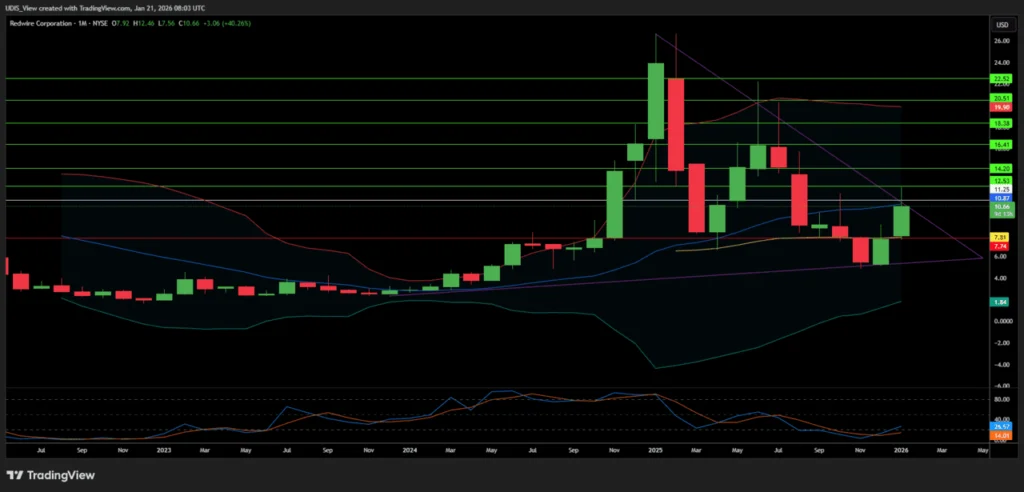
Redwire Long (Buy)
Enter At: 11.25
T.P_1: 12.53
T.P_2: 14.20
T.P_3: 16.41
T.P_4: 18.38
T.P_5: 20.51
T.P_6: 22.52
S.L: 7.74