


Plexus stock has gained roughly 86% this year, closing at $273.13 on October 2 against $147 at the end of 2025. The company has earned much of that move: record revenue, rising returns on capital and a record pipeline of new manufacturing programs.
The harder question is what investors are paying for. Plexus trades near 40 times trailing earnings as a contract manufacturer that owns no proprietary products, keeps about four cents of every sales dollar, and depends on ten customers for more than half its revenue. This analysis weighs the execution against the price, ahead of fiscal fourth-quarter results expected around October 28.
The Quarter Behind the Plexus Stock Rally
Start with the results behind Plexus stock, because they are genuinely strong.
Plexus reported fiscal third-quarter revenue of $1.305 billion for the period ended July 4, up 28% year over year and 12% sequentially, and well above guidance of $1.200 billion to $1.250 billion. Non-GAAP earnings per share reached $2.32, above the $2.02 to $2.18 guidance range. On a GAAP basis, operating margin was 4.7% and diluted earnings were $1.58.
| Plexus fiscal Q3 2026 | Result |
|---|---|
| Revenue | $1.305 billion, up 28% |
| Sequential growth | Up 12% |
| Non-GAAP EPS | $2.32 (guided $2.02 to $2.18) |
| GAAP EPS | $1.58 |
| Non-GAAP operating margin | 6.3% |
| New program wins | 31 programs, $255 million annualized |
| Qualified opportunity funnel | $4.5 billion, a record |
The forward picture is equally firm. Management guided fourth-quarter revenue to $1.330 billion to $1.380 billion and non-GAAP earnings of $2.47 to $2.63, and now expects fiscal 2026 revenue growth above 20%. Revenue has climbed every quarter this year, from $1.070 billion in the first quarter to $1.164 billion in the second.
Returns Are Rising, Not Falling
One measure deserves particular attention, because it is often misread.
Plexus defines return on invested capital as tax-effected annualized adjusted operating income divided by average invested capital. ROIC reached 14.9% in the third quarter, up from 13.8% in the second and 13.2% in the first, its highest level in several years. Subtracting the company’s weighted average cost of capital produced an economic return of 5.9%, implying a cost of capital near 9.0%.
| Plexus fiscal 2026 | ROIC |
|---|---|
| Q1 | 13.2% |
| Q2 | 13.8% |
| Q3 | 14.9% |
| Q3 economic return over cost of capital | 5.9% |
Higher interest rates have lifted the cost of capital, but returns have risen faster. The spread between what Plexus earns and what its capital costs is widening, not narrowing. For a capital-intensive manufacturer, that is the clearest sign that growth is creating value rather than consuming it.
Cash Flow and the Working Capital Trade
Growth in contract manufacturing absorbs cash before it returns it, and Plexus stock now reflects a company at that stage.
Third-quarter operating cash flow was $25.9 million against capital expenditures of $26.6 million, a free cash flow usage of $0.7 million. Management expects a modest usage for fiscal 2026 as a whole, then a return to meaningful free cash flow above $100 million in fiscal 2027. Cash cycle days improved to 62, the best result in more than five years.
| Balance sheet and cash | Figure |
|---|---|
| Q3 operating cash flow | $25.9 million |
| Q3 capital expenditure | $26.6 million |
| Q3 free cash flow | Usage of $0.7 million |
| Cash | ~$315 million |
| Total debt | ~$275 million |
| Fiscal 2026 capex guidance | $100 million to $120 million |
| Cash cycle | 62 days |
The balance sheet carries the strain comfortably, with about $315 million of cash against roughly $275 million of debt. Plexus refinanced its revolving credit facility in June, extending maturity to June 2031.
Geopolitics: Built for Supply Chain Diversification
Plexus’s footprint fits the way Western manufacturers are reorganizing supply chains.
The company operates high-volume sites in Penang, Malaysia, and Bangkok, Thailand, along with a facility in Xiamen, China. In the Americas, it runs operations in Neenah, Wisconsin, and Guadalajara, Mexico, with European sites in Kelso, Scotland, and Oradea, Romania. That spread lets customers diversify away from single-country exposure, the strategy often called China plus one, while Mexico serves North American customers seeking shorter, tariff-resilient supply chains.
The concentration cuts both ways. Heavy reliance on Southeast Asia exposes Plexus to regional disruption, including tensions affecting shipping routes in the South China Sea.
Defense as the Anchor
The aerospace and defense business is where the longest-duration demand sits.
Aerospace and defense wins totaled $400 million in the first three quarters of fiscal 2026, more than double the combined total for fiscal 2024 and 2025. Defense procurement runs on multi-year cycles that are largely insulated from commercial downturns, a dynamic also visible at primes such as General Dynamics, and regulated programs reward suppliers with proven compliance records, including export controls under the International Traffic in Arms Regulations.
Customer Concentration: The Plexus Stock Risk to Watch
Plexus stock carries one structural vulnerability that the rally has made more important, not less.
The top ten customers accounted for 55% of revenue in the third quarter, up one percentage point from the second quarter and seven points from a year earlier. Rapid growth with large customers is good news while programs ramp. It also means the loss or delay of a single major program would hit revenue harder than it would have a year ago.
No Proprietary IP: Plexus Wins When Its Customers Win
This is the structural point that matters most for how investors value Plexus stock over the long term.
Plexus is an electronics manufacturing services provider. It designs, builds, and sustains products for customers in its three market sectors, Industrial, Healthcare/Life Sciences, and Aerospace/Defense, and its customers own the underlying product intellectual property. Plexus does not sell proprietary products of its own.
A correction is needed here, because a widely circulated analysis attributes high-density fiber optic module patents, including US8712206B2 and US9116324B2, to Plexus. Patent records list those as assigned to Corning Cable Systems, now Corning Optical Communications. They describe Corning’s fiber housing hardware, not a Plexus portfolio.
The real implication is different and more useful. Because Plexus owns no product IP, it cannot capture technology premiums the way patent holders can, which helps explain margins near 4%. Instead, it captures value when its customers win technology shifts. The migration toward advanced chip packaging is a good example: it concentrates value at semiconductor and packaging specialists such as TSMC, yet it also drives demand for semiconductor capital equipment as chipmakers, including Intel, expand capacity, a subsector Plexus names as a growth driver in its fourth-quarter guidance.
| Plexus positioning | Implication |
|---|---|
| Product IP | Owned by customers, not Plexus |
| Margin structure | Net margin near 4% |
| Value capture | Volume, complexity and regulated programs |
| Technology shifts | Benefits when its customers gain share |
| Advanced packaging trend | Indirect beneficiary through semiconductor equipment |
Leadership, Buybacks and Plexus Stock
Management continuity is unusually long. Todd Kelsey, who joined Plexus as an engineer in 1994, has served as chief executive since 2016. David Abuhl became chief financial officer in May 2026 in an orderly transition.
The company has also returned capital steadily. It repurchased 79,707 shares in the third quarter at an average price of $258.75, and $63.6 million of stock over the first nine months of fiscal 2026. On August 20, the board approved a new $100 million repurchase program to follow the current one. Insider selling has been modest: Kelsey sold 1,500 shares on September 16 at $242.41, about $363,600.
Valuing Plexus Stock Against the Bear Case
At current levels, Plexus stock asks a great deal of a low-margin business.
| Valuation marker | Figure |
|---|---|
| Share price, October 2 | $273.13 |
| Year-to-date gain | ~86% |
| 52-week range | $132.03 to $307.06 |
| Trailing P/E | ~40 |
| Trailing revenue | ~$4.60 billion |
| Analyst consensus | Buy, average target ~$304.60 |
| KeyBanc, September 22 | Upgraded to Overweight, $300 target |
The bull case is record revenue growing more than 20%, ROIC at a multi-year high, a $4.5 billion funnel, $400 million of defense wins, disciplined working capital, and steady buybacks.
The bear case is a trailing multiple near 40, the same premium question we examined at L3Harris, for a manufacturer with net margins around 4%, top-ten customer concentration of 55% and rising, a stock that has nearly doubled in nine months, and a business model that captures no technology premium of its own. In our view, the current price offers little margin of safety if growth slows.
The Risks That Matter
- Valuation. A trailing P/E near 40 leaves little room for any slowdown in growth.
- Customer concentration. The top ten customers account for 55% of revenue, up seven points in a year.
- No proprietary IP. Plexus cannot capture technology premiums, so margins stay structurally thin.
- Working capital. Rapid growth absorbs cash, with free cash flow recovery not expected until fiscal 2027.
- Cyclicality. Semiconductor equipment and industrial demand can reverse quickly.
- Geographic exposure. Southeast Asian concentration brings regional geopolitical and logistics risk.
- Program timing. Delays in large program ramps would hit a business now leaning on fewer, larger customers.
Closing Thoughts
Plexus stock reflects a company executing as well as it ever has. Revenue is growing at its fastest pace in years, returns on capital are rising faster than the cost of capital, defense wins have more than doubled, and the funnel of new opportunities is at a record. The rally reflects real operating progress.
The verdict rests on one question: can a contract manufacturer that owns no product IP keep growing fast enough to justify 40 times earnings? Watch four markers in the fiscal fourth-quarter report expected around October 28: whether revenue lands in the $1.330 billion to $1.380 billion range, whether ROIC stays above 14%, whether top-ten customer concentration keeps rising, and what management signals about fiscal 2027 growth and free cash flow. Investors should treat the defense business as the stable anchor and value the rest on the quality of the customers Plexus chooses.
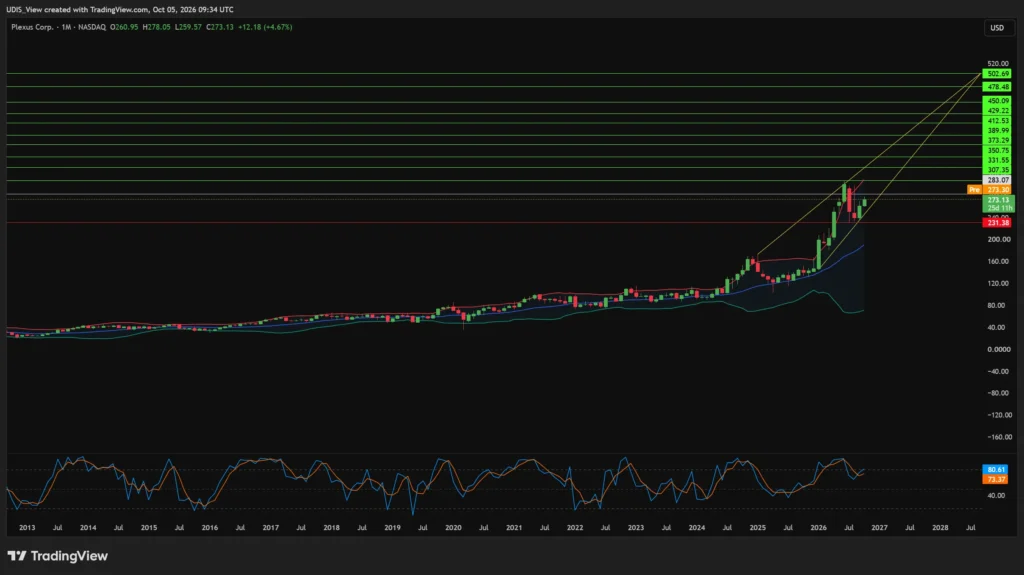
Plexus Long (Buy)
Enter At: 283.07
T.P_1: 307.35
T.P_2: 331.55
T.P_3: 350.75
T.P_4: 373.29
T.P_5: 389.99
T.P_6: 412.53
T.P_7: 429.22
T.P_8: 450.09
T.P_9: 478.48
T.P_10: 502.69
S.L: 231.38