

Intel Corporation currently occupies the center of a global industrial shift. The ongoing transition redefined the role of Intel within the American economy. The United States government secured a historic 10% equity stake in August 2025.
Washington converted $11.1 billion in CHIPS Act funds into company shares. This rare intervention connects taxpayer interests directly to the survival of Intel Corporation. According to AP News, this investment strategy prevents a potential sale or spin-off of the critical foundry division.
Meanwhile, the financial partnership creates a unique geopolitical moat for the firm. Intel Corporation now offers a resilient supply alternative within North America. Intel Corporation provides policy stability that competitors like TSMC cannot currently match.
Furthermore, the Sovereign AI movement elevates the strategic value of Intel Corporation. Nations view domestic chip production as essential for national security positioning. The Intel Shield Contract ensures the foundry remains under American control for national security.
Table 1: Federal Investment and Fiscal Terms of the CHIPS Act Stake
| Financial Metric | Detail |
| Ownership Stake | 10% (Approx. 9.9% – 10%) |
| Fund Conversion | $11.1 Billion Total |
| Shares Issued | 433.3 Million |
| Conversion Price | $20.47 per share |
| Immediate Gain | $1.9 Billion (on paper) |
| Program Source | CHIPS Act and Secure Enclave |
Technical Leadership: The Intel 18A Node and Angstrom Era
The “5 Nodes in 4 Years” strategy reaches its peak with the Intel 18A node. This process node introduces RibbonFET and PowerVia technologies to the market. RibbonFET wraps the gate around the transistor channel to improve electrical control.
The RibbonFET architecture reduces current leakage during high-power operations. RibbonFET offers a 15% improvement in performance-per-watt over legacy nodes. Intel Corporation aims to reclaim the silicon throne through these technical breakthroughs.
In addition, PowerVia represents a revolutionary backside power delivery system for semiconductors. Intel Corporation moved power circuitry to the reverse side of the wafer. According to FinancialContent, PowerVia reduces voltage droop by 30% to enhance chip performance.
Moreover, the Intel 18A node enables a 6% boost in clock frequency. These technical gains support the high-power needs of modern AI workloads. Intel increased transistor density by nearly 10% on this node.
Table 2: Comparative Capabilities of the Intel 18A Node
| Technology Feature | Intel 18A | Legacy FinFET (Intel 3) |
| Transistor Architecture | RibbonFET (GAA) | FinFET |
| Power Delivery | PowerVia (Backside) | Front-side Delivery |
| Performance/Watt | +15% vs. Intel 3 | Base Metric |
| Transistor Density | +30% vs. Intel 3 | Base Metric |
| Frequency Gain | +6% Improvement | Base Metric |
| Production Target | Early 2026 | In Production |
Systems Foundry Strategy and Market Positioning
Intel Corporation now operates the foundry business as an independent subsidiary. This structure builds trust with external customers who compete with Intel products. The Systems Foundry approach includes advanced packaging and heterogeneous integration.
Intel Corporation utilizes Foveros Direct 3D packaging to stack compute dies. This method provides higher bandwidth and lower power for advanced chips. Intel Corporation aims to become the second-largest global foundry by 2030.
Consequently, TSMC currently controls approximately 70% of the global foundry market. Intel Corporation holds a 6% revenue share in the broader Foundry 2.0 market. Intel Corporation is winning tier-one customers like Microsoft and AWS.
These cloud giants value the domestic manufacturing presence of Intel Corporation. Secure supply chains represent a top priority for major technology firms. The Intel 18A node serves as the primary draw for these customers.
Table 3: Global Foundry Market Share Comparison for 2025
| Company | Pure-Play Share (%) | Key Advantage |
| TSMC | 70% – 72% | 3nm Maturity, Scale |
| Samsung | 7% | 2nm Early Adoption |
| SMIC | 5% | China Domestic Support |
| Intel Foundry | <1% (Pure-Play) | 18A Node, US Moat |
| GlobalFoundries | 4% | Specialty Nodes |
AI Accelerators: Gaudi 3 and AI Accelerator Economics
Intel Corporation offers the Gaudi 3 accelerator as a cost-effective alternative to NVIDIA. Gaudi 3 delivers 1,835 TFLOPS of BF16 compute performance. The list price for Gaudi 3 is approximately half the price of NVIDIA H100.
Integrated 200Gb/s Ethernet ports eliminate the need for expensive external networking. This design can reduce total system costs by $50,000 per node. According to the Gaudi 3 Deployment Guide, firms can double their compute capacity for the same budget.
Ultimately, Gaudi 3 performs 1.7 times faster than competitors in training Llama 2 models. Intel Corporation targets the enterprise AI market, where total cost of ownership is critical. Intel Corporation expects only $500 million in Gaudi 3 sales for 2025.
Table 4: AI Accelerator Specifications and Industry Benchmarks
| Specification | Intel Gaudi 3 | NVIDIA H100 | NVIDIA B200 |
| BF16 TFLOPS | 1,835 | 1,979 | 2,250 |
| FP8 TFLOPS | 1,835 | 3,341 | 4,500 |
| VRAM (GB) | 128 | 80 | 180 |
| Bandwidth (TB/s) | 3.7 | 3.35 | 7.7 |
| List Price | $15,000 | $30,000 | N/A |
Cybersecurity and Quantum Silicon Qubits
Intel Corporation prioritized security as a primary differentiator in the AI era. The company partnered with Anthropic to secure the silicon stack. Claude Mythos AI identifies vulnerabilities at Layer Zero of the computing stack.
Moreover, Layer Zero consists of hardware, firmware, and critical device drivers. Breaches at this level allow full device control before the operating system loads. Intel gains a competitive edge by offering immune silicon to customers.
Meanwhile, Intel Corporation focuses quantum research on silicon spin qubits. This approach leverages the existing manufacturing expertise of Intel Corporation. Silicon qubits are 1 million times smaller than competing quantum technologies.
The Tunnel Falls chip features a 95% yield rate across 300mm wafers. Intel Corporation achieved 99.9% gate fidelity for these CMOS-manufactured qubits. High yield and fidelity are critical milestones for scaling quantum systems.
Investment Drivers and Risks
- 18A Execution: Timely delivery of the Intel 18A node remains the primary driver for stock recovery.
- Government Backing: The 10% federal stake provides a “Silicon Shield” against market volatility.
- Foundry Customers: Winning major external clients for 14A could catalyze future growth.
- Capital Constraints: High capital intensity led to a negative $4.9 billion free cash flow in 2025.
- Software Ecosystem: Maturity in AI software remains a significant challenge for Gaudi 3 adoption.
Patent Portfolio and Financial Recovery
Intel Corporation uses a layered patent strategy to create robust barriers. The company holds nearly 2,000 patents in the domain of advanced packaging. These patents cover high-yield interconnects and 3D stacking for chips.
Intel filed 35 AI accelerator patents in a single year during 2025. These filings target architectural bottlenecks like zero-skipping in matrix operations. Advanced packaging patents address thermal and electrical constraints in high-performance chips.
Table 5: Intel Patent Filing Distribution Across Technology Domains
| Technology Domain | Patent Count | Market Impact |
| Advanced Packaging | 1,987 | Heterogeneous Integration |
| CPU Architecture | 839 | Client and Server Core |
| GPU Architecture | 416 | Discrete GPU Expansion |
| Security | 193 | Confidential Computing |
| AI Acceleration | 76 | LLM Specific Silicon |
Total revenue for Intel Corporation stabilized at $52.9 billion in 2025. The company reported a non-GAAP EPS of $0.42 during this period. Operating margins rose to 5.5% as Intel Corporation executed radical surgery.
Intel Corporation ended the year with $37.4 billion in cash. However, free cash flow remained negative due to the high cost of the turnaround. Intel Corporation aims for 40% operating margins for its products by 2030.
Ultimately, CEO Lip-Bu Tan focuses on improving execution across all business units. The 18A node builds credibility with the analyst community through timely delivery. Professional investors recognize Intel as a high-conviction fundamental play.
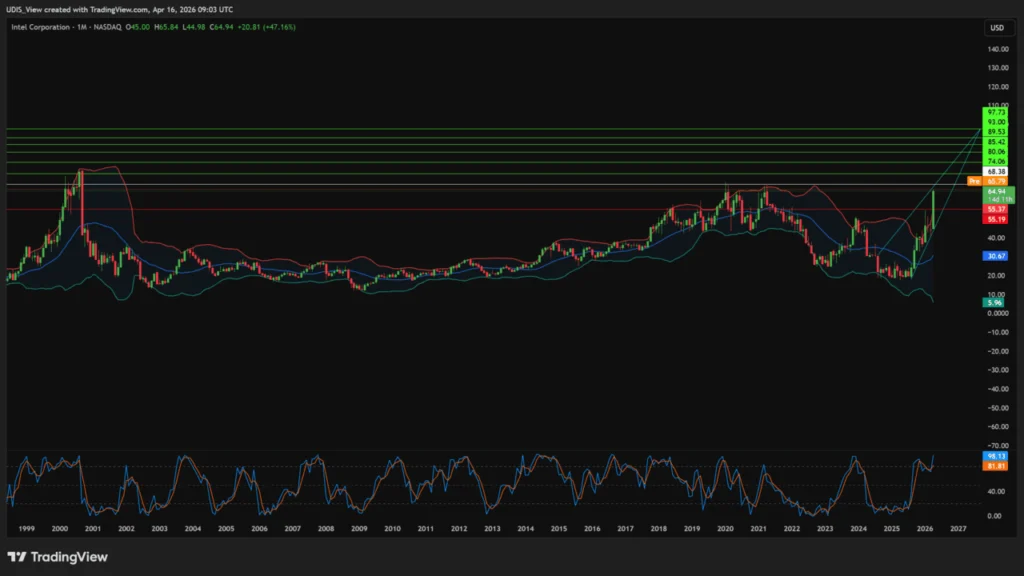
Intel Long (Buy)
Enter At: 68.38
T.P_1: 74.06
T.P_2: 80.06
T.P_3: 85.42
T.P_4: 89.53
T.P_5: 93.00
T.P_6: 97.73
S.L: 55.19