

Moderna stock more than doubled in a single session on August 19, when Merck and Moderna announced that their personalized cancer therapy had met its primary endpoint in a Phase 3 melanoma trial. The shares have since climbed to a 52-week high of $187.20.
The result is genuine, and the scientific validation is real. The harder question is financial: Moderna lost $0.8 billion last quarter on revenue of $145 million, carries a contingent $1.3 billion patent liability, and now trades well above the average analyst price target. This analysis examines whether one positive readout justifies a valuation near $70 billion.
The Readout That Changed the Question
Start with what the trial actually showed, because the details matter for Moderna stock from here.
INTerpath-001 enrolled more than 1,000 patients with completely resected stage IIB to IV melanoma, comparing intismeran autogene plus Merck‘s Keytruda against Keytruda alone. The combination met its primary endpoint of recurrence-free survival and a key secondary endpoint of distant metastasis-free survival. Notably, the result came at an interim analysis, earlier than several analysts had expected.
| INTerpath-001 | Detail |
|---|---|
| Therapy | Intismeran autogene (mRNA-4157, V940) plus Keytruda |
| Comparator | Keytruda alone |
| Population | Resected stage IIB to IV melanoma |
| Enrollment | ~1,089 patients |
| Primary endpoint | Recurrence-free survival, met |
| Key secondary endpoint | Distant metastasis-free survival, met |
| Trial started | July 2023 |
| Full data | ESMO 2026 Presidential Symposium |
RBC Capital Markets wrote that the strength of the data must have been compelling to trigger significance at the interim analysis. William Blair noted positive read-through for the other Intismeran studies. The full dataset is scheduled for a Presidential Symposium at the ESMO Congress.
Intismeran works differently from a conventional drug. Each patient’s tumor is sequenced, abnormal proteins called neoantigens are identified, and a bespoke mRNA therapy is manufactured to train that patient’s immune system against them, a very different approach from the targeted small molecules we examined at Kura Oncology.
How Moderna Stock Responded
The reaction in Moderna stock was extraordinary, and the analyst community has not followed it.
Moderna closed at $182.56 on September 22 after touching $187.20, up nearly 40% in a month and close to 400% year to date. Its 52-week low was $22.28. At current levels, market capitalization sits near $70 billion.
| Analyst view | Position |
|---|---|
| Bank of America | Raised target to $170 |
| Argus | Buy, $180 target |
| Rothschild (Simon Baker) | Downgraded to Sell while doubling target |
| Consensus, 18 analysts | Hold |
| Average target | ~$96.60 |
The average price target sits roughly 45% below the current share price. That gap is unusual. It means most analysts accept the trial result while doubting that it justifies the valuation the market has assigned. Rothschild’s move captures the tension precisely: doubling a price target while downgrading to Sell. Biotech valuations stretched after a single readout have unwound sharply before, as Viking Therapeutics showed.
The Financial Reality Behind Moderna Stock
The income statement has not yet caught up with the move in Moderna stock.
Second-quarter revenue reached $145 million, against $142 million a year earlier. The net loss was $0.8 billion, or $1.97 per share, a modest improvement from $2.13 a year earlier. First-quarter results carried $878 million of litigation settlement charges, lifting that quarter’s net loss to $1.3 billion.
| Moderna financials | Figure |
|---|---|
| Q2 2026 revenue | $145 million |
| Q2 2026 net loss | $0.8 billion ($1.97 per share) |
| Q1 2026 net loss | $1.3 billion ($3.40 per share) |
| Cash, June 30, 2026 | $6.9 billion |
| Arbutus payment, July 2026 | $950 million |
| 2026 year-end cash guidance | $4.7bn to $5.2bn |
| 2026 GAAP operating expense guidance | ~$4.7 billion |
| 2026 revenue growth guidance | Up to 10% |
Management improved its 2026 operating expense outlook by roughly $200 million and reiterated revenue growth of up to 10%. The respiratory business remains the revenue base, and it continues to shrink in the United States even as international government partnerships partially offset the decline.
The Capital Raise
Moderna moved quickly to strengthen its balance sheet after the readout.
On August 27 the company proposed a $2.0 billion private placement of convertible senior notes, then priced an upsized $2.6 billion offering the following day. It also carries a $600 million senior secured term loan maturing in November 2030.
The timing is the story. Raising $2.6 billion at a share price near triple its pre-readout level is capital raised from a position of strength, not under duress. Convertible notes can dilute shareholders if converted, but conversion prices set after a large rally mean holders give up considerably less ownership per dollar than an equity raise before the data would have required.
The Arbutus Settlement
The largest intellectual property dispute in Moderna’s history is resolved, with one open element.
On March 3, Moderna settled all worldwide patent litigation with Arbutus Biopharma and Genevant Sciences over its lipid nanoparticle delivery technology. The agreement required a $950 million noncontingent payment, made in July. It also provides for up to $1.3 billion more, depending on the outcome of Moderna’s appeal to the Federal Circuit on whether 28 U.S.C. §1498 shields doses supplied to the US government.
| Settlement term | Detail |
|---|---|
| Date | March 3, 2026 |
| Noncontingent payment | $950 million, paid July 2026 |
| Contingent payment | Up to $1.3 billion, prorated |
| Trigger | Federal Circuit ruling on §1498 |
| Coverage | Spikevax, mRESVIA, future infectious disease vaccines |
| Future royalties | None owed |
| If ruling later reversed | Contingent payment returned with interest |
The settlement covers Spikevax, mRESVIA, mNEXSPIKE, mCOMBRIAX and the future vaccine pipeline, with no future royalties owed. That certainty has real value for a company whose entire platform depends on lipid nanoparticle delivery.
Lucy and the AI Question
Moderna’s approach to artificial intelligence is more proprietary than often assumed.
At its June 25 Science Day, the company unveiled Lucy, an internal machine learning platform built to run closed-loop experimental cycles with no human intervention between iterations. Moderna says it can test hundreds of thousands of iterations per cycle, using barcoding to place up to 1,000 candidates in a single mouse or primate and deconvolute the results afterward.
Lucy draws on all of Moderna’s human mRNA clinical trial data, accumulated over more than a decade. The company partnered with OpenAI to combine public-domain datasets with that proprietary clinical record. According to David Huss, Chief Technology Officer for Research, the platform can vary mRNA design, lipid formulation, or both simultaneously at a scale previously impossible.
The competitive argument is data, not algorithms. General-purpose AI models are widely available, as Recursion Pharmaceuticals has demonstrated, but a decade of human clinical results from mRNA therapies is not, and that is the input later entrants cannot easily replicate.
What Moderna Stock Needs Beyond Melanoma
The valuation assumes the Moderna cancer vaccine works in more than one cancer, and that is where the next tests sit.
Intismeran is being studied in nine Phase 2 and Phase 3 trials, including multiple Phase 3 studies in non-small cell lung cancer, plus renal cell carcinoma and bladder cancer. A kidney cancer readout is expected later in 2026. At Science Day, the company also disclosed mRNA-6007, an in vivo CAR-T candidate for lupus scheduled to enter the clinic in 2027 and a rival to in vivo approaches pursued by gene editors such as CRISPR Therapeutics, and mRNA-2151, a multiplexed T-cell engager for ovarian cancer.
| Program | Indication | Stage |
|---|---|---|
| Intismeran autogene | Adjuvant NSCLC (several studies) | Phase 3 |
| Intismeran autogene | Renal cell carcinoma, bladder cancer | Phase 2 |
| mRNA-6007 | Lupus, in vivo CAR-T | Clinic in 2027 |
| mRNA-2151 | Ovarian cancer, T-cell engager | Early development |
| mFLUSIVA (mRNA-1010) | Influenza, adults 50+ | FDA approved August 5 |
| mRNA-1403 | Norovirus | Phase 3, missed interim criteria |
The respiratory franchise continues to expand. The FDA approved the mFLUSIVA influenza vaccine on August 5 and updated 2026-2027 COVID vaccines on August 27, while the European Commission authorized the mCOMBRIAX flu and COVID combination in April. Not everything succeeds: the mRNA-1403 norovirus vaccine missed its early success criteria at a Phase 3 interim analysis, and Moderna is enrolling an additional cohort. Regulatory and clinical reversals can reprice platform stories quickly, as uniQure learned.
Valuing the Moderna Cancer Vaccine Against the Bear Case
The disagreement over the Moderna cancer vaccine is about scale, not about whether the science works.
The bull case is a validated individualized oncology platform with read-through to lung, kidney, and bladder cancer, a Merck partnership providing commercial reach, a proprietary clinical dataset feeding Lucy, a royalty-free settlement across infectious disease, and fresh capital raised at a strong share price.
The bear case is that quarterly revenue is $145 million against a $0.8 billion loss, the respiratory business keeps contracting in the United States, $1.3 billion of contingent liability remains, convertible notes add potential dilution, one pipeline program has just missed its interim criteria, and the average analyst target sits far below the market price.
The Risks That Matter
- Valuation gap. The average analyst target of roughly $96.60 sits about 45% below the current share price.
- Revenue base. Quarterly revenue of $145 million against a $0.8 billion net loss leaves the company dependent on its balance sheet.
- Contingent liability. Up to $1.3 billion more is payable to Arbutus/Genevant depending on the §1498 appeal.
- Dilution. The $2.6 billion convertible offering can add shares if the notes convert.
- Indication risk. Most of the implied value rests on trials in other tumor types that have not yet read out, the same concentration problem that hurt Sarepta.
- Manufacturing complexity. Individualized therapies require bespoke production for each patient, which is harder to scale than mass vaccines.
- Respiratory decline. US COVID vaccine sales continue to fall, eroding the revenue base.
- Clinical setbacks. The mRNA-1403 norovirus miss shows that platform validation does not guarantee individual program success.
Closing Thoughts
The Moderna cancer vaccine has achieved what many doubted it could. The first Phase 3 success for an individualized mRNA cancer therapy, reached at an interim analysis, with read-through across nine further trials. A proprietary AI platform trained on a decade of human clinical data. Royalty-free certainty over its infectious disease portfolio. And $2.6 billion of fresh capital raised after the stock had already tripled.
The verdict rests on one question: does a single melanoma success justify a valuation that assumes the platform works across lung, kidney and bladder cancer as well? Watch four markers into 2027: the full INTerpath-001 dataset at ESMO, the non-small cell lung cancer Phase 3 readouts, the Federal Circuit ruling on the §1498 appeal, and whether revenue from mFLUSIVA and international contracts slows the respiratory decline. The science has delivered. The valuation now asks it to deliver several more times.
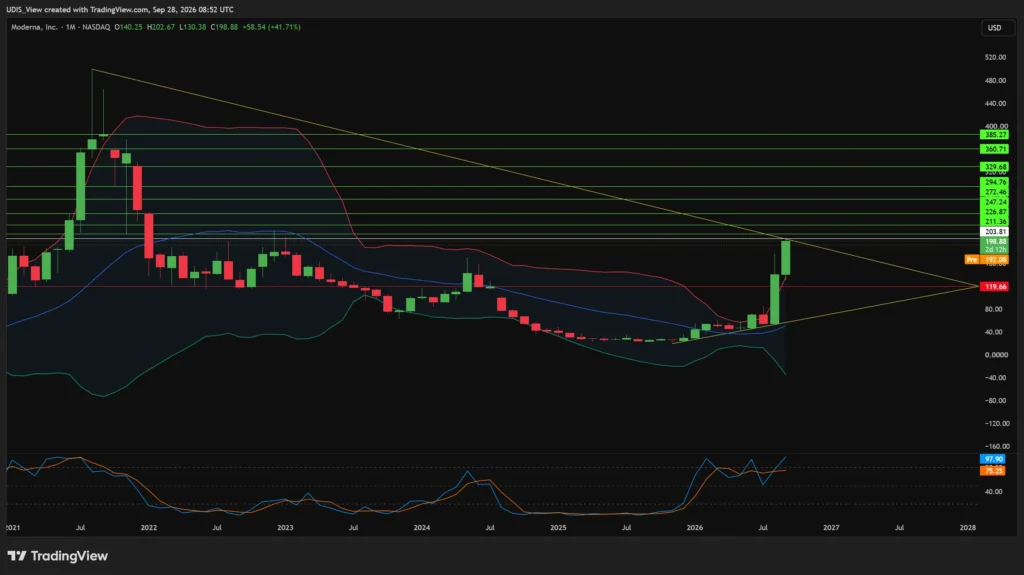
Moderna Long (Buy)
Enter At: 203.81
T.P_1: 211.36
T.P_2: 226.87
T.P_3: 247.24
T.P_4: 272.46
T.P_5: 294.76
T.P_6: 329.68
T.P_7: 360.71
T.P_8: 385.27
S.L: 119.66