

Cisco Stock Price: Is It America’s Trusted Tech Shield?
The Cisco stock price closed at $115.34 on October 12, up about 55% this year and roughly 11% below its 52-week high of $130.37. The rally rests on a clear driver: hyperscaler orders for AI networking gear jumped 4.5 times to $9.3 billion in fiscal 2026. Most traders read Cisco as an AI infrastructure story.
In our view, that reading misses the larger picture. Cisco sits at the center of what Washington now calls the trusted American tech stack: networks the government wants built without Chinese components, collaboration tools vetted for government use, a seat among the initial collaborators of the Energy Department’s Genesis Mission, and a quantum networking program that could connect the computers of the next decade. This analysis examines what the evidence supports, and what traders watching the Cisco stock price, and the CSCO ticker, should track before results on November 11.
The Numbers Behind the Cisco Stock Price
Start with the results, because they were records.
Cisco reported fiscal fourth-quarter revenue of $17.3 billion for the period ended July 25, up 18%, with non-GAAP earnings of $1.22 per share against a $1.17 estimate. Networking revenue rose 28%, product orders climbed 35%, and public sector orders grew 30%.
| Cisco Q4 fiscal 2026 | Result |
|---|---|
| Revenue | $17.3 billion, up 18% |
| Non-GAAP EPS | $1.22, versus $1.17 expected |
| Networking revenue | $9.8 billion, up 28% |
| Security revenue | $2.2 billion, up 14% |
| Public sector orders | Up 30% |
| Hyperscaler AI orders, fiscal 2026 | $9.3 billion, 4.5 times prior year |
| Fiscal 2027 revenue guidance | $72.2 billion to $73.4 billion |
Management guided fiscal 2027 revenue up about 15% at the midpoint, with non-GAAP earnings of $5.05 to $5.11 per share, including about $7.5 billion of hyperscaler AI infrastructure revenue. Shares dipped anyway, because Cisco guided gross margin to 65% to 66%, below the 66.3% of the fourth quarter, as lower-margin hardware takes a larger share of sales.
What the Order Mix Reveals
The order breakdown shows where demand is coming from. Service provider and cloud orders surged 95%, driven by hyperscaler AI builds. Public sector orders rose 30% and enterprise orders 21%, with Cisco reporting acceleration across every geography. That breadth matters, echoing the carrier spending we examined in Verizon’s dark fiber push: a rally built only on four or five cloud giants would be fragile, while rising government and enterprise demand points to a refresh cycle with more durable support.
| Measure, Q4 fiscal 2026 | Figure |
|---|---|
| Service provider and cloud orders | Up 95% |
| Public sector orders | Up 30% |
| Enterprise orders | Up 21% |
| Software revenue | $6.2 billion, up 11% |
| Non-GAAP operating margin | 35.9% |
| Operating cash flow | $5.4 billion, up 27% |
Earnings quality held up as well. Software revenue, largely subscriptions, reached $6.2 billion, non-GAAP operating margin came in at 35.9%, and operating cash flow climbed 27% to $5.4 billion. For the full fiscal year, revenue rose 12% to $63.3 billion.
Washington’s Doctrine: Promote and Protect
The policy backdrop explains why trusted networking now carries strategic weight.
On April 14, 2025, White House science adviser Michael Kratsios laid out the administration’s technology strategy at the Endless Frontiers Retreat in Austin. He described a policy of “both promotion and protection.” On protection, he called for stopping rival nations “from infiltrating our infrastructure and supply chains,” warned against reliance on “Chinese-controlled critical infrastructure, whether in telecom, the grid, or AI,” and urged “trusted supply chains.” On promotion, he called for American companies to “distribute the American tech stack around the world.”
Kratsios also framed the stakes in sweeping terms, saying “our technologies permit us to manipulate time and space,” and closing with a call for discoveries that “will bend time and space.” Read in context, he meant how technology shrinks distance and lifts productivity, not a literal program.
Two further elements of the speech bear directly on Cisco. Kratsios said the federal government “must become an early adopter and avid promoter of American technology,” which points to government purchasing as a growth channel. He also called for “strict and simple export controls and know your customer rules,” which govern where American companies can sell networking gear.
The chain from policy to share price runs through several links:
Policy: protect infrastructure, promote the American tech stack
        |
Demand for trusted, non-Chinese networks rises
        |
Public sector and allied orders grow  -->  higher revenue visibility
        |
Mix shifts toward hardware  -->  gross margin pressure
        |
Cisco stock price weighs growth against margins
The Genesis Mission and Cisco’s Place in It
That policy took concrete form in November 2025.
President Trump launched the Genesis Mission by executive order on November 24, 2025. The Department of Energy runs it as a national AI platform for science, linking the supercomputers, quantum systems, and data of its 17 national laboratories, with goals that include energy dominance and national security. Under Secretary for Science Darío Gil leads the effort, with Kratsios coordinating across agencies.
Cisco appears on the list of roughly 50 initial collaborators published at launch, alongside RTX, Dell, Hewlett Packard Enterprise, NVIDIA, Microsoft and Quantinuum. On December 18, 2025, the Energy Department announced formal collaboration agreements with 24 organizations, including Dell and HPE. NVIDIA said its agreement covers areas such as nuclear fission and fusion and quantum computing.
The executive order directs the Energy Department to build an “American Science and Security Platform” that integrates national laboratory supercomputers, secure cloud-based AI environments, scientific datasets, domain foundation models and AI agents. The department has since created a Genesis Mission Consortium, administered by RTI International through TechWerx, to bring more companies and universities into the effort.
One detail matters for traders. The Energy Department said any products produced for the Genesis Mission will be “architecture-agnostic,” meaning partners can contribute different clouds, models, and computing systems. That design limits lock-in for any single vendor, Cisco included.
In our view, secure networking is a natural requirement for any platform that connects national laboratories, sensitive data and frontier computing. Neither Cisco nor the Energy Department has disclosed a contract value for Cisco’s role, however, so traders cannot yet model its revenue.
Credentials Washington Already Uses
Cisco’s national security role predates Genesis.
| Credential | Detail |
|---|---|
| NSA collaboration guidance, 2020 | NSA evaluated 17 services; Cisco says Webex ranked best of breed |
| Webex encryption | End-to-end encryption for meetings, messages and files |
| DoD Comply-to-Connect | Cisco markets solutions for the Pentagon’s device-access program |
| Artemis I, 2022 | Webex flew on NASA’s Orion capsule in the Callisto demonstration |
| Starlink integration | Cisco SD-WAN supports Starlink satellite connectivity |
In August 2020, the National Security Agency published guidance that evaluated 17 collaboration services against about a dozen security criteria for government users. Cisco says Webex ranked best of breed, citing features such as end-to-end encryption and the option for customers to hold their own encryption keys. The Pentagon’s Comply-to-Connect program, which checks every device before it joins a network, uses the same zero-trust principle Cisco sells across its security portfolio.
Quantum Networking: Cisco’s Long Bet
Here Cisco looks furthest ahead.
Quantum computers today hold too few qubits to solve most practical problems. Hardware makers such as IonQ race to add qubits. Cisco’s strategy is to connect many quantum computers into one larger system, the same way it connected classical computers into the internet.
| Quantum milestone | Date |
|---|---|
| Prototype entanglement chip with UC Santa Barbara; Santa Monica lab opens | May 2025 |
| Multi-node entanglement across 17.6 km of New York City fiber | February 2026 |
| Universal Quantum Switch prototype | April 2026 |
| Quantum Network Controller research prototype | October 2026 |
The prototype chip generates up to 200 million pairs of entangled photons per second, works over standard telecom fiber, and uses less than a milliwatt of power. In April 2026, Cisco said its switch prototype carried 5,400 entangled qubit pairs per hour across the New York route, about 10,000 times faster than previous experiments. This month it unveiled a controller that lets applications request entanglement on demand, an approach Cisco calls Entanglement-as-a-Service, working with hardware from partners such as Qunnect and Swabian Instruments. Its Santa Monica quantum lab is also developing a distributed quantum compiler, a quantum network development kit and a quantum random number generator that draws on vacuum noise.
The AI Engine That Pays Today
While quantum is a long bet, AI is paying now.
Hyperscaler AI infrastructure orders rose from about $2 billion in fiscal 2025 to $9.3 billion in fiscal 2026, with $4 billion in the fourth quarter alone. Cisco recognized about $4 billion of that as revenue and expects about $7.5 billion in fiscal 2027. It also booked more than $1 billion of AI orders from neocloud, sovereign and enterprise customers during the year. Its Silicon One P200 routing chip, which competes in a market where Broadcom also sells networking silicon, won two additional hyperscaler designs in the third quarter, and all three new design wins produced orders in the fourth. UBS analyst David Vogt asked on the call why the revenue target was not higher, given the order backlog.
The Security Paradox
Trusted vendors attract the most capable attackers.
Cisco’s security revenue grew 14% to $2.2 billion last quarter, helped by Splunk. Yet Cisco’s own equipment remains a target. In January 2026, it patched a critical remote code execution flaw in its unified communications products that attackers were actively exploiting. Because Cisco equipment runs so much of the world’s network infrastructure, any widely exploited flaw can draw scrutiny from customers and regulators alike.
For traders, the disclosure mechanics matter. Since December 2023, the SEC has required public companies to report material cybersecurity incidents on Form 8-K, under Item 1.05, within four business days of determining that an incident is material. Most vulnerability patches never reach that threshold, because a flaw in a product differs from a breach of the company itself, but a material incident at Cisco would arrive through that filing.
Trading the Cisco Stock Price Around November 11
Cisco reports first-quarter fiscal 2027 results on November 11. Analysts expect about $1.29 per share, and Cisco guided revenue of $18.0 billion to $18.2 billion. Traders can frame the reaction with a simple formula:
Expected move ≈ Share price × Implied move
Using a hypothetical 5% implied move, the expected move at $115.34 would be about $5.77, putting the range at roughly $109.57 to $121.11. Traders should replace that assumption with the live options-implied figure before the report.
Position sizing turns that range into risk control. With a hypothetical $50,000 account risking 1%, or $500, and a stop 5% below a $115.34 entry, the per-share risk is about $5.77, for a position of roughly 86 shares. These figures are illustrations, not recommendations.
| Signal | Where to find it | Likely effect on the CSCO stock price |
|---|---|---|
| Gross margin guidance | Earnings release | Key swing factor after August’s dip |
| AI orders and revenue | Earnings call | Tests the $7.5 billion target |
| Public sector orders | Earnings release | Gauge of government demand |
| Genesis or federal contract news | DOE and Cisco releases | Sentiment, potential new revenue |
| Actively exploited vulnerabilities | Cisco and CISA advisories | Short-term pressure |
Valuing the Cisco Stock Price Against Peers
| Valuation marker | Figure |
|---|---|
| Close, October 12 | $115.34 |
| 52-week range | $66.81 to $130.37 |
| Record close | $129.01, June 4, 2026 |
| Market capitalization | About $455 billion |
| Trailing P/E | About 35.6 |
| Average analyst target | $136.16, Buy consensus |
| Target range | $110 to $170 |
Capital returns add support. Cisco returned $3.2 billion to shareholders in the fourth quarter, paying a $0.42 dividend and buying back about 13 million shares at an average of $111.53, close to today’s Cisco stock price, with $8.1 billion left on its authorization.
Analysts disagree sharply. Citi holds a Buy with a $139 target, while Bernstein rates the stock Hold at $110 and Piper Sandler cut its target to $125 on fears that growth is peaking. In our view, the market prices Cisco on AI networking orders and margins, but gives little value to its role in the trusted American tech stack or its quantum networking position.
The peer comparison sharpens the point. On Morningstar’s normalized earnings, Cisco trades at about 27 times, against roughly 105 times for Palo Alto Networks and 61 times for Arista Networks.
| Normalized valuation | Cisco | Palo Alto Networks | Arista Networks |
|---|---|---|---|
| Price/earnings | 26.7 | 105.4 | 61.0 |
| Price/sales | 7.3 | 26.9 | 25.5 |
| Price/cash flow | 24.8 | 77.6 | 60.6 |
Cisco grows more slowly than either peer, which explains part of the gap. Yet it now posts double-digit growth with AI orders rising 4.5 times, while trading at a fraction of their multiples.
The Risks That Matter for the Cisco Stock Price
- Margin pressure. AI hardware carries lower gross margins than software and services.
- Peaking growth fears. Piper Sandler cut its target on concerns that growth is near its peak.
- Hyperscaler concentration. A handful of cloud giants drive most AI orders.
- Security incidents. Exploited flaws in Cisco equipment carry outsized reputational risk.
- Policy dependence. Federal priorities can shift with administrations and budgets.
- Valuation. A trailing P/E near 36 leaves less room for disappointment than in past cycles.
Closing Thoughts
Cisco has assembled a position few technology companies can match: record revenue, AI orders up 4.5 times in a year, a seat among the Genesis Mission’s initial collaborators, collaboration tools vetted under NSA guidance, and a quantum networking program advancing from chip to switch to controller in 18 months. Washington’s own strategy calls for exactly the trusted, American-built infrastructure Cisco sells.
The verdict rests on one question: will the market value Cisco as a pillar of America’s trusted tech stack, or only as a cyclical AI hardware supplier? Watch four markers: gross margin guidance on November 11, AI revenue against the $7.5 billion target, any disclosed Genesis Mission or federal contracts, and progress in quantum networking. In our view, Cisco is far more than a networking company, and the market still underprices its strategic role in American technology security.
Sources
- Cisco fourth quarter and fiscal year 2026 earnings release, August 12, 2026 (SEC Form 8-K); Cisco Q4 FY2026 earnings call coverage by Investing.com, The Motley Fool and BigGo Finance.
- The White House, Remarks by Director Kratsios at the Endless Frontiers Retreat, April 14, 2025.
- U.S. Department of Energy, Genesis Mission collaboration agreements announcement, December 18, 2025; HPCwire on the Genesis Mission launch; published initial collaborator list, November 25, 2025.
- Webex Blog, NSA collaboration services guidelines, April 2021; NSA, “Selecting and Safely Using Collaboration Services for Telework,” August 2020.
- Lockheed Martin, Callisto announcement, January 5, 2022; Cisco Learning Network on SD-WAN and Starlink; Cisco Comply-to-Connect materials.
- Data Center Dynamics, Fast Company, TechTarget and Help Net Security on Cisco quantum networking, 2025–2026.
- Network World on Cisco’s January 2026 vulnerability patch.
- StockAnalysis, Robinhood, Morningstar, Macrotrends, Beinsure, and Public.com market data, October 2026.
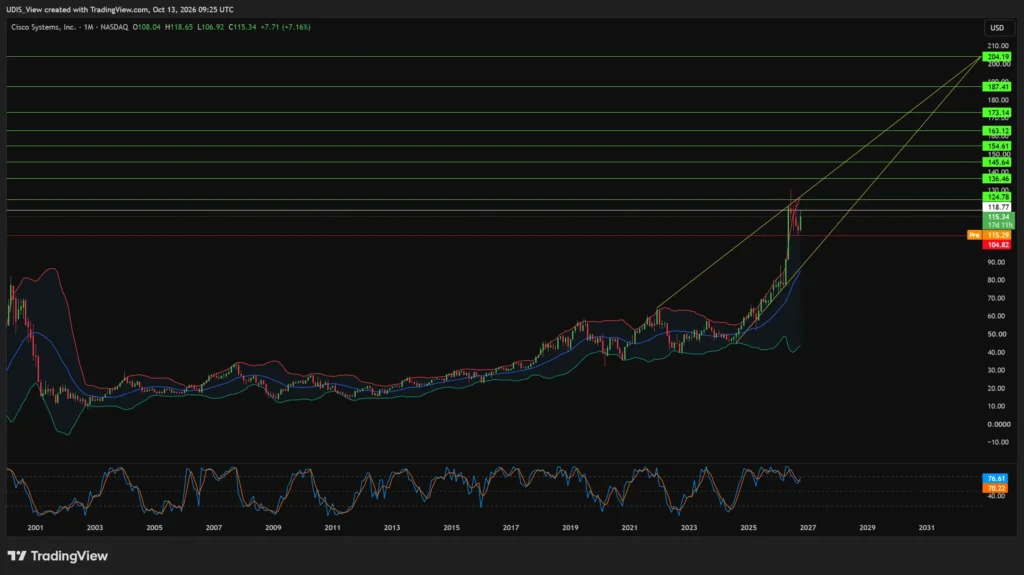
Cisco Long (Buy)
Enter At: 118.77
T.P_1: 124.78
T.P_2: 136.46
T.P_3: 145.64
T.P_4: 154.61
T.P_5: 163.12
T.P_6: 173.14
T.P_7: 187.41
T.P_8: 204.19
S.L: 104.82