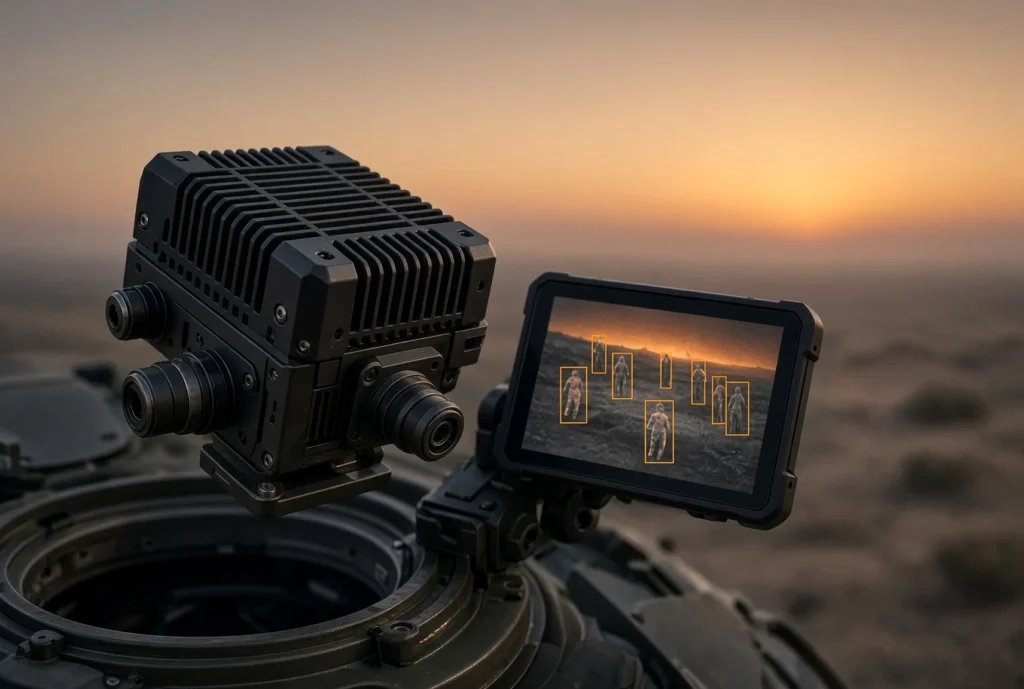


Kratos Defense stock has fallen while the business accelerated. The company reported second-quarter revenue up 30.5%, beat consensus by nearly 12%, raised full-year guidance, and carries a record backlog above $2 billion. Its shares have fallen roughly 41% over twelve months.
That gap is the investment case. Kratos is executing operationally at a rate few defense companies match, while trading at more than 270 times trailing earnings on net margins near 2%, with free cash flow negative and analysts cutting next-year estimates. This analysis works through both sides.
The Kratos Defense Stock Decline in Context
Start with the price action, because the magnitude of the Kratos defense stock move matters.
Shares traded as high as $134.00 within the past twelve months and have since fallen to roughly $46 to $48, near the 52-week low of $43.09. That is a decline of about 41% over twelve months and a similar fall across the most recent ninety days. Market capitalization sits near $8.6 billion to $9.1 billion.
| KTOS market data | Figure |
|---|---|
| 52-week high | $134.00 |
| 52-week low | $43.09 |
| Recent price | ~$46 to $48 |
| Twelve-month return | Down ~41% |
| Market capitalization | ~$8.6bn to $9.1bn |
| Short interest | 9.7 million shares, up 16.9% |
| Institutional ownership | ~94% |
The decline did not follow a deterioration in operations. It followed a compression in the multiple investors were willing to pay for those operations, which is a different problem with a different resolution.
The Quarter Was Genuinely Strong
Second-quarter results, reported August 4, exceeded expectations on both lines.
Revenue reached $458.8 million, up 30.5% year over year and roughly 12% above analyst estimates. Adjusted earnings of $0.21 per share beat consensus by a wide margin. Total backlog climbed to $2.084 billion, including $1.572 billion in funded orders. Management raised full-year revenue guidance to between $1.750 billion and $1.810 billion.
| Kratos Q2 2026 | Result |
|---|---|
| Revenue | $458.8 million, up 30.5% |
| Versus consensus | Beat by ~12% |
| Adjusted EPS | $0.21 |
| GAAP net income | $4.40 million |
| Quarterly net margin | 1.0% |
| Total backlog | $2.084 billion |
| Funded backlog | $1.572 billion |
| FY2026 revenue guidance | $1.750bn to $1.810bn, raised |
Growth came from hypersonics, engines and defense programs, with organic expansion across propulsion, unmanned systems and missile tracking. Analysts forecast revenue growing roughly 18% annually over three years, against 9% for the broader US aerospace and defense industry.
The Kratos Defense Stock Valuation Problem
Here is why the market has repriced Kratos Defense stock despite that performance.
Kratos trades at more than 270 times trailing earnings on one calculation, far above the premium multiples carried by peers such as L3Harris, and above 580 times on another, depending on the period used. Trailing net margin sits near 2.0% and return on equity near 1%. Quarterly net income of $4.40 million against $458.8 million of revenue illustrates the gap between scale and profit.
Two further signals deserve attention. Free cash flow is negative, reflecting heavy internal investment in capacity and prototypes. And analysts have cut next-year earnings per share estimates from $0.301 to $0.188, a reduction of roughly 38%, even as revenue forecasts rose.
Falling earnings estimates alongside rising revenue estimates is the clearest expression of the problem. Investors are being asked to fund growth that has not yet produced proportionate profit, and the timeline keeps extending.
The Balance Sheet Behind Kratos Defense Stock
One set of figures genuinely insulates Kratos from the risks that sink other growth-stage defense companies.
Kratos holds approximately $1.44 billion in cash and equivalents against total debt of $193.6 million. The debt-to-equity ratio sits near 0.04 and the current ratio near 5.5.
| Balance sheet | Figure |
|---|---|
| Cash and equivalents | ~$1.44 billion |
| Total debt | $193.6 million |
| Debt-to-equity | ~0.04 |
| Current ratio | ~5.5 |
| Enterprise value | ~$7.9 billion |
That position lets Kratos fund prototypes internally, which is central to its strategy. The company describes affordability as a technology and makes what it calls true internally funded research and capital investments to field solutions rapidly. Doing that without borrowing is rare among companies at this stage.
Propulsion Is the Clearest Catalyst
The engine programs are where development work is converting into production positions.
On August 17, Kratos and GE Aerospace announced the GEK800 had received US Military Engine Type Designation F143-ZZ-100 announced the GEK800 had received US Military Engine Type Designation F143-ZZ-100 along with an Air Force Engineering, Manufacturing and Development contract as a second-source propulsion system for the Joint Air-to-Surface Standoff Missile. The 800-pound-thrust turbofan targets cruise missiles, collaborative combat aircraft, and other uncrewed platforms.
The program’s maturity is documented. Kratos and GE began work in 2023 with support and funding from the Air Force Research Laboratory, completed a Technology Maturation and Risk Reduction phase, logged more than 50 engine starts in ground testing, and completed altitude testing at Purdue University’s Maurice J. Zucrow Laboratories in 2025. In September, the partners announced successful ignition testing, keeping development on schedule.
| Engine | Type | Thrust | Application |
|---|---|---|---|
| GEK800 / F143-ZZ-100 | Turbofan | 800 lbf | JASSM second source, CCAs, strike drones |
| TDI-J85 Spartan | Turbojet | 200 lbf | Boeing JDAM Long Range |
| TDI-J70 Spartan | Turbojet | 125 lbf | Uncrewed systems, tactical decoys |
| Zeus 1 and 2 | Solid rocket motor | High impulse | Hypersonic testbeds, MACH-TB |
| Oriole | Solid rocket motor | Staged booster | ARAV-B ballistic targets |
Kratos also supplies Spartan J85 engines for Boeing‘s JDAM Long Range, a 500-pound glide weapon with roughly 300 nautical miles of reach, manufactured at an expanded facility in Auburn Hills, Michigan.
Chief executive Eric DeMarco has framed the work as supporting reindustrialization of US capacity for low-cost, rapidly manufacturable jet engines.
Tactical Autonomy and Hypersonics
Two further areas carry the growth narrative.
In uncrewed aircraft, a missionized Marine Corps Valkyrie demonstrated electronic warfare capability and beyond-line-of-sight command and control at a US Navy test range, operating alongside crewed F-35 and F/A-18 aircraft before returning autonomously. Kratos partners with Northrop Grumman on the Missionized Valkyrie Air Vehicle for MUX TACAIR, and has expanded its Oklahoma City campus by more than 100,000 square feet.
In hypersonics, management targets revenue approaching $400 million during 2026, rising toward $700 million by 2027, supported by the Erinyes flyer and Zeus rocket motors. In ballistic targets, the ARAV-B completed its forty-third successful mission during the multinational Pacific Dragon 2026 exercise, validating Aegis Baseline 10 combat software and AN/SPY-6 radar tracking.
Kratos also received a US Army contract through DEVCOM to develop a next-generation infrared seeker for the Javelin missile, and a $35 million award for C5ISR hardware production.
Space and Ground Systems
The satellite business is quieter but strategically durable.
Kratos won a contract exceeding $20 million for mobile SATCOM gateways in Asia, integrating truck-mounted Trifold antennas with its Compass network monitoring system. Following the acquisition of Orbit Communication Systems, it received multi-million-dollar orders for GAIA 100 tri-band ground station systems using Orbit’s auto-track technology.
The company’s OpenSpace architecture virtualizes satellite ground infrastructure, replacing fixed hardware with software-defined systems that are harder to target. Its unclassified KnownSpace sensor network has been used to trace satellite jamming campaigns back to originating uplink transmitters.
Valuing Kratos Defense Stock Against the Bear Case
The analyst spread on Kratos Defense stock is unusually wide, which reflects genuine disagreement.
Across 21 to 29 covering analysts, the average price target runs from roughly $102 to $106, implying upside above 115% from current levels, with individual targets ranging from $60 to $150. Guggenheim initiated coverage in mid-September with a Buy rating and a $74 target. One systematic factor model ranks Kratos in the lower half of the US universe, describing the gap between Street optimism and factor scoring as the central tension.
| Firm or source | Position |
|---|---|
| Consensus, 21 to 29 analysts | ~$102 to $106 average |
| Target range | $60 to $150 |
| Guggenheim | Buy, $74 |
| Simply Wall St fair value | Raised to $150 |
| Systematic factor rank | 36 of 100, lower half |
The bull case is 30.5% revenue growth, a $2.084 billion backlog with $1.572 billion funded, raised full-year guidance, $1.44 billion of cash against minimal debt, a JASSM second-source position, and demonstrated Valkyrie capability.
The bear case is a multiple above 270 times earnings, net margins near 2%, negative free cash flow, next-year earnings estimates cut 38%, rising short interest, and the fact that none of the technology wins have yet produced proportionate profit.
The Risks That Matter
- Valuation. A trailing multiple above 270 times earnings on net margins near 2% leaves no room for execution error.
- Negative free cash flow. Heavy internal investment in capacity and prototypes consumes cash rather than generating it.
- Falling earnings estimates. Analysts cut next-year EPS from $0.301 to $0.188 while raising revenue forecasts.
- Margin compression. Aerospace component inflation and specialized labor costs limit near-term profitability.
- Development-to-production risk. EMD awards and demonstrations must convert into multi-year production runs to justify the multiple.
- Rising short interest. Short positions grew 16.9% to 9.7 million shares.
- Programme concentration. A small number of large programs, including JASSM and Valkyrie, carry disproportionate weight.
- Forecast dependence. The hypersonics targets of $400 million in 2026 and $700 million in 2027 are management guidance, not contracted revenue.
Closing Thoughts
Kratos Defense stock represents a portfolio that maps unusually well onto how defense procurement is changing. Low-cost attritable aircraft rather than exquisite platforms, the same shift driving AeroVironment. Second-source engines that break single-supplier bottlenecks on JASSM. Solid rocket motors for hypersonic testing. Virtualized satellite ground systems that survive attacks on fixed infrastructure. Backlog rose to $2.084 billion, and guidance went up, not down.
The verdict rests on one question: can a company earning roughly $4.4 million on $458.8 million of quarterly revenue expand margins fast enough to justify more than 270 times earnings? Watch four markers into 2027: whether next-year earnings estimates stop falling, whether free cash flow turns positive, whether the JASSM EMD award converts into production orders, and whether hypersonics revenue tracks toward the $400 million target. The engineering is working. The economics have not caught up.
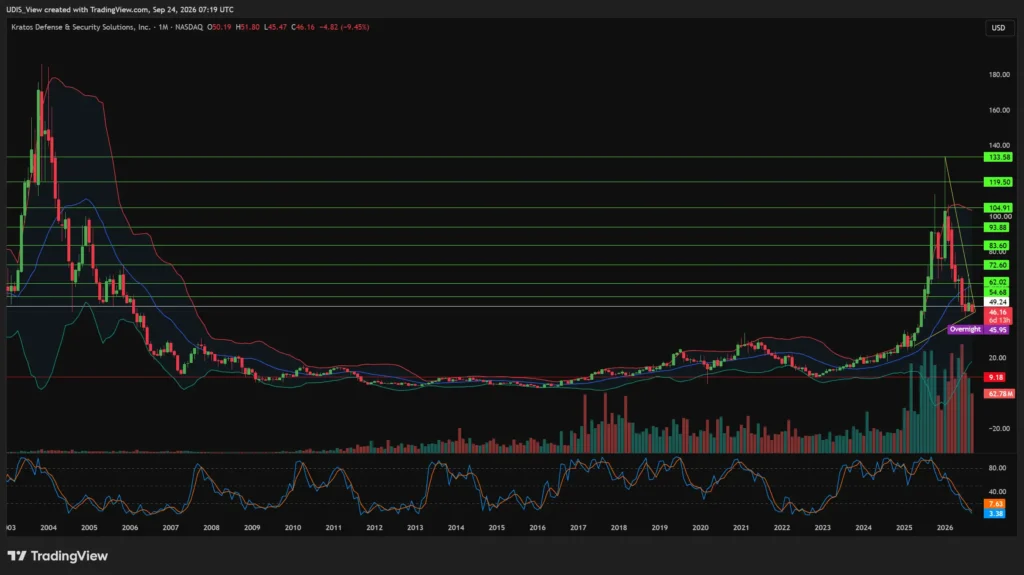
Kratos Long (Buy)
Enter At: 49.24
T.P_1: 54.68
T.P_2: 62.02
T.P_3: 72.60
T.P_4: 83.60
T.P_5: 93.88
T.P_6: 104.91
T.P_7: 119.50
T.P_8: 133.58
S.L: 9.18