

Overview
This article analyzes the PPA Defense ETF 2026 as a primary vehicle for navigating the current era of global rearmament and technological disruption. It details how record global defense spending and pivotal NATO policy shifts create a structural growth environment for leading military contractors. Investors will gain a data-backed framework for selecting high-growth defense stocks and managing positions within the evolving 2026 geopolitical landscape.
Geopolitical stability deteriorated significantly across the globe during the first quarter of 2026 as regional conflicts expanded rapidly. This volatile landscape forces investors to seek resilient assets like the Invesco PPA Fund that provide structural growth despite broader market fluctuations and uncertainty. The fund serves as the primary benchmark for analyzing this critical global industry and provides targeted exposure to companies involved in military hardware. What are the best defense stocks to buy right now and in 2026 as global tensions and military spending accelerate? This long-form guide evaluates the sector through a framework of established leaders, high-growth innovators, and diversified vehicles. Meanwhile, readers will learn to identify undervalued opportunities and manage risk within a sector transitioning toward structural importance. Therefore, this analysis assists active traders in building a clearer framework for selecting and monitoring their strategic market positions.
- Key Segments and Leaders
- Undervalued and Income Opportunities
- High-Growth Thematic Plays
- How to Diversify and Manage Risk
Analyzing the PPA Defense ETF 2026 as a Portfolio Core
Key Statistics for the Invesco Aerospace & Defense Fund
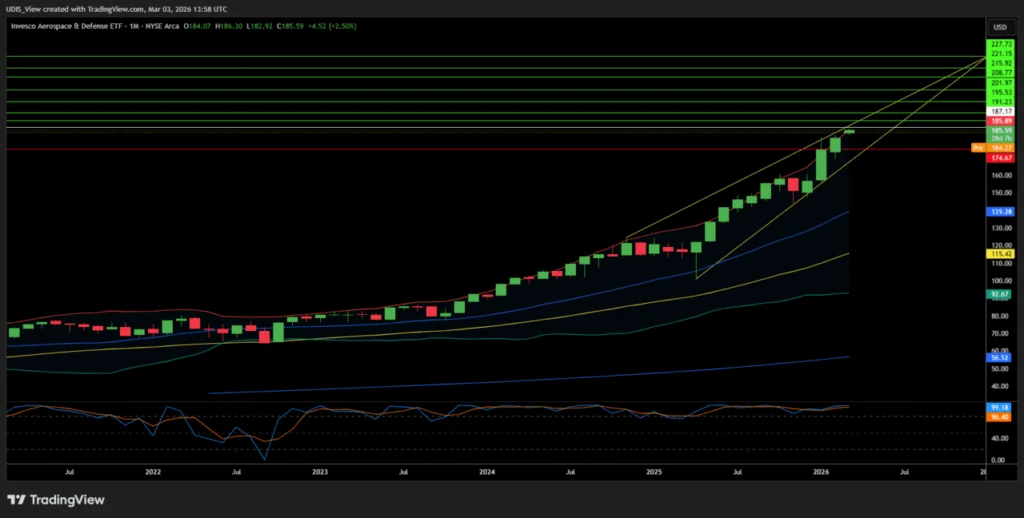
The fund manages approximately $8.24 billion in total assets as of early 2026, with 61 distinct holdings. Recent market activity shows the fund trading near its 52-week high of $186.30 following a massive growth period. This upward trajectory reflects a 60.67% one-year return driven by record global defense spending exceeding $2.63 trillion. Consequently, the portfolio maintains an average market capitalization of $123.46 billion while tracking the SPADE Defense Index. Top holdings include industry giants like Lockheed Martin and RTX Corporation, which benefit from record multi-year backlogs. Meanwhile, these firms capitalize on a unique combination of technological disruption and fiscal expansion within the domestic market. Therefore, investors increasingly view these aerospace companies as a defensive haven during periods of heightened geopolitical volatility. As a result, the sector provides long-term revenue visibility that justifies its premium price-to-earnings ratio of 35.80.
Major Drivers for High-Growth Defense Stocks 2026
The NATO 5 Percent Paradigm Shift and Regional Spending
A pivotal moment occurred at the 2025 NATO Summit in The Hagu,e where allies committed to new targets. Members agreed to an investment goal of 5% of GDP by 2035 to address evolving global threats. This paradigm shift ensures long-term revenue visibility for defense primes as nations replenish their conventional and asymmetric stockpiles. Furthermore, Germany recently overtook the United Kingdom as the second-highest spender within the alliance during this fiscal year. Poland currently leads the alliance in spending relative to its economy at 4.5% of GDP as regional demand surges. Meanwhile, these increases drive massive foreign demand for American-made defense goods from the leading fund constituents. Therefore, U.S. contractors remain deeply embedded in the global security architecture through critical export and partnership programs. As a result, the NATO 5% commitment for core requirements supports long-term revenue for investors.
Best Defense Stocks to Buy Now: Performance and Picks
Evaluating Industry Leaders in the 2026 Conflict Environment
Regional conflicts continue to drive unprecedented demand for conventional weaponry as high-intensity battles of attrition deplete global stockpiles. Analysts expect global spending to grow by 8.1 percent through 2026 as nations modernize their existing military capabilities. Specifically, the recent strikes on Iranian nuclear facilities during Operation Roaring Lion validated the platform strategies of major firms. Shares of Lockheed Martin and RTX reached record highs immediately after these events highlighted the role of air superiority. Furthermore, recent Boeing defense contracts contribute to the massive backlogs, driving a significant stock rally for the aerospace giant. The company remains a top holding within the fund alongside RTX, which secured a $50 billion umbrella contract. Consequently, investors prioritize these firms because they offer stable returns amid the current cycle of escalating geopolitical tension. Therefore, these industry giants represent the best defense stocks to buy now for traders seeking high-conviction market exposure.
Future Frontiers for Aerospace Innovation and Expansion
Hypersonic Weapons and the $19 Billion Market Opportunity
Hypersonic flight represents the most significant breakthrough in aerospace science as systems operate at speeds exceeding Mach 5. Mastery of complex aerodynamic shock waves allows vehicles to maintain precision guidance while traveling at extreme atmospheric velocities. Furthermore, the global hypersonic vehicle market is expected to hit $19.66 billion by 2033 as deployment cycles accelerate. Lockheed Martin successfully tested a hypersonic glide vehicle that achieved speeds above Mach 6 over the California coastline. Meanwhile, GE Aerospace recently developed two engines capable of 1,500 pounds of thrust to power advanced military UAVs. Northrop Grumman also completed validation of a hypersonic missile system to enhance the domestic long-range strike capability. Therefore, these technological enablers represent the future of high-growth defense plays that redefine the competitive landscape for traditional aerospace firms. As a result, fund constituents aggressively invest in these areas to maintain their dominance in next-generation weaponry.
Undervalued Defense Stocks and Income Opportunities
Capital Allocation and Dividend Growth for Long-Term Investors
Major constituents focus on disciplined capital allocation to maximize shareholder value during this period of high free cash flow. Lockheed Martin repurchased $555 million in shares and paid $937 million in dividends during the last fiscal year. Furthermore, BAE Systems recommended a 10% increase in its total dividend to reflect the strength of major programs. These returns highlight the robust profitability of firms that manage multi-year government contracts with high revenue visibility. Meanwhile, identifying undervalued opportunities requires an analysis of firms transitioning toward digital engineering and software-defined architectures. Lockheed Martin manages over 80 space projects using artificial intelligence to reduce long-term sustainment and maintenance costs. Consequently, these efficiency gains improve operating margins, which typically range between 10% and 12% for the big primes. Therefore, investors find value in established companies that utilize digital twins to streamline their complex manufacturing processes.
Diversification Strategy for the PPA Defense ETF 2026
Comparative Analysis of the Portfolio Structure
| Category | Primary Driver | Risk Level | Notable Ticker | Weighting |
| Established Leaders | Record Backlogs | Moderate | Lockheed Martin (LMT) | 9.06% |
| Growth Innovators | Hypersonic Tech | High | RTX Corp (RTX) | 8.51% |
| Industrial Suppliers | Aircraft Orders | Moderate | General Electric (GE) | 8.45% |
| Agile Tech | Software Contracts | High | Palantir (PLTR) | Diversified |
Risk Management and Supply Chain Constraints in 2026
Persistent manufacturing backlogs for complex systems currently stretch into the 2030s as shipyards struggle to meet rising demand. Aging demographics and specialized labor shortages create significant supply-side headwinds for firms attempting to ramp up their production. Furthermore, inflation remains a critical variable for profitability as legacy programs operate under firm-fixed-price contract agreements. These contracts assign nearly all performance and cost risk to the contractor during periods of rising material expenses. However, new Department of Defense rules effective late 2025 allow for economic price adjustments to protect the industrial base. Meanwhile, the 2025 National Defense Authorization Act includes provisions to mitigate the risk of bankruptcy for smaller suppliers. Therefore, the PPA Defense ETF 2026 provides a diversified vehicle to manage these idiosyncratic risks. As a result, investors gain exposure to a broad ecosystem that balances traditional primes with high-growth software firms.
Summary and Final Outlook for the Defense Sector
The PPA Defense ETF 2026 is positioned for sustained growth as global spending reaches permanent baselines. This shift from a cyclical play to a structurally vital component of the global economy redefines the sector. Furthermore, the convergence of AI, hypersonics, and autonomous systems represents a generational shift in modern military doctrine. Traditional hardware firms successfully reinvent themselves as software orchestrators to protect their market share against agile tech startups. Meanwhile, strategic alliances like AUKUS and GCAP provide multi-decade revenue visibility for the leading American defense contractors. Investors should expect the sector to continue trading near record levels as these long-term trends finally mature. Therefore, the frameworks and screening criteria provided in this guide assist in building a high-quality defense portfolio.
Invesco Aerospace & Defense ETF Long (Buy)
Ente At: 187.17
T.P_1: 191.23
T.P_2: 195.53
T.P_3: 201.97
T.P_4: 208.77
T.P_5: 215.92
T.P_6: 221.15
T.P_7: 227.73
S.L: 174.67