

Artificial intelligence has run headlong into a hard physical limit, and that limit is electricity. America’s hyperscale buildout faces a baseload deficit that wind and solar cannot close on their own. Into that gap steps the decade’s strangest energy story: a social media company reinventing itself as a fusion infrastructure play.
On December 18, 2025, Trump Media & Technology Group (Nasdaq: DJT) signed a definitive all-stock fusion merger with developer TAE Technologies. The deal carries a valuation above $6 billion and creates one of the world’s first publicly traded fusion companies. Shareholders of each firm walk away with roughly half of the combined entity. The Trump Media fusion play is no media pivot but a leveraged wager on AI-era physics.
Inside the Trump Media Fusion Moat
The Trump Media fusion case rests on two structural edges. The first is geometric. Decades ago, the company walked away from the unstable tokamak donut. In its place it pioneered a Field-Reversed Configuration that confines plasma inside a straight magnetic cylinder. That linear design shrinks both the reactor footprint and the cost of building one. Utilities can then site plants close to urban demand. The company’s April 2025 “Norm” breakthrough went further still, eliminating the plasma formation section altogether. That step cut complexity and cost while holding stable plasma above 70 million degrees Celsius, per reporting on the milestone.
The second edge is chemical. TAE runs a hydrogen-boron (p-B11) fuel cycle rather than the usual deuterium-tritium. Because the reaction is aneutronic, it throws off stable helium nuclei instead of destructive neutrons. That spares the reactor walls the radiation damage that plagues rival designs within a few years. The fuel math reinforces the edge. Boron is abundant and cheap. Tritium runs into tens of thousands of dollars per gram and barely exists outside fission reactors.
Underneath both advantages sits a wall of intellectual property: more than 1,600 granted patents since the company’s founding in 1998. They span FRC geometry, particle accelerators, and direct energy conversion. That portfolio sharply limits how Microsoft-backed Helion and other rivals can engineer around TAE.
The Google Engine
The Trump Media fusion story draws its credibility from Alphabet (Nasdaq: GOOGL). Google has backed TAE since 2014, and not as a passive check-writer. Its engineers have worked on-site at TAE’s facilities. Together, the two co-developed the Optometrist Algorithm, which compresses month-long plasma optimization into a single day.
Google keeps writing checks too. It joined TAE’s $250 million round in 2022 and the $150 million-plus round in June 2025. All told, TAE has raised more than $1.3 billion. Backers include Chevron Technology Ventures, Goldman Sachs, and Sumitomo Corporation of Americas. Former Energy Secretary Ernest Moniz sits on its board.
The logic is self-reinforcing. Google’s data centers are desperate for carbon-free baseload power, and TAE is engineering exactly that. For $DJT, the merger buys instant entry into an AI-plus-fusion flywheel.
Co-CEO Devin Nunes has framed the deal in national-security terms. Homegrown fusion, he argues, secures America’s AI lead against foreign rivals. The regulatory backdrop helps the case. The NRC oversees fusion under its lighter Part 30 framework. The ADVANCE Act of 2024 spares it from slow, fission-style licensing.
Financial Health and Valuation
Here the Trump Media fusion thesis runs into hard reality. Trump Media’s standalone numbers are tiny, and investors are not buying cash flow. What they are buying is optionality on fusion, backed by a balance sheet that tripled in a year.
| Metric | Value | Note |
|---|---|---|
| FY2025 revenue | $3.7M | Roughly flat vs $3.6M in FY2024 |
| FY2025 net loss | -$712.3M | Widened from -$400.9M in FY2024 |
| Adjusted EBITDA loss | -$664.4M | FY2025 |
| Digital-asset fair-value losses | -$403.2M and -$178.8M | Drove most of the net loss |
| Financial assets | ~$2.5B | Tripled from $776.8M at end of 2024 |
| Operating cash flow | Positive | Includes $44M from options strategy |
A forward P/E or PEG ratio means nothing here, since $DJT earns nothing to divide. The $712.3 million loss came mostly from unrealized declines on its digital-asset treasury, per the company’s full-year 2025 results. Operating cash flow stayed positive, a thin but real sign of discipline. The actual fuel is the $2.5 billion asset base. It funds the $200 million the company injected into TAE at signing, plus another $100 million on the S-4 filing. That money lets TAE outspend rivals on the road to commercialization. Strip away the narrative and the valuation is a venture bet wearing a public ticker.
Risk Factors
The first risk is physics, and physics does not negotiate. TAE’s commercial Da Vinci reactor has to sustain 3 billion degrees Celsius. That runs roughly twenty times hotter than D-T fusion at 150 million degrees. No one has demonstrated net energy gain at that threshold on a commercial scale. Even the sixth-generation Copernicus machine is still chasing its net-energy milestone before decade’s end. First commercial power is not penciled in until around 2031. A single confinement setback could reset the whole thesis.
The second risk is governance. The $712.3 million loss reflects a balance sheet stuffed with volatile digital assets. The all-stock structure also dilutes existing $DJT holders to roughly half the combined company. The S-4 will lay out the full share count.
The third risk is political. TAE has taken federal money through the Department of Energy’s INFUSE program. President Trump owns roughly 52% of TMTG through a trust run by Donald Trump Jr. Ethics specialists, among them former White House lawyer Richard Painter, have called the setup a conflict of interest. The White House has dismissed those concerns. Either way, regulatory or legal friction could still delay the targeted mid-2026 close.
The last risk is the field itself. More than two dozen US fusion firms are competing for capital and government favor. Canada’s General Fusion even beat $DJT to the public markets, going public through a SPAC merger in early 2026.
The Bottom Line
Two catalysts matter from here: the S-4 filing and the mid-2026 close. Closing unlocks the second $100 million tranche. It also clears the way to break ground on the first 50 MWe plant. Later plants target 350 to 500 MWe. The thesis is clean even where the science is not. $DJT is converting speculative liquidity and a $2.5 billion treasury into the most patent-protected aneutronic fusion platform on the market. A decade of Alphabet engineering validates it. In the end, the Trump Media fusion bet is binary and high-conviction. You are not buying Truth Social. You are buying a leveraged option on whether America powers its AI revolution with fusion.
Related reading on udisview.com: Is NuScale Power (NYSE: SMR) the only reactor AI can wait for? and Crypto’s breaking point: regulation, geopolitics, and quantum threats.
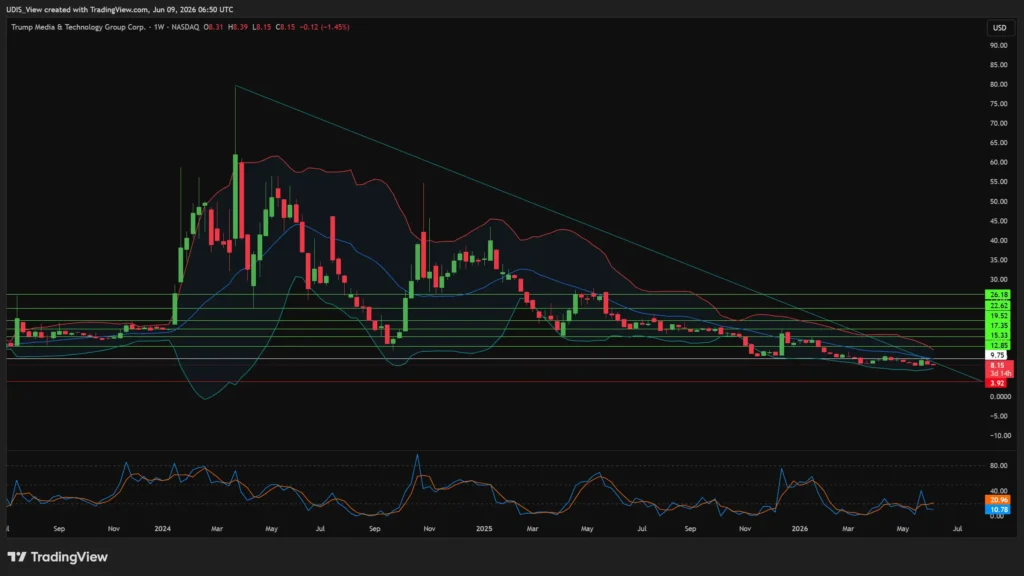
TMTG & TAE Technologies Long (Buy)
Enter At: 9.75
T.P_1: 12.85
T.P_2: 15.33
T.P_3: 17.35
T.P_4: 19.52
T.P_5: 22.62
T.P_6: 26.18
S.L: 3.92