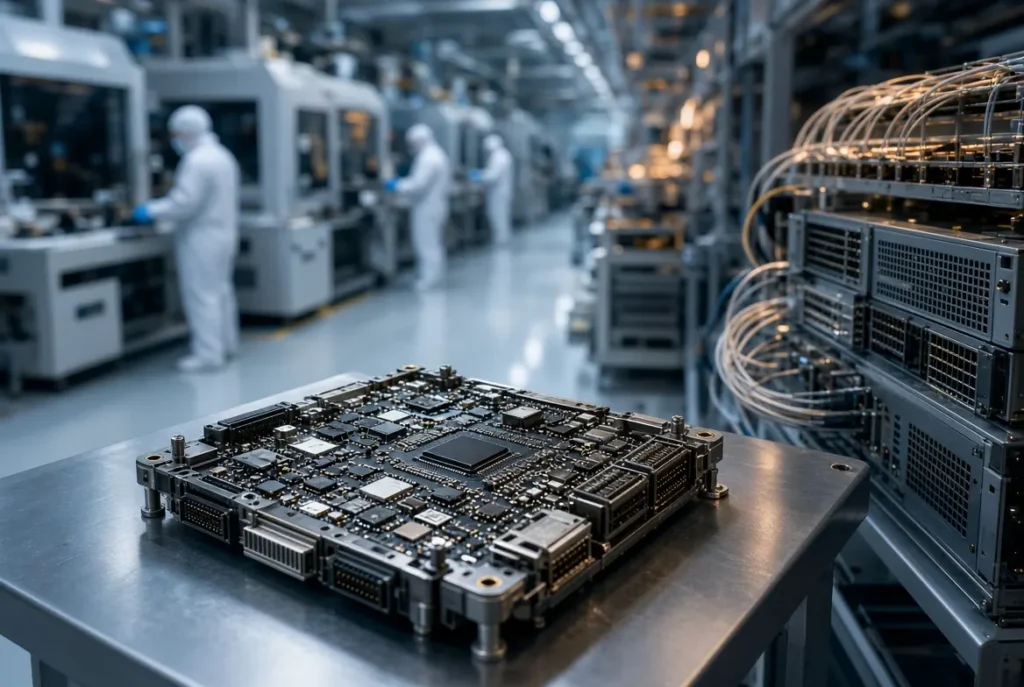


Maris-Tech stock trades near $0.71, giving the company a market value of roughly $7.5 million. On September 28, the Israeli edge video company announced a $10 million order, the largest in its history, for video systems on next-generation airborne defense platforms. The shares rallied on the news, then fell back below $1.
When a company announces an order larger than its own market value, and the stock still falls, the market is telling you something. Maris-Tech builds combat-relevant technology that fits exactly where defense spending is heading. In our view, its corporate structure has not kept pace: the company finances a growing business with share sales, thin cash reserves, and a balance sheet that recently fell below Nasdaq’s listing minimum. This analysis examines both sides of that gap.
The Record Order Behind Maris-Tech Stock
Start with the headline, because the details matter for Maris-Tech stock.
The $10 million order covers the development and supply of advanced video systems for multiple next-generation manned airborne platforms. It sits within a multi-year project that Maris-Tech is carrying out jointly with Magam Safety, an Israeli defense supplier that says it has served the market for more than nine decades. The systems will draw on Maris-Tech’s existing Jupiter and Opal product lines for video processing, recording and streaming.
| Record order | Detail |
|---|---|
| Announced | September 28, 2026 |
| Order value | US$10 million |
| Partner | Magam Safety Ltd. |
| Platforms | Next-generation manned airborne platforms |
| Product lines | Jupiter and Opal |
| Deliveries by end of 2028 | About US$7.1 million |
| Potential total with options | About US$14.1 million |
The timing is the key point for investors. Maris-Tech expects to deliver about $7.1 million of the order by the end of 2028, so revenue arrives over more than two years. Hardware orders also require the company to buy and assemble components before customers pay.
First Half 2026: Growth With a Loss
The latest results show the same tension in Maris-Tech stock.
Maris-Tech reported first-half 2026 revenue of $2,077,545, up 194% from $707,021 a year earlier. The company swung to a net loss of $2,816,584, against net income of $2,388,294 in the first half of 2025. Cash fell to about $2.39 million at June 30.
| Maris-Tech H1 2026 | Result |
|---|---|
| Revenue | $2,077,545, up 194% |
| Prior-year revenue | $707,021 |
| Net loss | $2,816,584 |
| Non-cash fair-value changes in loss | $650,958 |
| Prior-year result | Net income of $2,388,294 |
| Cash, June 30, 2026 | About $2.39 million |
The headline loss needs context. About $651,000 of it came from fair-value changes on financial instruments, which do not consume cash. Those accounting swings also shaped the prior year’s profit. Even so, the operating business is losing money while revenue grows, and the cash balance is small relative to the obligations ahead.
The Nasdaq Equity Test for Maris-Tech Stock
This is the event that moved Maris-Tech stock most this year.
Maris-Tech filed its audited annual report on Form 20-F on May 15, 2026, after using the standard late-filing extension. It reported stockholders’ equity of about $601,583 as of December 31, 2025, well below Nasdaq’s $2.5 million minimum for continued listing. On May 22, Nasdaq sent a formal notice of non-compliance.
The company responded with capital raises and note conversions. On June 11, Nasdaq confirmed that Maris-Tech once again met the minimum equity requirement. The exchange said it will keep monitoring compliance, and that if the June 30 interim financials do not show sufficient equity, delisting proceedings could follow.
A company whose equity fell to about $600,000 at year-end has very little room before the next test. Each quarter of losses brings the threshold back into view.
How Dilution Weighs on Maris-Tech Stock
The company has funded itself primarily through equity, and its filings document the dilution.
In March 2026, Maris-Tech raised about $2.0 million in a registered direct offering, selling 882,825 ordinary shares at $1.24 plus pre-funded warrants for up to 722,311 shares. It also converted $2.0 million of previously issued convertible notes. Under an at-the-market sales agreement with A.G.P./Alliance Global Partners dated March 30, 2026, it may sell up to about $3.0 million of shares, and had sold 630,674 shares for roughly $923,000 by June 7.
| Capital source | Detail |
|---|---|
| Registered direct offering, March 2026 | About $2.0 million; 882,825 shares at $1.24 |
| Pre-funded warrants | Up to 722,311 shares |
| Convertible notes converted | $2.0 million |
| At-the-market program | Up to ~$3.0 million; ~$923,000 raised by June 7 |
| Bank credit line, March 2025 | $4 million, Mizrahi-Tefahot Bank |
| Shares outstanding | About 10.56 million |
The company also holds a $4 million credit line from United Mizrahi-Tefahot Bank. It signed the facility in March 2025 on terms it describes as customary for similarly sized companies. Drawings mature within three months, and the facility includes liens on company assets and restrictive covenants.
Geopolitics: Drones, Jamming and Chinese Bans
The demand side behind Maris-Tech stock is strong, and it is structural.
The war in Ukraine showed how central drones have become, a theme we explored in Red Cat’s drone strategy, and how vulnerable they are to electronic warfare that jams communications links. Systems that process video on the device itself, rather than streaming everything to remote servers, keep working when links degrade. That is Maris-Tech’s core product.
US law also favors non-Chinese suppliers.
| US restriction | Scope |
|---|---|
| FY2020 NDAA, Section 848 | Bars Pentagon use of drones and components from China, such as DJI |
| FY2019 NDAA, Section 889 | Bars certain Chinese telecom and video surveillance equipment, such as Hikvision |
| Effect | Creates demand for allied, compliant suppliers |
The same rules reshaped the outlook for Draganfly. Maris-Tech markets its products as NDAA-compliant, which gives it access to US and allied defense buyers seeking alternatives to restricted Chinese equipment.
From Israel to Global Markets
Maris-Tech operates from Rehovot and works inside Israel’s defense ecosystem, home to primes such as Elbit Systems, which gives it combat-tested customers and fast feedback.
On June 26, Maris-Tech won its first contract as a prime contractor for a military-standard, vehicle-mounted audio system for armored fighting vehicles. On August 11, the government customer exercised an option worth about $184,000, lifting the contract to roughly $534,000. In September, the company highlighted repeat follow-on orders from a governmental intelligence customer.
On October 5, it announced a pilot order from a leading global defense company, which it won through a distributor, for an armored vehicle situational awareness application. The pilot followed an extensive adaptation of the Jupiter product line to the customer’s video requirements, and Maris-Tech says the customer’s own forecasts point to significant follow-on orders if it succeeds.
The company has also built routes abroad. It operates a Delaware subsidiary, Maris North America, and signed a US product supply agreement with One Stop Systems. Defense procurement is slow, however, and pilot orders can take years to become production programs.
Technology: Edge Video and the Hailo-8
Maris-Tech designs ruggedized computing boards and software around merchant processors rather than building its own chips.
Several of its AI products use the Hailo-8 processor from Hailo, another Israeli company. The chip runs AI workloads for detecting, classifying, and tracking objects directly on the device.
| Hailo-8 specification | Value |
|---|---|
| AI performance | Up to 26 TOPS |
| Typical power | About 2.5 watts |
| Memory | No external DRAM required |
| Benefit | Low heat and power for sealed military housings |
Low power and low heat matter in military hardware. Drones lose flight time when computers draw too much power, a constraint familiar to suppliers such as Unusual Machines, and sealed armored vehicles have little airflow for cooling. Size, weight, power, and cost are the constraints every design must meet.
New Products: Diamond Ultra V2 and Peridot Night
The product pipeline is active.
On September 29, Maris-Tech completed development of Diamond Ultra V2, its next-generation video and AI platform built on Qualcomm’s Dragonwing IQ9 Series. Maris-Tech designed it for situational awareness in armored vehicles, counter-drone missions, and airborne mission computing, markets where larger players such as AeroVironment also compete, and it works with the company’s Peridot camera family.
In August, the company received a $280,000 order for Peridot Night systems, which combine day and thermal cameras with onboard AI for round-the-clock observation in terrain dominance applications.
Cyber Resilience and Bandwidth
Streaming raw video from the battlefield is risky. Adversaries can intercept or jam transmissions, and emitters can reveal operator locations.
Maris-Tech’s approach processes video at the edge using efficient H.264 and H.265 encoding, then sends compressed video or extracted information over limited links. That lowers bandwidth needs and keeps systems useful when connections degrade. If the link drops, onboard AI can keep detecting and tracking targets.
Intellectual Property: Certification Over Patents
Maris-Tech’s public patent record is thin. A widely shared analysis credited the company with a 2006 radio patent, but patent records show that a Broadcom engineer filed it, that it belongs to Broadcom, and that it has since expired. The company’s real defenses lie elsewhere.
In our view, the strongest is its AS9100D certification, the aerospace and defense quality standard built on ISO 9001. It requires risk management, product safety controls, and counterfeit-parts prevention throughout the supply chain, and defense primes audit suppliers against it. The company’s proprietary firmware and integration know-how form the rest of the moat.
Leadership and Governance
Founder and chief executive Israel Bar leads the company, and chief financial officer Nir Bussy has managed its financing through the credit line, the direct offering, and the at-the-market program.
The filing record shows strain. The company used the late-filing extension for its 2025 annual report before filing it on May 15, and then received the Nasdaq equity notice a week later. In our view, the board should strengthen independent financial oversight as the company scales.
Valuing Maris-Tech Stock
At roughly $7.5 million, the market values Maris-Tech stock below the size of its new order. That reflects the market’s doubts about execution and funding, not about the technology.
The bull case is a record order with options up to $14.1 million, revenue up 194%, repeat government customers, new platforms, NDAA tailwinds and AS9100D certification.
The bear case is a cash balance near $2.4 million, losses that continue as revenue grows, equity that fell below Nasdaq’s minimum at year-end, ongoing share sales and deliveries that stretch through 2028.
The Risks That Matter for Maris-Tech Stock
- Listing risk. Nasdaq is monitoring stockholders’ equity after a non-compliance notice in May.
- Dilution. Registered offerings, warrants, and the at-the-market program keep adding shares.
- Minimum bid price. With shares below $1.00, Nasdaq can issue a separate deficiency notice if the price stays under $1 for 30 consecutive business days.
- Cash runway. About $2.39 million in cash supports a business that is still losing money.
- Working capital. Large orders require spending on components before customers pay.
- Timing. About $7.1 million of the record order is due by the end of 2028.
- Customer concentration. A small number of defense and government customers drive revenue.
- Execution. Pilot orders must convert into production programs.
Closing Thoughts
Maris-Tech has the kind of technology modern defense demands: edge video and AI that keeps working under jamming, NDAA-compliant hardware, AS9100D certification, and a record order on next-generation airborne platforms. Revenue nearly tripled in the first half.
The verdict rests on one question: can Maris-Tech fund its own growth without diluting shareholders faster than the business grows? Watch four markers: stockholders’ equity in the coming filings, use of the at-the-market program, deliveries under the Magam order, and whether pilot orders turn into production contracts. In our view, the technology is viable, necessary, and combat-relevant, but a fundamentally broken stock structure holds it back, and a strategic acquisition may be the clearest path to realizing the underlying value.
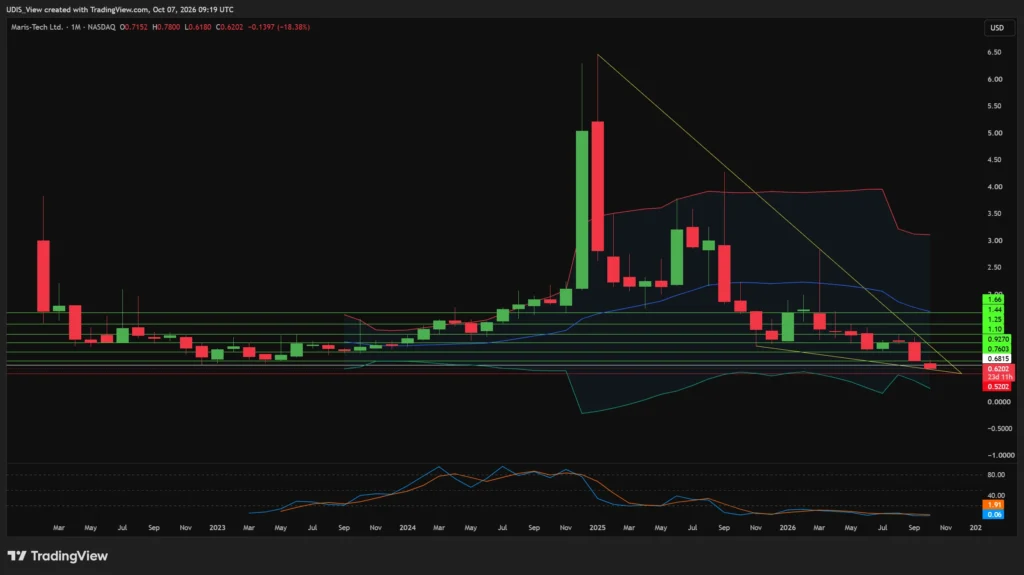
Maris-Tech Long (Buy)
Enter At: 0.6815
T.P_1: 0.7630
T.P_2: 0.9270
T.P_3: 1.10
T.P_4: 1.25
T.P_5: 1.44
T.P_6: 1.66
S.L: 0.5202