

The Palantir AI bubble debate reopened on September 3, when Michael Burry posted that the company is “a consultant riding a bubble of AI FOMO demand” and warned its market capitalization could eventually fall below $100 billion from roughly $432 billion. The stock fell 6% that day to $169.46.
Two days earlier, Palantir had won a new US Army contract. Within hours of Burry’s post, PwC expanded its alliance with the company. The bear case arrived in the middle of two corporate wins, and it deserves examination on its merits rather than acceptance or dismissal, because parts of it are strong and parts of it ignore what Palantir actually reported. This analysis works through both.
The Disclosure That Frames Everything
Start with a fact that belongs at the top of any discussion of this thesis.
Burry holds put options against Palantir and has been publicly short since November 2025. He has described the position alongside a long holding in Molina Healthcare as “long MOH stock and long PLTR puts, like peanut butter and bananas.” That does not make his analysis wrong. It does mean he profits if the stock falls, which readers should weigh.
A short seller publishing a bear thesis is normal and often valuable. Reading that thesis without knowing the position behind it is not.
The Palantir AI Bubble Case, Which Is Genuinely Strong
The core of the Palantir AI bubble argument concerns what kind of company this is, and the numbers he cites are real.
Pure software businesses collect cash in advance and recognize it over the contract term, producing large deferred revenue balances. Software-as-a-service peers typically show deferred revenue-to-revenue ratios between 80% and 207%. Palantir reports roughly 32%. Accenture, an IT consulting firm, reports about 31%.
| Metric | Palantir | SaaS peers | Accenture |
|---|---|---|---|
| Deferred revenue to revenue | ~32% | 80% to 207% | ~31% |
| Delivery model | Forward-deployed engineers | Automated cloud tenancy | Professional services teams |
| Receivables concentration | One client at 27% | Diversified | Distributed |
| Federal cash tax exposure | Shielded by $9bn NOLs | Standard | Standard |
The receivables picture reinforces the point. Accounts receivable climbed to $1.49 billion as of June 30 from $1.04 billion at the end of 2025. One customer accounts for 27% of receivables while contributing less than 10% of recognized revenue, which is an unusual asymmetry and gives that client considerable renegotiation leverage.
Palantir also carries roughly $9 billion in federal net operating loss carryforwards, shielding pre-tax income from cash taxes for now. Burry’s summary is blunt: “the stock price is the business model.”
He extended the critique to governance. Palantir disclosed $17.2 million of expenses in 2025 related to chief executive Alex Karp’s personally owned aircraft, more than double the $7.7 million recorded a year earlier. Burry called the spending profligate and egregious. Jefferies analyst Brent Thill estimated the figure could represent between 1,147 and 2,457 flight hours depending on the aircraft’s operating costs. Governance criticism of this kind rarely moves a share price alone, but it shapes how investors read management’s stewardship of shareholder capital.
What the Palantir AI Bubble Case Leaves Out
Here is the material Burry’s critics point to, and it is substantial.
Palantir’s second quarter showed revenue rising 93% to $1.94 billion, extending the trajectory from our earlier Palantir analysis. US commercial revenue grew 149% to $764 million. US government revenue grew 90% to $809 million. The company raised its 2026 revenue outlook to $8.15 billion, implying growth of roughly 82%.
| Palantir Q2 2026 | Result |
|---|---|
| Total revenue | $1.94 billion, up 93% |
| US commercial revenue | $764 million, up 149% |
| US government revenue | $809 million, up 90% |
| Raised FY2026 outlook | $8.15 billion |
| Implied FY2026 growth | ~82% |
Whatever Palantir is structurally, it is growing revenue at 93% and accelerating in both segments simultaneously. Consulting firms do not typically do that. Accenture, the comparison Burry draws, grows in the low single digits.
The timing of the bear call also matters. Palantir had banked a new Army contract two days before the post, covering eight TITAN systems through a wholly owned subsidiary, and PwC announced an expanded alliance within hours. The stock fell 6% and then largely held, which suggests the market weighed the argument against the contracts and did not find it decisive.
The Patent Gap Is Real
One element of the skeptical case receives less attention than it deserves.
Palantir holds more than 3,800 global patent filings, but the composition is revealing. Data analysis technologies account for over 72% of its patent families, with digital data processing representing a further 62%. The filings cover database structures, user interfaces, authorization controls, cross-ontology replication, mobile reporting and network mapping.
What the portfolio does not contain is foundational neural network architecture. Google DeepMind, by contrast, holds patents covering deep reinforcement learning, actor-critic networks, continuous control models, neural compression and generative verification.
| IP category | Palantir | Google DeepMind |
|---|---|---|
| Primary patent domain | Data integration, graphical UI | Deep learning, neural networks |
| Core registered inventions | Cross-ontology replication | Actor-critic, continuous control |
| Generative AI architecture | Integrates external models | Proprietary foundation models |
| Provenance | Role-based access controls | Watermarking, neural verification |
Palantir builds the operational layer that connects third-party models to enterprise data, the same territory contested by BigBear.ai in federal markets. That is valuable work and arguably the harder commercial problem, but it is not the same as owning the algorithmic science. The distinction matters for whether the company deserves a foundational-AI multiple or an enterprise-software one.
The Competitive Threat From Hyperscalers
The most concrete near-term risk emerged from an unexpected direction.
Palantir shares fell 7% when Google DeepMind unveiled Gemini 3.8 Flash Cyber, a model built specifically for cybersecurity, vulnerability detection and automated patching. Google restricted access through a new initiative called the Fairwind Program, available exclusively to government authorities, critical infrastructure operators and software maintainers.
That structure matters because Palantir has long argued commercial hyperscalers could not serve restricted defense environments. Google delivering a specialized security model directly to government customers, and claiming better performance at lower cost, tests that assumption directly.
| Competitive pressure point | Detail |
|---|---|
| Google DeepMind model | Gemini 3.8 Flash Cyber |
| Access program | Fairwind, restricted distribution |
| Eligible users | Government, critical infrastructure, software maintainers |
| Google’s claim | Better performance at lower cost |
| PLTR reaction | Shares fell 7% |
The Interface Moat Question
A separate challenge came from a single engineer rather than a corporation.
Technologist Bilawal Sidhu built WorldView, a browser-based spy satellite simulator, in a matter of days. It integrates Google 3D Tiles, WebGPU rendering and open-source intelligence feeds, displaying thermal shaders, live orbital vectors and street-level camera feeds. The project attracted attention from Palantir’s own co-founder.
The demonstration does not prove that Palantir’s platform is replicable. Enterprise deployment involves data governance, classification handling, audit trails and integration with legacy systems that no browser demo addresses. What it does show is that the visualization layer, historically part of the sales pitch, is no longer scarce.
The wider point concerns where software value now accumulates. When open web standards let a competent engineer reproduce a visual capability in days, the premium attached to that capability erodes quickly. Enterprise buyers notice, and procurement teams increasingly ask why a license costs what it costs when a demonstration exists for free.
Palantir’s counterargument is that the demonstration is the easy part. Accreditation for classified environments, data lineage, audit trails and the ability to operate inside legacy government systems take years to build and cannot be replicated in a browser. That argument is sound, and it is also narrower than the moat the company once described.
The Palantir AI Bubble Verdict
The disagreement is ultimately about what multiple this business deserves.
Palantir’s market capitalization near $432 billion sits against 2026 revenue guidance of $8.15 billion, a multiple well above any enterprise software comparable, and well above where Snowflake re-rated after its own growth decelerated. Burry’s floor of below $100 billion implies a roughly 77% decline. Morgan Stanley has downgraded the stock, arguing Palantir is an enterprise data integrator rather than a generative creator.
| Valuation marker | Figure |
|---|---|
| Market capitalization | ~$432 billion |
| FY2026 revenue guidance | $8.15 billion |
| Implied FY2026 growth | ~82% |
| Burry’s stated floor | Below $100 billion |
| Implied decline to that floor | ~77% |
| Share price, September 3 close | $169.46 |
The bull case rests on 93% revenue growth, 149% US commercial expansion, raised guidance, a continuing stream of government contracts including the recent Army award, and an integration capability that competitors have not replicated at scale.
The bear case rests on a 32% deferred revenue ratio resembling consulting, receivables concentrated in one client, no foundational AI patents, hyperscaler encroachment into defense, and a valuation that requires the growth to continue for years without interruption.
The Risks That Matter
- Valuation. A market capitalization near $432 billion against $8.15 billion of guided revenue leaves no room for deceleration.
- Business model classification. A 32% deferred revenue ratio resembles consulting economics, which historically command far lower multiples.
- Customer concentration. One client represents 27% of receivables while contributing under 10% of revenue.
- Hyperscaler competition. Google’s Fairwind Program delivers restricted defense AI directly, at claimed lower cost.
- No foundational IP. Palantir integrates third-party models rather than owning the underlying algorithmic science.
- Dilution. Heavy stock-based compensation continues to dilute existing shareholders.
- Rate sensitivity. High-multiple growth equities remain vulnerable to elevated discount rates on distant cash flows.
- Sovereignty pressure. Allied governments increasingly demand open architectures to avoid foreign vendor lock-in.
Closing Thoughts
Michael Burry has identified something real. The deferred revenue ratio, the receivables concentration, the reliance on forward-deployed engineers and the absence of foundational AI patents together describe a company whose economics resemble services more than software. Those are structural observations, not opinions, and they justify skepticism about the multiple.
But the verdict rests on a question the bear case does not answer: how does a consulting firm grow revenue 93% year over year, expand US commercial sales 149%, and raise full-year guidance to imply 82% growth? Watch three markers into 2027: whether the deferred revenue ratio moves toward software norms as contracts mature, whether hyperscaler competition shows up in win rates or pricing, and whether commercial growth holds as the comparison base hardens. Burry may be right about the valuation. The business, on current evidence, is not the one his description implies.
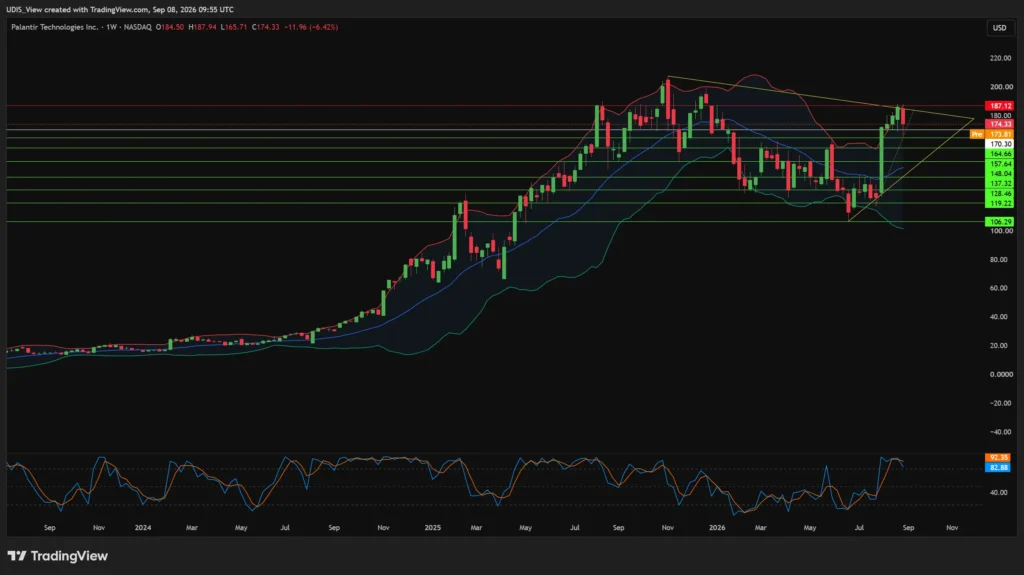
Palantir Short (Sell)
Enter At: 170.30
T.P_1: 164.66
T.P_2: 157.64
T.P_3: 148.04
T.P_4: 137.32
T.P_5: 128.46
T.P_6: 119.22
T.P_7: 106.29
S.L: 187.12