

The SpaceX valuation debate began with the largest initial public offering in history on June 12, pricing at $135 per share and raising roughly $75 billion at a valuation near $1.75 trillion. Its first quarterly report as a public company then showed revenue rising 92%.
It also showed that only one of its three businesses makes money. Starlink generated $1.656 billion of operating income while the AI segment lost $1.257 billion and the space segment lost $542 million, which means the entire structure depends on satellite broadband funding two loss-making divisions through a lockup calendar that runs to December. This analysis examines whether that works.
The SpaceX Valuation Starts With Segments
Any SpaceX valuation starts with the segment split, because the consolidated figures conceal the story.
SpaceX reported second-quarter revenue of $7.8 billion on August 4, up 92% year over year and comfortably ahead of the $6.8 billion analysts expected. Adjusted EBITDA reached $3.5 billion, up 191%. The net loss narrowed to $541 million from roughly $1 billion a year earlier.
| Segment | Q2 2026 revenue | Growth | Operating result |
|---|---|---|---|
| Connectivity (Starlink) | $4.291 billion | Up 66% | Income of $1.656 billion |
| AI | $2.561 billion | Up 247% | Loss of $1.257 billion |
| Space (launch and Starship) | $962 million | Up 29% | Loss of $542 million |
| Consolidated | $7.8 billion | Up 92% | Net loss of $541 million |
All three segments beat analyst estimates on revenue. Only one produced profit. That asymmetry is the whole investment case: Starlink is a fast-growing profitable utility, while AI and space remain capital-intensive and cash-consuming.
The Number Nobody Quotes
One Starlink metric complicates the SpaceX valuation argument, and most coverage omits it.
Starlink reached 12 million subscribers, double a year earlier, extending the competitive pressure we examined in Starlink versus AT&T and up 17% from the first quarter, with 1.7 million net additions in the quarter. Average revenue per user came in at $66, unchanged from the prior quarter but down sharply from $85 a year earlier, a decline of roughly 22%.
| Starlink metric | Q2 2026 | Year-ago |
|---|---|---|
| Subscribers | 12 million | ~6 million |
| Quarterly net additions | 1.7 million | |
| Average revenue per user | $66 | $85 |
| Segment revenue | $4.291 billion | Up 66% |
| Operating income | $1.656 billion |
Subscriber growth of 100% against revenue growth of 66% is the arithmetic of falling ARPU. SpaceX is adding users faster than it is adding revenue, which is normal as a network moves from early adopters in underserved markets toward mainstream and lower-priced tiers. It also means the funding engine scales less efficiently than subscriber counts suggest.
The Capital Problem Behind the SpaceX Valuation
Capital spending is what moved the SpaceX valuation after results, and the magnitude was unexpected.
Second-quarter capital expenditure reached $18.4 billion, against $10.1 billion in the prior quarter and roughly $13 billion that analysts had modeled. Shares rose 9.4% during the regular session to $125.33, then fell as much as 8.6% after hours once the capex figure landed.
| Balance sheet and spending | Figure |
|---|---|
| Q2 capital expenditure | $18.4 billion |
| Prior quarter | $10.1 billion |
| Analyst estimate | ~$13 billion |
| Cash and equivalents | $93.5 billion |
| Prior quarter cash | $24.7 billion |
| Debt and finance leases | $36.8 billion |
| Prior quarter debt | $22 billion |
The IPO proceeds transformed the balance sheet, lifting cash from $24.7 billion to $93.5 billion. Debt and finance leases also grew, from $22 billion to $36.8 billion. Analysts at Phillip Capital project cash staying broadly flat over four years as capital spending absorbs it, while debt rises nearly 150%, returning the company to a net debt position of roughly $3.3 billion by fiscal 2030.
The Lockup Calendar and the SpaceX Valuation
Share supply is the mechanical force acting on the price, and the schedule is unusually staged.
The main 180-day lockup expires December 8, 2026, but shares release in tranches before then: 20% after second-quarter earnings, then 7% tranches every two to four weeks from August through October, then roughly 28% triggered by third-quarter results, with the remainder on December 8. An August 6 release alone covered roughly 911 million shares.
Elon Musk’s approximately 6.4 billion shares sit under a separate 366-day lockup with no early release provisions, first becoming transferable on June 12, 2027.
The staged structure matters. Rather than one cliff, SPCX faces repeated supply events through the fourth quarter, each testing whether demand absorbs insider selling. The August 6 release passed without a collapse, which the market read as evidence of genuine demand.
Geopolitics: Italy Bypasses Europe
One agreement illustrates how SpaceX is reshaping national space policy, and it is more concrete than the frequently reported telecommunications talks.
On August 7, 2025, the Italian space agency ASI signed an agreement with SpaceX to carry Italian payloads to the surface of Mars aboard Starship. The package includes a plant growth experiment, a radiation sensor and a meteorological monitoring station, with data collected during the six-month cruise and on the Martian surface. ASI President Teodoro Valente called it a first of its kind and said it affirmed Italy’s commitment to lead in space exploration. SpaceX chief operating officer Gwynne Shotwell responded that SpaceX is now offering Starship services to the Red Planet. Musk has separately acknowledged growing operational overlap with Tesla.
The strategic significance lies in what it bypasses. Italy is the single largest contributor to the European Space Agency’s ExoMars mission, having covered roughly 40% of its cost, and that mission targets a 2028 launch. Choosing SpaceX for a separate Mars payload sidesteps the European program entirely.
Two caveats belong alongside this. SpaceX has not yet flown a commercial payload to orbit aboard Starship, let alone to another planet, a gap Rocket Lab is also working to close with Neutron. And ASI itself has been in governance upheaval, with its board resigning in August 2026 to allow appointment of career diplomat Mario Cospito as extraordinary commissioner.
Starship Flight 14 and the Bandwidth Multiplier
The operational catalyst arrives this month, and it changes the constellation economics.
SpaceX scheduled the fourteenth Starship test flight for September 22, the vehicle’s first attempt at true orbital velocity after a series of suborbital trajectories. The plan calls for six orbits at roughly 275 kilometers altitude across a ten-hour mission. Crucially, it is also the first revenue-generating Starship flight, deploying 26 next-generation Starlink V3 satellites.
| Vehicle | Payload | Bandwidth added |
|---|---|---|
| Falcon 9 | ~27 Starlink V2 Mini | 2.6 terabits per second |
| Starship Flight 14 | 26 Starlink V3 | 26 terabits per second |
| Starship at production target | 60 Starlink V3 | 60 terabits per second |
The capacity arithmetic explains why Starship matters commercially rather than symbolically. A single Starship flight delivers ten times the bandwidth of a Falcon 9 launch, rising toward twenty-three times at production scale. That is what converts Starlink from a capacity-constrained network into one that can serve direct-to-cell at scale.
A July engine ignition failure contributed to consecutive down sessions in the stock, so execution risk here is priced and immediate.
The Physics Problem and the Spectrum Answer
Direct-to-cell faces a constraint no amount of capital removes.
Terrestrial mobile networks place base stations roughly 200 feet from a handset. Low Earth orbit satellites operate hundreds of miles away. Signals traveling 220 miles weaken roughly 48,000 times compared with signals traveling one mile. T-Mobile executives have argued that satellite direct-to-cell cannot circumvent fundamental physics.
SpaceX responded with capital rather than argument, acquiring 65 MHz of nationwide mid-band spectrum from EchoStar for $17 billion. Starship then provides the lift capacity to orbit the large phased-array antennas that partially offset signal degradation.
Patents: Trade Secrets Versus Antennas
The intellectual property strategy is deliberate and revealing.
SpaceX holds roughly 166 published patent families, a fraction of what legacy aerospace contractors maintain. The concentration is striking: radio frequency, antennas, and user terminals account for about 122 families, or 73.5% of the portfolio, while rockets, propulsion, and metallurgy account for five families, roughly 3%.
| Technology domain | Patent families | Share |
|---|---|---|
| RF, antennas, user terminals | 122 | 73.5% |
| Communication protocols, direct-to-cell | 27 | 16.3% |
| Satellite structures and deployment | 12 | 7.2% |
| Rockets, propulsion, metallurgy | 5 | 3.0% |
The logic is that patents require public disclosure. Musk has argued that patenting rocket technology creates an engineering recipe book for state-funded competitors. Rapid assembly cadence, proprietary alloys, and operational tempo cannot easily be reverse-engineered from a filing. Customer-facing hardware is different, since terminals can be bought and dismantled, so SpaceX patents beamforming, RF routing, and terminal manufacturing aggressively.
SpaceX Valuation and the Bear Case
The market has been unable to settle on a SpaceX valuation since listing.
Shares priced at $135, closed the first day near $161, fell below $110 after the capex disclosure, recovered toward $133 on an Argus upgrade, and have since traded higher. Greenlight Capital’s David Einhorn criticized both the valuation and the debt ratings, arguing investment-grade status sits awkwardly with persistent negative free cash flow.
The bull case is 92% revenue growth, Starlink at 12 million subscribers producing $1.656 billion of quarterly operating income, $93.5 billion of cash, a $100 billion annualised revenue run rate targeted by year-end, and Starship about to multiply constellation capacity tenfold.
The bear case is that two of three segments lose money, ARPU fell 22% year over year, quarterly capex of $18.4 billion exceeded estimates by 40%, debt is rising toward a projected net debt position by 2030, and insider supply keeps arriving through December 8.
The Risks That Matter
- Segment concentration. Only Starlink is profitable, and it funds two loss-making divisions.
- Falling ARPU. Average revenue per user dropped from $85 to $66 year over year while subscribers doubled.
- Capital intensity. Quarterly capex of $18.4 billion exceeded analyst estimates by roughly 40%.
- Lockup supply. Staged releases continue through December 8, with Musk’s 6.4 billion shares freeing in June 2027.
- Starship execution. A July ignition failure preceded Flight 14, the first orbital and first revenue-generating attempt.
- Rising leverage. Debt and finance leases grew from $22 billion to $36.8 billion in one quarter.
- Unproven Starship commerce. No commercial payload has yet reached orbit aboard Starship.
- Political reversibility. Agreements such as Italy’s bypass European institutions and could be revisited by future governments.
Closing Thoughts
SpaceX is now three businesses inside one listing. A profitable satellite broadband utility with 12 million subscribers. An AI compute operation growing 247% while losing $1.257 billion a quarter, competing with dedicated providers such as Nebius. And a launch business that loses money on every quarter it spends developing Starship. The IPO raised enough cash to fund all three for roughly four years.
The verdict rests on one question: can Starlink’s operating income grow faster than AI and space consume capital, before the balance sheet tightens? Watch four markers into 2027: whether ARPU stabilizes near $66 or keeps falling, whether Flight 14 succeeds on September 22, whether capital spending moderates from $18.4 billion a quarter, and how the market absorbs supply through December 8. The engine works. Whether it is large enough is the open question.
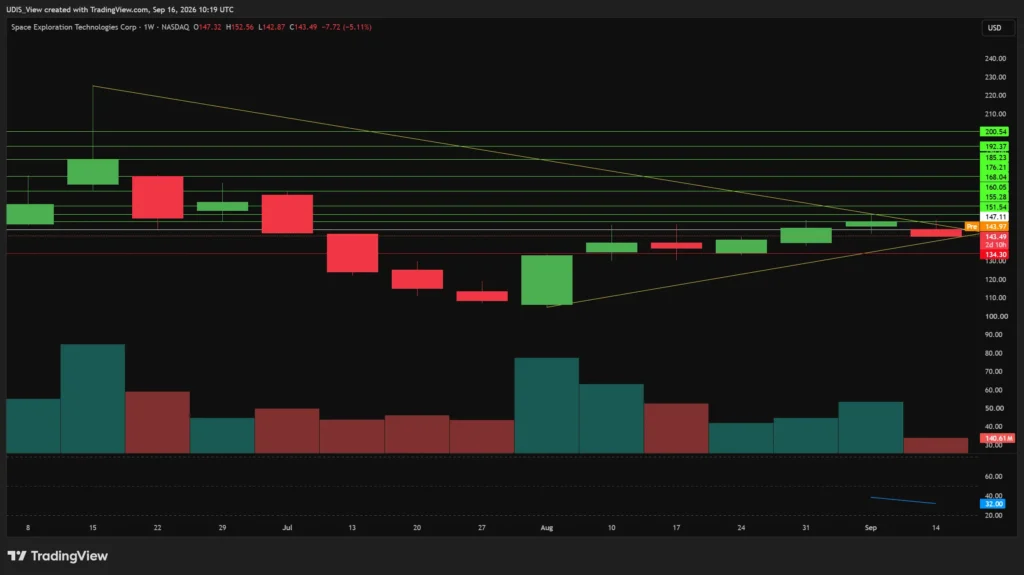
SpaceX Long (Buy)
Enter At: 147.11
T.P_1: 151.54
T.P_2: 155.28
T.P_3: 160.05
T.P_4: 168.04
T.P_5: 176.21
T.P_6: 185.23
T.P_7: 192.37
T.P_8: 200.54
S.L: 134.30