

Xanadu quantum stock has fallen roughly 80% in a year during which the company executed almost flawlessly on engineering. It signed ASML, expanded with Tower Semiconductor, launched a hardware integration layer with AMD, and won CAD 195 million from the Canadian government for a domestic fabrication plant.
The disconnect is striking. The gap is not primarily about quantum computing timelines. It is about a CAD 300 million equity facility that funds the company by selling stock into a declining market, and roughly $233 million of that capacity remains. This analysis examines whether the technical progress can outpace the dilution required to finance it.
The Xanadu Quantum Stock Collapse in Context
Start with the numbers, because Xanadu quantum stock has fallen further than the headline suggests.
Xanadu completed its public listing through a business combination with Crane Harbor Acquisition Corp in March 2026, establishing an initial enterprise value near $3.1 billion. Shares peaked at $42.44 in April before falling to roughly $8.62, within a 52-week range whose low is $6.97, a reversal from the trajectory set out in our earlier Xanadu analysis.
| Xanadu market data | Figure |
|---|---|
| 52-week high | $42.44 |
| 52-week low | $6.97 |
| Recent price | ~$8.62 to $9.05 |
| Decline from peak | ~80% |
| Market capitalization | ~$2.62 billion |
| Shares outstanding | ~304 million |
| Employees | 252 |
| Next earnings | December 2, 2026 |
The market capitalization arithmetic is worth following. At roughly 304 million shares, the current $2.62 billion valuation implies a peak market value near $12.9 billion in April. The company was never worth that on any fundamental measure, which is why the correction has been so severe.
The Financials, in the Right Currency
Xanadu reports in Canadian dollars, and the distinction matters when the share price is quoted in US dollars.
Second-quarter 2026 revenue reached CAD 1.5 million, above the CAD 1.1 million recorded a year earlier. It was, however, down from CAD 2.8 million in the first quarter, a sequential decline of roughly 46%. Revenue derives largely from research contracts and software grants rather than product sales.
| Xanadu Q2 2026 | Figure |
|---|---|
| Revenue | CAD 1.5 million |
| Prior-year quarter | CAD 1.1 million |
| Prior quarter | CAD 2.8 million, down 46% sequentially |
| Net loss | CAD 42.1 million |
| Research and development | CAD 19.7 million |
| General and administrative | CAD 11.1 million |
| Cash and equivalents | CAD 312.8 million |
| Total debt | ~CAD 37.9 million |
Trailing twelve-month revenue sits near CAD 8.5 million against a net loss running above CAD 40 million per quarter, a profile familiar from D-Wave. Management has said research and capital spending will accelerate through the second half.
The Dilution Machine Behind Xanadu Quantum Stock
Here is the mechanism that explains the share price better than any quantum timeline.
Xanadu has access to a CAD 300 million equity purchase facility with Yorkville Advisors. During the second quarter, it drew CAD 67.2 million by selling 5.5 million shares at an average price of CAD 12.28. Roughly $233 million of capacity remains available.
The structure is a standing arrangement to issue new stock into the market as cash is needed. When the share price falls, each dollar raised requires more shares, which increases the share count which pressures the price further.
This is why the technical announcements have not lifted the stock. Every positive development arrives alongside a financing mechanism that converts good news into an opportunity to issue equity. Existing holders are diluted precisely when sentiment improves enough to make issuance attractive.
Sovereign Manufacturing and Non-Dilutive Capital
The counterweight to dilution in the Xanadu quantum stock case is government money, and the company has secured a substantial amount.
The Canadian federal government committed CAD 195 million under Project OPTIMISM, part of a CAD 893 million initiative financing domestic semiconductor fabrication. The resulting 158,000-square-foot facility, named Inception, will anchor photonic chip manufacturing and packaging in Ontario, echoing the wider race to build quantum foundry capacity.
Additional non-dilutive capital flows from bilateral programs. Canadian and Japanese agencies jointly fund Xanadu’s research partnership with Mitsubishi Chemical on quantum semiconductor applications, including work on eliminating photoresist blur in advanced lithography. The National Research Council Canada co-leads materials research with Xanadu and the University of Toronto, and Xanadu has partnered with the University of Alberta on pharmaceutical discovery applications.
| Non-dilutive funding source | Amount or status |
|---|---|
| Project OPTIMISM, Canadian federal | CAD 195 million |
| Total project envelope | CAD 893 million |
| Inception facility, Ontario | 158,000 square feet |
| Canada-Japan, Mitsubishi Chemical | Joint agency grants |
| National Research Council Canada | Materials research co-lead |
| DARPA Stage C | Discussions progressing |
Management has also indicated that discussions with DARPA regarding Stage C funding are progressing, which would represent meaningful US government validation for a Canadian company.
The Manufacturing Partnerships
The engineering problem Xanadu must solve is specific, and its partner list addresses it directly.
Photonic quantum computing degrades through optical loss, the same physics constraint shaping optical interposer developers like POET Technologies. Nanometer-scale imperfections in waveguide sidewalls, known as line edge roughness, scatter photons out of the optical path through Rayleigh scattering. Every unit of loss increases the physical qubit overhead required for error correction.
On September 9, Xanadu announced a collaboration with ASML to optimize deep-ultraviolet lithography processes, improving patterning control to produce smoother sidewalls. Tower Semiconductor manufactures ultra-low-loss silicon nitride wafers on commercial lines, and EV Group supplies precision wafer bonding.
| Manufacturing metric | Status |
|---|---|
| Optical loss achieved | 0.085 dB per facet |
| Silicon nitride wafer output | ~150 per month |
| Lithium niobate wafer output | ~175 per month |
| Loss reduction target | 24.1x to 1.0x by 2030 |
| Lithography partner | ASML |
| Foundry partner | Tower Semiconductor |
| Bonding partner | EV Group |
Backline and the Integration Layer
The AMD partnership addresses a problem separate from hardware quality.
Fault-tolerant quantum computing requires classical processors to detect and correct errors within microseconds, before quantum states decohere. Xanadu and AMD released Backline, an open-source extension to PennyLane that connects quantum processors directly to AMD EPYC CPUs, Instinct GPUs, and adaptive FPGAs.
The architecture achieves round-trip loop latency below three microseconds, using zero-copy user-space memory to bypass operating system overhead and Pensando SmartNICs with RDMA for the network fabric.
Photonic systems hold a structural advantage over trapped-ion and superconducting rivals here. They operate at room temperature, eliminating the dilution refrigerators superconducting architectures require, which permits deployment configurations competitors cannot match.
PennyLane Is the Real Moat
The software position may be more defensible than the hardware.
PennyLane, Xanadu’s Python framework for quantum programming, commands more than 35,000 active users and 200,000 monthly downloads, with developer surveys attributing roughly 30.8% global market share. It has been used in high-performance computing research, including work with Oak Ridge National Laboratory on the Frontier supercomputer.
Lockheed Martin adopted PennyLane for its Quantum Talent Pipeline program, training aerospace engineers on quantum algorithms for radar and logistics applications. That embeds Xanadu’s toolchain inside a major defense prime’s workforce development.
Software mindshare compounds differently than hardware leads. Engineers trained on PennyLane carry that familiarity to whichever employer they join next, and hardware-agnostic frameworks survive even if a particular qubit architecture loses.
Valuing Xanadu Quantum Stock
Analyst coverage is bullish on price targets and cautious in direction of travel.
CIBC’s Todd Coupland initiated at Outperformer with a $22 target. Canaccord maintains a Buy while lowering its target to $34 from $45 following second-quarter results. Kingsley Crane reiterated Buy at $34. Against a share price near $8.62, those imply substantial upside, though technical indicators have registered as strongly negative.
| Firm | Rating | Target |
|---|---|---|
| Canaccord | Buy | $34, lowered from $45 |
| Kingsley Crane | Buy | $34 |
| CIBC | Outperformer | $22 |
| Current price | ~$8.62 to $9.05 |
The roadmap gives those targets something to underwrite: 200 logical qubits by 2029, more than 1,000 by 2031, fault tolerance targeted for 2028 to 2029, and optical loss reduced from 24.1 times to 1.0 times by 2030.
The bull case is CAD 312.8 million in cash, CAD 195 million of government funding, an industrial supply chain spanning ASML, Tower and EV Group, dominant open-source software mindshare, and room-temperature operation.
The bear case is quarterly revenue of CAD 1.5 million that fell 46% sequentially, a CAD 42.1 million quarterly loss, an equity facility with $233 million of remaining capacity diluting holders continuously, targets being cut rather than raised, and a fault-tolerance milestone still three years away.
The Risks That Matter
- Continuous dilution. A CAD 300 million equity facility with roughly $233 million remaining issues stock into a falling market.
- Revenue contraction. Second-quarter revenue of CAD 1.5 million fell 46% from CAD 2.8 million in the first quarter.
- Cash burn. Quarterly losses above CAD 42 million against a CAD 312.8 million balance imply limited runway without further issuance.
- Distant milestones. Fault tolerance is targeted for 2028 to 2029 and 1,000 logical qubits for 2031.
- Lockup expirations. Post-SPAC insider lockups continue to release shares into the market.
- Target reductions. Canaccord cut its target from $45 to $34 following second-quarter results.
- Technology risk. Photonic architectures remain unproven at fault-tolerant scale against superconducting and trapped-ion approaches.
- Geographic exclusion. Recent US government equity stakes went to American quantum firms, and Xanadu’s Canadian domicile may limit access to those programs.
Closing Thoughts
Xanadu has assembled something genuinely rare for a company at this stage. A lithography partnership with ASML, commercial wafer production through Tower Semiconductor, CAD 195 million of sovereign manufacturing capital, an open-source framework with 30% developer market share, and a measured optical loss milestone of 0.085 dB per facet. Room-temperature operation remains a structural advantage over cryogenic alternatives.
But the verdict rests on a question the technical roadmap does not address: can Xanadu reach fault tolerance in 2028 or 2029 without diluting existing shareholders beyond recognition? Watch three markers into 2027: whether revenue resumes sequential growth, how much of the remaining equity facility gets drawn and at what prices, and whether DARPA Stage C funding converts into non-dilutive capital. The engineering is progressing. The share count is the variable nobody is modeling.
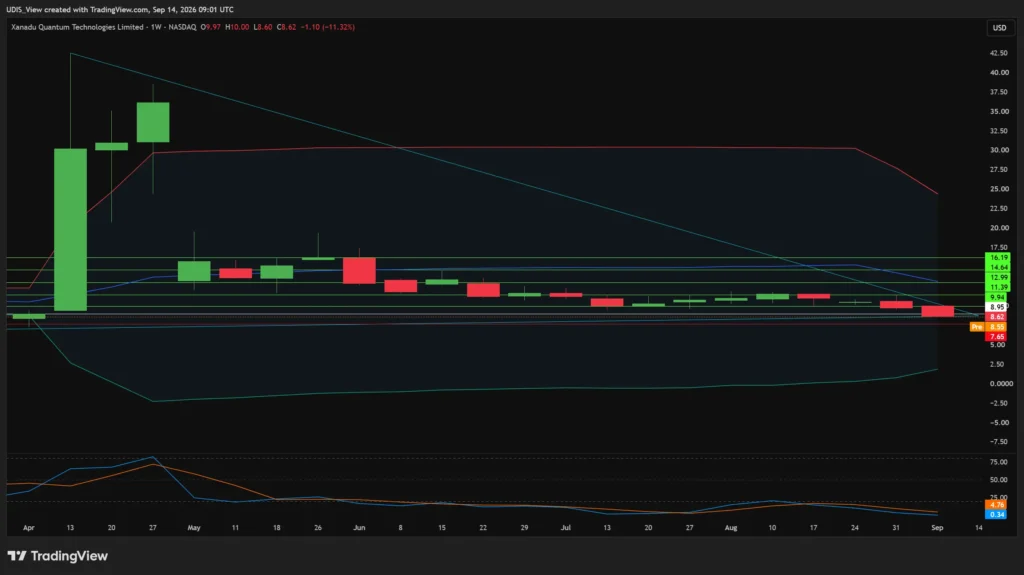
Xanadu Long (Buy)
Enter At: 8.95
T.P_1: 9.94
T.P_2: 11.39
T.P_3: 12.99
T.P_4: 14.64
T.P_5: 16.19
S.L: 7.65