

Quantum computing companies are supposed to buy physicists, not factories. The IonQ SkyWater acquisition breaks that rule, and the logic behind it may define the industry’s next phase.
On January 26, 2026, IonQ and SkyWater Technology announced a definitive agreement: IonQ will acquire the Minnesota-based foundry for roughly $1.8 billion. The world’s most prominent trapped-ion quantum company is betting that the race to useful quantum machines is now a manufacturing problem, not a physics problem. The market, mid-selloff in quantum names, is still deciding whether to believe it. It is exactly the kind of structural shift we track across our technology and markets coverage.
Inside the IonQ SkyWater Acquisition
The IonQ SkyWater acquisition is structured as a cash-and-stock offer worth $35.00 per SkyWater share, split between $15.00 in cash and $20.00 in IonQ stock, with the stock portion protected by a collar tied to IonQ’s price near closing. The headline premium is 38% to SkyWater’s 30-day volume-weighted average price. Against the last close before the announcement, $31.32, the premium was a slimmer 12%, a gap worth knowing when judging how rich the offer really is.
| Deal term | Detail |
|---|---|
| Consideration | $35.00 per share: $15.00 cash + $20.00 IonQ stock |
| Stock protection | Collar tied to IonQ’s pre-close trading price |
| Implied equity value | ~$1.8 billion |
| Premium | 38% to 30-day VWAP; ~12% to last close ($31.32) |
| Structure post-close | Wholly owned subsidiary, keeps SkyWater name |
| Leadership | CEO Thomas Sonderman stays, reports to IonQ’s Niccolo de Masi |
| Expected close | By end of September 2026 |
The path to closing has already cleared its biggest internal hurdle. SkyWater stockholders approved the merger, leaving regulatory review as the remaining gate. SkyWater will continue operating as a merchant foundry serving outside customers, a commitment both CEOs stressed to calm clients who suddenly find their supplier owned by a quantum company.
Why a Quantum Company Bought a Fab
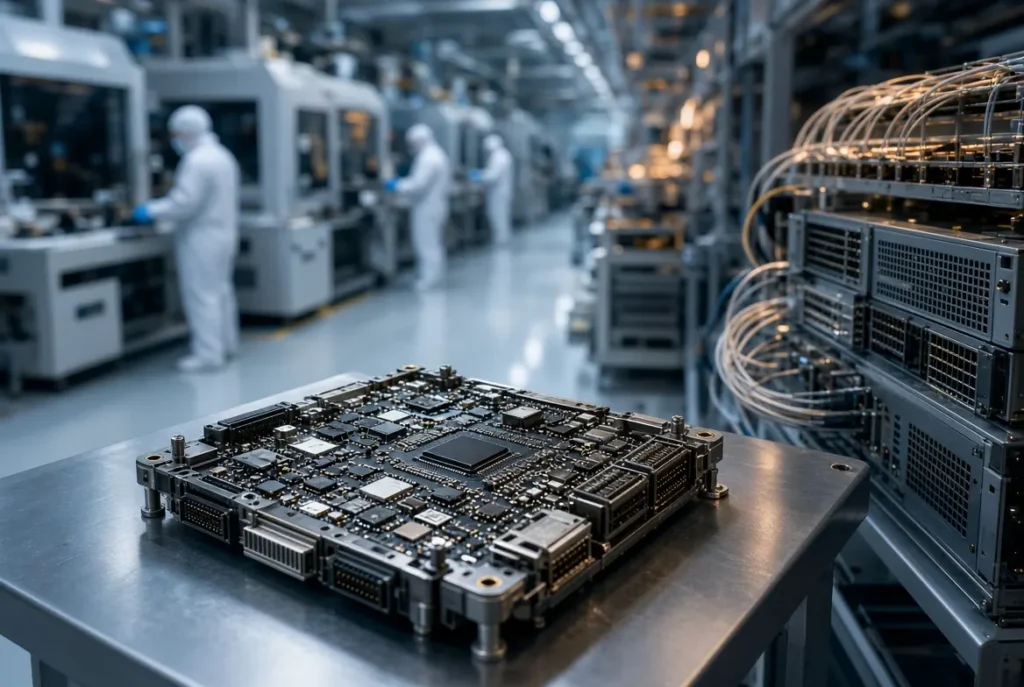
IonQ’s trapped-ion architecture stores qubits in individual atoms, but the traps themselves are semiconductor chips. Every design iteration previously meant waiting in an external foundry’s queue. That wait was becoming the bottleneck.
The numbers management put on the acceleration are specific. De Masi expects the time from design completion to first samples of IonQ’s 256-qubit chip to collapse from nine months to two. More wafer runs and parallel prototyping compress every subsequent generation. The company now expects to functionally test its first 200,000-qubit QPUs in 2028, chips designed to support more than 8,000 ultra-high-fidelity logical qubits. The two-million-qubit chip on IonQ’s roadmap gets pulled forward by up to a year.
| Roadmap milestone | Before SkyWater | With SkyWater |
|---|---|---|
| 256-qubit chip, design to first sample | ~9 months | ~2 months |
| 200,000-qubit QPU functional testing | Later timeline | 2028 |
| Logical qubits enabled at that scale | n/a | 8,000+ |
| 2,000,000-qubit chip | Prior schedule | Up to a year earlier |
De Masi frames the shift bluntly: with electronic qubit control on a semiconductor architecture, scaling to millions of qubits becomes “primarily a matter of semiconductor engineering.” Management also cites an independent review finding the parts for a two-million-qubit machine could cost under $30 million in 2025 dollars. Those are projections, not deliveries, and quantum roadmaps have slipped before. But the strategic logic is coherent: own the iteration loop, own the pace.
What IonQ Is Actually Buying
SkyWater is the largest exclusively US-based, pure-play semiconductor foundry, with fabs in Minnesota, Florida, and Texas. It holds DMEA Category 1A Trusted Foundry accreditation, the Pentagon’s designation for secure, tamper-resistant chip production, a status Sonderman highlighted on the deal call. That accreditation is the strategic crown jewel: it positions the combined company as the default quantum partner for the US government and its allies.
The financial story is louder and messier. On June 30, 2025, SkyWater closed its acquisition of Infineon’s Fab 25 in Austin, instantly becoming the largest US foundry without foreign controlling ownership. Fab 25 added $175.6 million of revenue in just two quarters, driving fiscal 2025 to a record $442.1 million, up 29%.
| SkyWater metric | FY 2024 | FY 2025 | Change |
|---|---|---|---|
| Consolidated revenue | $342.3M | $442.1M | +29% |
| Legacy SkyWater revenue | $342.3M | $266.6M | -22% |
| SkyWater Texas (Fab 25) revenue | $0 | $175.6M | New |
| GAAP gross margin | 20.3% | 19.7% | -60 bps |
| Non-GAAP gross margin | 21.0% | 20.7% | -30 bps |
| GAAP net income | $(6.8)M | $118.9M | Swing to profit |
One number in that table demands a footnote. The record $118.9 million GAAP net income rests largely on a one-time bargain-purchase gain of roughly $110.8 million, booked because SkyWater bought Fab 25 below fair value, plus a tax benefit. It is an accounting artifact, not operating profitability. Strip it out and the underlying business still runs thin margins. Note also the legacy business: revenue fell 22% as government-funded development programs slowed.
The quantum connection was already real before IonQ called. SkyWater ended 2025 with eight commercial Advanced Technology Services engagements with quantum computing companies, and quantum-related revenue grew more than 30% for the year.
The Balance Sheet Problem
The first quarter of 2026 shows both the promise and the strain, straight from the 10-Q.
| Q1 2026 metric | Value | Versus Q1 2025 |
|---|---|---|
| Revenue | $160.7M | +162% |
| Net loss attributable | $(12.3)M | Widened 68% |
| Adjusted EBITDA | $13.0M | Improved |
| Interest expense | $6.2M | +240% |
| Revolver drawn | $182.4M | Elevated |
| Cash on hand | $22.2M | Thin |
Revenue nearly tripled, powered by $86.3 million from the Texas fab, and beat estimates by almost 10%. Yet the loss widened as integration costs and tripled interest expense ate the gains. With $182.4 million drawn on the revolver against $22.2 million of cash, SkyWater is running a capital-intensive expansion on a leveraged balance sheet. IonQ’s deeper pockets are part of the acquisition’s logic.
Institutional money split on the story. Lountzis Asset Management fully liquidated its SkyWater position, per its filing. Vazirani Asset Management opened a new 125,000-share position after shareholders approved the merger. One saw integration risk; the other saw a discounted claim on $35.
The Sector Land Grab
The IonQ SkyWater acquisition did not happen in a vacuum. Quantum stocks sold off hard in early 2026 as capital rotated away from speculative technology, with short interest elevated across the group. Yet beneath the falling prices, the sector’s cash-rich players raced to buy manufacturing.
| 2026 quantum hardware M&A | Buyer | Value | Status |
|---|---|---|---|
| SkyWater Technology | IonQ | ~$1.8B | Shareholders approved, closing expected by Sept |
| Luminar Semiconductor | Quantum Computing Inc. | $110M cash | Completed Feb 2 |
| NHanced Semiconductors | Quantum Computing Inc. | $73.1M + up to $72M earnouts | Completed June 23 |
| Quantum Circuits | D-Wave Quantum | Undisclosed | Completed January |
Quantum Computing Inc. is the most aggressive smaller mover. Flush with roughly $1.4 billion after capital raises, it bought Luminar’s photonics arm out of the parent’s Chapter 11 process, added NuCrypt, and then acquired advanced-packaging specialist NHanced as its “Fab 2.” D-Wave, whose quarterly product revenue remains tiny at a few million dollars, bought Quantum Circuits in January to expand from annealing into gate-model machines.
The pattern is unmistakable. Every serious player concluded the same thing at once: whoever controls domestic fabrication controls the scaling timeline. IonQ simply wrote the biggest check.
The Technology and Security Moat
Beyond speed, SkyWater brings capabilities that map directly onto national-security demand.
Its partnership with Multibeam deploys multicolumn electron-beam lithography, a maskless patterning approach that can embed unique chip IDs during fabrication for lifecycle traceability, a direct answer to counterfeiting and tampering threats. A federal CHIPS Act award of roughly $16 million is funding cleanroom and IT modernization at the Bloomington headquarters.
The research pipeline reaches further. SkyWater collaborates with QuamCore on a digital superconducting controller built from Single Flux Quantum devices, designed to operate natively at temperatures near 10 millikelvin inside the cryostat. It works with Silicon Quantum Computing on hybrid quantum-classical fabrication, contributing superconducting resonators and tailored wafers. A DARPA-backed program at SkyWater built 3D chips interweaving carbon nanotubes with resistive RAM, targeting fifty-fold gains in compute efficiency by removing the memory bottleneck. An IP license from Infineon, signed alongside the Fab 25 purchase, adds silicon-proven mixed-signal design blocks, and Weebit Nano’s ReRAM is already integrated in SkyWater’s S130 process for radiation-tolerant edge memory.
The Risks That Matter
The IonQ SkyWater acquisition still carries real failure modes, however strategic it looks.
- Regulatory gate. Shareholder approval is done, but the close still requires regulatory clearance, and any delay pushes past the September target.
- Roadmap credibility. The 200,000-qubit and two-million-qubit milestones are management projections. Quantum timelines across the industry have a history of slipping.
- Stock-heavy consideration. SkyWater holders take $20 per share in IonQ equity. The collar limits, but does not remove, exposure to IonQ’s volatile stock.
- Merchant-foundry tension. Rival quantum firms among SkyWater’s eight ATS clients must now buy from a competitor’s parent. Some may migrate.
- Leverage and losses. SkyWater’s widening net loss, tripled interest expense, and thin cash demand disciplined integration.
- Legacy erosion. Legacy revenue fell 22% in 2025 as development programs slowed; Fab 25 masks, but does not fix, that trend.
- Sector sentiment. The early-2026 quantum selloff shows how fast capital exits the theme. A weak tape raises IonQ’s cost of any future funding.
Closing Thoughts
Strip away the quantum vocabulary, and this is a classic vertical-integration bet. IonQ concluded that fab access, not qubit physics, sets its speed limit, and paid $1.8 billion to own the constraint. SkyWater gets a capital-rich parent for a leveraged expansion it could barely finance alone.
The thesis now runs on a visible clock. Watch the regulatory clearance against the end-of-September close, then the first integrated wafer runs, then whether 200,000-qubit test chips actually appear in 2028. For SKYT holders, the trade is the spread to $35 and the collar math. For IONQ holders, the question is simpler and harder: does owning the factory make the roadmap real, or just more expensive? The 2028 test date will answer it.
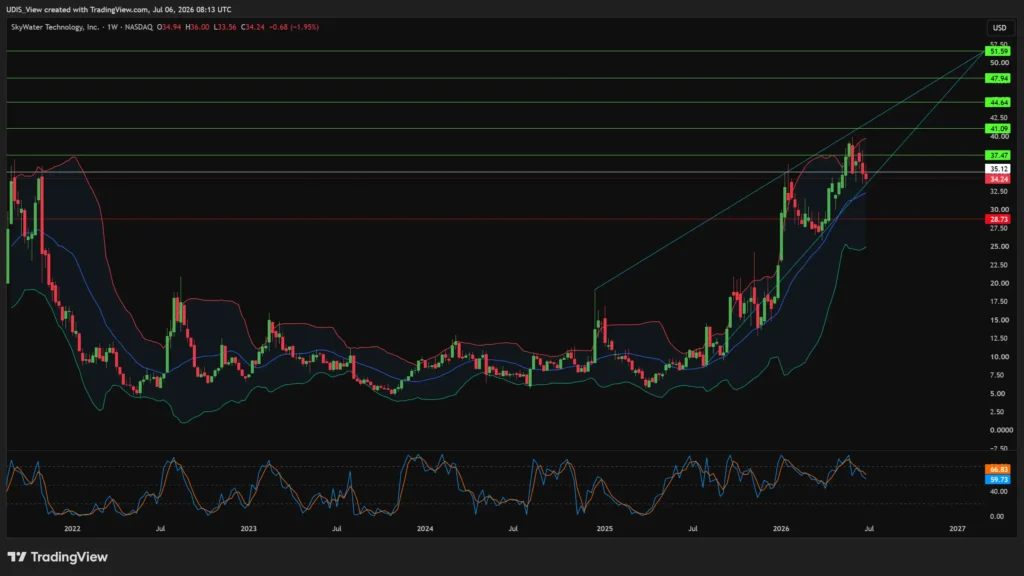
SkyWater Technology Long (Buy)
Enter At: 35.12
T.P_1: 37.47
T.P_2: 41.09
T.P_3: 44.64
T.P_4: 47.94
T.P_5: 51.59
S.L: 28.73