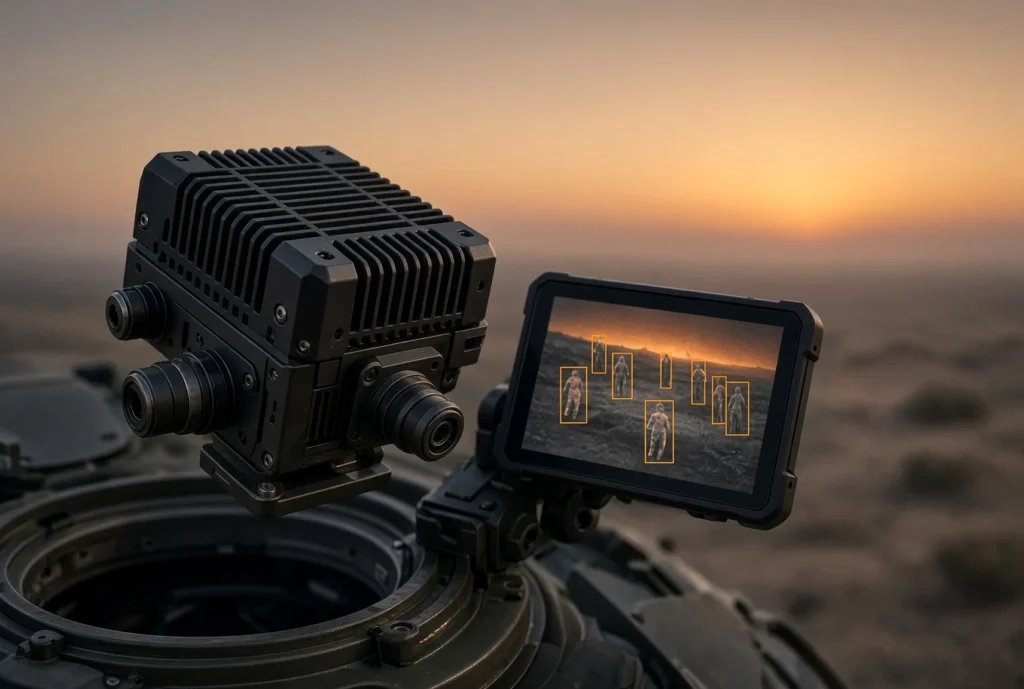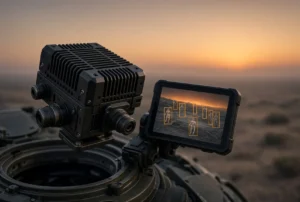


An Archer Aviation eVTOL air taxi maker just unveiled an autonomous attack helicopter, and Wall Street noticed. Can a defense pivot save Archer Aviation stock? The shares have lost roughly half their value in a year.
Archer Aviation trades near $5, close to its 52-week low, down about 47% over twelve months. Yet on July 20, 2026, Archer and Anduril unveiled Thunder, a Group 5 autonomous attack rotorcraft, and the stock jumped as much as 20% in a session. This analysis separates the genuine strategic progress from the still-formidable financial risk, and asks whether the dual-use story justifies owning ACHR before its August earnings. It sits within our broader autonomous defense coverage.
The Thunder Reveal: A Real Pivot
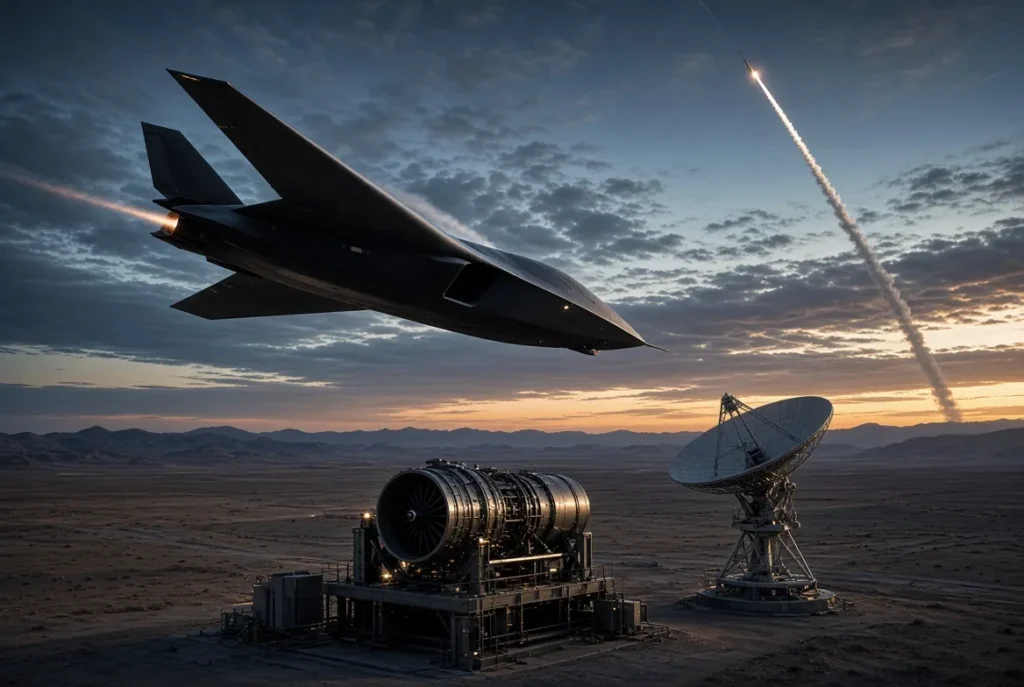
The centerpiece is a defense partnership that changes how investors should frame the company. At the Farnborough International Airshow, Anduril Industries and Archer unveiled Thunder, a clean-sheet autonomous attack rotorcraft built to fly alongside crewed helicopters like the AH-64 Apache.
Anduril’s maneuver-dominance chief Shane Arnott summarized it bluntly: Thunder has “the range of a Cheyenne, the speed of a Cheyenne, but the payload equivalency of the Apache.” The specifications are serious hardware, not concept art.
| Thunder capability | Detail |
|---|---|
| Classification | Group 5 autonomous air vehicle (over 1,320 lb) |
| Main payload options | Up to 10 air-to-ground missiles, 76 APKWS II rockets, or 16 launched effects |
| Missile types | AGM-114 Hellfire, AGM-179 JAGM, or Anduril Barracuda-100M |
| Speed | Over 200 knots |
| Range | Thousands of nautical miles |
| Powertrain | Series hybrid-electric with tilting rotors |
| Transport | Fits inside a standard shipping container |
| Role | Autonomous wingman to crewed attack helicopters |
One correction to the popular narrative matters here. Thunder is a clean-sheet design, not a militarized version of Archer’s Midnight air taxi. It shares engineering DNA with the Archer Aviation eVTOL platform: the series hybrid-electric powertrain and optimum-speed tiltrotors. But it is a purpose-built combat aircraft. The nose bay can carry a dozen counter-drone effectors. Modular bays accommodate electronic warfare and ISR payloads. The two companies first teamed up in December 2024, and Thunder is the result.
Why Defense Changes the Timeline
The strategic logic is about time, and time is the resource Archer is shortest on. The Archer Aviation eVTOL program has burned cash for years chasing an uncertain approval.
Passenger air taxis face a long, uncertain FAA certification process before they can carry a paying customer. Military platforms do not. Defense procurement runs on a separate track, and autonomous systems that keep pilots out of “the robotic kill zone” are exactly what militaries are rushing to buy after watching drones reshape modern combat. The US Army cancelled its Future Attack Reconnaissance Aircraft program in 2024 and has been patching the gap ever since, precisely the opening Thunder targets. It is the same shift powering the wider autonomous weapons market.
Archer’s defense push extends beyond Thunder. The company opened an engineering hub in Bristol, United Kingdom, to support the British Army’s Project NYX uncrewed-rotorcraft program, working with GKN Aerospace and Anduril. Anduril was one of four companies shortlisted for NYX in May 2026, and Thunder’s design visibly aligns with that British pursuit of robotic wingmen for its Apache fleet.
The Financial Reality Check
Now the sobering half, because the Thunder enthusiasm has to be weighed against the balance sheet and the burn.
Archer’s first quarter of 2026 showed a company still deep in its cash-consuming development phase. Revenue was just $1.6 million, essentially pre-commercial, while the net loss widened to $217.7 million and total operating expenses reached $256.2 million.
| ACHR Q1 2026 metric | Result |
|---|---|
| Revenue | $1.6 million |
| Net loss (GAAP) | $217.7 million |
| Adjusted EBITDA loss | $172.5 million (within $160-180M guidance) |
| Total operating expenses | $256.2 million |
| Liquidity | ~$1.78 billion |
| Operating cash used | $149.1 million |
| Q2 2026 EBITDA loss guidance | $170 million to $200 million |
The Cash Cushion and the Clock
The one genuinely strong number is liquidity. Archer ended the quarter with roughly $1.78 billion in cash, equivalents, and short-term investments, against limited debt of about $122 million. At the first quarter’s combined $181.7 million of operating cash use and capital spending, that balance funds roughly ten quarters, or about two and a half years, of runway. That cushion is the reason Archer can pursue defense, AI, and certification simultaneously without an immediate capital raise.
The stock tells the harder story. ACHR trades near $5 with a market capitalization around $3.5 billion, which means its cash alone accounts for roughly half its market value. The shares fell about 30% in June on a broad rotation out of speculative growth names, with little company-specific bad news. Q2 results are due August 6, 2026, and management has guided to another Adjusted EBITDA loss of $170 million to $200 million.
The AI Layer: Zee and the Software Bet
Beyond aircraft, Archer is building a software story designed to raise margins and attract a different kind of investor.
In July 2026, the company unveiled Zee, an AI foundation model purpose-built for aviation. It is designed to give the Archer Aviation eVTOL fleet an onboard brain. Zee ingests airspace data, air-traffic-control radio calls, maps, weather, and telemetry. It runs offline on aircraft hardware without cloud connectivity, solving the latency gaps that plague autonomous flight. Archer trains it on a global network of roughly 6,000 ADS-B receivers. The effort is led by former Apple engineer Mario Srouji. Former Meta AI research director Ruslan Salakhutdinov advises the team.
The AI stack is reinforced by three marquee partners. NVIDIA is integrating its IGX Thor platform for onboard compute, Starlink will provide low-Earth-orbit connectivity for Midnight, and Palantir was named a finalist for the FAA’s SMART AI project tied to the Department of Transportation’s roughly $20 billion air-traffic-control modernization effort.
The Archer Aviation eVTOL Moat: Charging and Certification
Two less glamorous efforts may matter as much as the aircraft, because they address whether electric aviation can actually scale.
On infrastructure, Archer launched America’s Consortium for Electric Skyways, or ACES, with BETA Technologies and Macquarie Capital. The consortium aims to build more than 250 interoperable charging sites across the United States by 2030, using BETA’s charging hardware on the open CCS standard, with Macquarie arranging investment capital. The open, shared model echoes the early Tesla Supercharger playbook and prioritizes core markets like California and New York.
On regulation, Archer is leading its domestic peers. It became the first eVTOL company to close Phase 3 of the FAA’s four-phase Type Certification process for Midnight, and it is now in Phase 4, formal testing and compliance. Archer expects to begin initial US operations later in 2026 under the White House’s eIPP program, in preparation for its designated role as the official air taxi provider of the LA28 Olympic Games. Abroad, the UAE’s civil aviation regulator created a Restricted Type Certificate framework to let Midnight enter limited commercial service, with Abu Dhabi Aviation managing early routes. Rival Joby Aviation is racing along a parallel certification path.
Valuation and the Skeptics’ Case
Here the bull and bear cases collide, and both are legitimate.
The bull case: Archer has about $1.78 billion in cash, a genuine defense partnership with Anduril, FAA certification leadership, a credible AI software layer, and an infrastructure consortium, all for a market capitalization of roughly $3.5 billion, half of which is cash. Analysts’ consensus one-year target sits near $10 to $11, with at least one firm reaffirming an $18 target on the expanding commercial-and-defense opportunity. If even one pillar, defense orders, US commercial launch, or AI licensing, delivers, the upside is large.
The bear case: the company generates almost no revenue, loses over $170 million a quarter, and depends on multiple unproven bets paying off before the cash runs out. The stock has a beta above 3, meaning it swings violently with market sentiment, and it has already fallen roughly 47% in a year. Thunder is a concept reveal, not a signed defense contract, and phased government awards are only “anticipated.” Competitors including Vertical Aerospace, Joby, and EHang are chasing the same eVTOL future.
The Risks That Matter
- Cash burn. Over $170 million per quarter in Adjusted EBITDA loss against $1.6 million of revenue; the roughly 2.5-year runway is a countdown, not a guarantee.
- Contracts not yet signed. Thunder is an unveiled platform; government awards are anticipated, not booked. A concept is not a purchase order.
- Certification risk. FAA Phase 4 remains unfinished, and passenger service still depends on completing it.
- Extreme volatility. A beta above 3 means the stock amplifies every market swing, as June’s 30% drop on no company news showed.
- Dilution. A pre-revenue company burning this fast may eventually return to markets for capital, diluting shareholders.
- Competition. Joby, Vertical Aerospace, EHang, and others target the same commercial and defense openings.
- Execution across fronts. The thesis requires aircraft, defense, AI, and infrastructure to advance together, a demanding ask for one company.
Closing Thoughts
Archer Aviation has done something few pre-revenue companies manage. The Archer Aviation eVTOL business built a second act before the first one earned a dollar. Thunder gives it a defense path that sidesteps the FAA bottleneck. Zee gives it a software story, and ACES gives it an infrastructure moat. The $1.78 billion balance gives it time to pursue all three. The 20% pop on the Thunder reveal shows investors will reward that optionality.
But the verdict rests on a single tension: can Archer convert unveiled platforms and anticipated awards into real revenue before its cash cushion thins? Watch the markers into 2027: the August 6 earnings and burn rate, any signed defense contract flowing from Thunder or Project NYX, the start of US commercial operations under eIPP, and progress toward FAA Phase 4 completion. Archer has assembled an impressive set of bets. For the stock, the question is no longer vision. It is execution against a clock that never stops running.

Archer Long (Buy)
Enter At: 5.85
T.P_1: 6.98
T.P_2: 8.05
T.P_3: 8.91
T.P_4: 9.90
T.P_5: 10.60
T.P_6: 11.34
T.P_7: 12.16
T.P_8: 12.86
T.P_9: 13.76
S.L: 2.80