

The 355-Ship Deficit and HII Positioning
The Structural Shortfall
The U.S. Navy confronts a structural shipbuilding deficit. No amount of budget rhetoric can paper over the gap. The fleet remains well short of its 355-ship Navy goal.
Great power competition intensifies across the Indo-Pacific. Legacy yards struggle to accelerate production. Labor shortages and design complexity now constrain the entire industrial base.
The Only Scaled Builder
Huntington Ingalls Industries (HII) has emerged as the answer. The company combines proven hulls with serial production. HII is the only scaled prime positioned to close the gap at speed.
The market still treats HII as a slow industrial giant. The reality looks very different. HII operates as a technology integrator, not a legacy shipyard.
Any Huntington Ingalls investment analysis must credit execution speed. The USS Ted Stevens delivery proved that point. Therefore, investors should treat execution as the core HII moat.
Arleigh Burke Flight III Dominance and AN/SPY-6 Radar Superiority
The Arleigh Burke-class destroyer remains the workhorse of the fleet. Ingalls Shipbuilding masters this platform. The program has entered the Flight III era.
The First Moat
The Arleigh Burke Flight III is not a simple upgrade. The hull looks familiar, yet the capability changes completely. The AN/SPY-6 radar drives the entire transformation.
The radar delivers 30 times the sensitivity of the legacy SPY-1D. GaN radar technology powers that leap. Higher sensitivity lets the destroyer detect stealthier targets far earlier.
The performance edge reshapes naval missile defense. The ship now tracks hypersonic and saturation threats. As a result, the Flight III becomes a dedicated missile hunter.
Table 1: Radar Evolution, AN/SPY-1D vs AN/SPY-6(V)1
| Feature | AN/SPY-1D (Legacy) | AN/SPY-6(V)1 (Flight III) | Operational Impact |
|---|---|---|---|
| Technology | Passive phased array | Active electronically scanned array | Instant beam steering |
| Semiconductor | Gallium arsenide | Gallium nitride (GaN) | Higher power density and range |
| Sensitivity | Baseline | 30 times more sensitive | Earlier detection of stealthy targets |
| Voltage | Baseline | 30% higher voltage | Greater radiated power |
| Uptime | Baseline | 15% more uptime | Higher operational availability |
| Tracking capacity | High | More than 100 targets | Defeats saturation attacks |
| Threat set | Cruise and ballistic | Hypersonic, ballistic, and drone | Future-proofs the fleet |
Delivery and Backlog
Ingalls delivered USS Ted Stevens (DDG 128) in late 2025. The ship was the second Flight III destroyer in the fleet. Four more hulls sit in fabrication, and seven sit in pre-planning.
The integration demanded major engineering work. HII redesigned the interior, the grid, and the cooling plants. The company kept the existing hull form to minimize program risk.
Table 2: Arleigh Burke Flight III Program Status and Backlog
| Program Stage | Quantity | Revenue Significance |
|---|---|---|
| Delivered (Flight III) | USS Ted Stevens (DDG 128), late 2025 | Confirms transition mastery |
| Under fabrication | 4 ships | Near-term production revenue |
| Pre-planning | 7 ships | Multi-year revenue visibility |
| Hull length | 509.5 feet | Larger combatant footprint |
| Displacement | 9,700 tons | Power and cooling for SPY-6 |
The economic case extends beyond the platform. A 2025 report credited SPY-6 ships with protecting trade. The report cited a 45% reduction in successful attacks by hostile groups.
The same protection covers $1.2 trillion in annual trade flows. The radar tracks drones and missiles at once. Consequently, sensor dominance justifies the full cost of each ship.
The Legend-Class Frigate Pivot and Program Validation
The Navy made a stunning pivot in late 2025. Navy leadership canceled the troubled Constellation-class frigate. The Navy then selected the proven HII Legend-class design.
The Second Moat
The Constellation-class promised a quick win. The design instead grew too complex. Delays mounted and costs rose across the program.
Navy Secretary John Phelan announced the change. He cited the Legend-class as a proven American-built ship. Therefore, the Navy now rewards execution over theoretical perfection.
A Warm Production Line
The Legend-class National Security Cutter is a known quantity. Ingalls has delivered 10 cutters to the Coast Guard. A warm line, fixed supply chain, and documented build times beat any new design.
CEO Chris Kastner called the design stable and producible. The hull provides immediate distributed lethality capacity. The Legend-class frigate offers a fast track toward the 355-ship Navy goal.
Table 3: Legend-Class Frigate Base Specifications
| Metric | Specification | Strategic Relevance |
|---|---|---|
| Length | 418 feet | Ocean-going capability |
| Beam | 54 feet | Stability in rough seas |
| Displacement | 4,500 to 4,700 long tons | Sufficient payload capacity |
| Speed | 28-plus knots | Keeps pace with task forces |
| Range | 12,000 nautical miles | Global reach without tankers |
| Endurance | 60 to 90 days | Sustained independent patrols |
The award leverages existing Ingalls infrastructure. HII already builds the DDG 51, the LHA, and the LPD at Pascagoula. The new frigate line sits beside the destroyer line and shares the same workforce.
Industrial Execution, Distributed Shipbuilding, and Backlog Strength
The U.S. industrial base faces a real labor shortage. Shipyards struggle to hire welders and fitters. HII attacked the problem directly.
The Distributed Shipbuilding Strategy
HII concluded that one yard cannot build everything. The company now outsources structural module work. Distributed shipbuilding expands the industrial base beyond a single location.
HII doubled its outsourced hours during 2025. The company plans to quadruple those hours within two years. Therefore, HII can scale throughput without overloading the main yard.
Investment drivers behind the industrial execution moat include:
- A network of 23 manufacturing partners across multiple states
- Doubled outsourced hours in 2025, with a plan to quadruple by 2027
- A $1 billion facility upgrade program at Ingalls
- Technology transfer talks with HD Hyundai Heavy Industries
- Wage increases that improved retention of skilled trades
Beyond surface ships, HII also supports the nuclear domain. The Newport News division builds carriers and submarines. Therefore, the naval nuclear propulsion base widens the HII moat.
The Workforce Battle
First-year attrition for shipbuilders ran near 50% to 60%. HII raised wages in mid-2025. Retention of skilled trades improved almost immediately after the raise.
Kastner described the new approach as paying for experience. HII now favors apprentice-school and community-college graduates. As a result, naval backlog execution rests on a more stable workforce.
Table 4: Key Naval Positions and Revenue Visibility
| Program | Status | Revenue Visibility |
|---|---|---|
| Flight III destroyers | 4 in fabrication, 7 in pre-planning | Booked into the next decade |
| Legend-class frigate | New build based on the NSC | Roughly a 20-year production line |
| Amphibious ships (LHA, LPD) | Active at Pascagoula | Stable, recurring construction |
| Legend-class cutters | 10 delivered to the Coast Guard | Warm line plus future refits |
| Maintenance and refits | Sole technical-data holder | High-margin recurring annuity |
Geopolitical Drivers and the Golden Fleet Strategy
HII does not operate in a vacuum. Global events drive the HII order book. The world has grown more dangerous.
The China Challenge and the Red Sea Lesson
China launches more naval tonnage than the United States each year. The Arleigh Burke Flight III answers that buildup directly. The Flight III tracks Chinese hypersonic missiles, so the Navy keeps ordering it.
Houthi attacks in the Red Sea reshaped naval thinking. Cheap drones now threaten billion-dollar ships. The Navy consequently needs both numbers and depth, not only exquisite platforms.
The Division of Labor
The Golden Fleet concept calls for distributed lethality. The Navy wants more sensor nodes and more shooters. The Navy cannot risk a destroyer on every routine mission.
HII supplies the hull volume through the Legend-class frigate. Raytheon supplies the SPY-6 radar for the Flight III destroyers. This division of labor matches the Pentagon shift toward distributed maritime operations.
HII also extends the fleet through unmanned systems. The company unveiled the Romulus surface vessel family in September 2025. The Odyssey autonomy software turns HII into both the platform and the operating system.
Table 5: Romulus 190 USV Capabilities
| Capability | Specification | Mission Application |
|---|---|---|
| Length | 190 feet | Open-ocean stability |
| Speed | 25-plus knots | Transit and intercept |
| Range | 2,500-plus nautical miles | Long-duration surveillance |
| Payload | Four 40-foot ISO containers | Modular mission packages |
| Autonomy | Odyssey control system | COLREGS-compliant navigation |
HII reinforces the position through the Remus undersea family. HII has sold more than 700 Remus vehicles to 30 countries. The Odyssey system logs over 6,000 operational hours across 23 vessel types.
The undersea mission rewards specialized suppliers. The field spans subsea intelligence and autonomous underwater systems. Therefore, the undersea segment deepens the broader naval shipbuilding opportunity.
Valuation Discount and the Huntington Ingalls Investment Analysis
Any Huntington Ingalls investment analysis starts with the valuation gap. HII carries strong fundamentals and a long backlog. The discount reflects skepticism about execution risk.
The Valuation Disconnect
Defense primes usually trade at high multiples. Peers such as Northrop Grumman and L3Harris span a wide valuation range. HII screens cheaper than the industry average while posting a higher growth estimate.
The Flight III ramp drives the first leg of revenue. The Legend-class frigate adds a second engine. The unmanned business then supplies a third independent growth driver.
Table 6: Valuation Multiples and Peer Comparison
| Metric | HII | General Dynamics | Northrop Grumman | Industry Average |
|---|---|---|---|---|
| P/E ratio | ~24.2x | 21.8x | 20.5x | 37.6x |
| Growth estimate | 11.19% | 7.55% | 5.22% | ~8% |
| Market cap | ~$13.6B | $90B-plus | $90B-plus | n/a |
Revenue Visibility and the Maintenance Annuity
Shipbuilding runs on long contract cycles. Ingalls holds a backlog that reaches into the 2030s. Signed contracts let HII plan capital and reward shareholders with confidence.
HII does not only build ships. HII also maintains and refits them. The Navy cannot go elsewhere, since HII owns the technical data.
The aging Arleigh Burke fleet needs continuous upgrades. The Legend-class cutters need scheduled refits. This service revenue carries high margins and balances new-construction economics.
Risks, Catalyst, and Outlook
No Huntington Ingalls investment analysis stands without clear risks. Investors should weigh the downside drivers directly. The execution moat reduces, but does not remove, these risks.
Risks that investors should monitor include:
- Labor availability at Pascagoula and Newport News as the binding constraint
- Wage inflation that could compress margins on fixed-price contracts
- Concentrated exposure to a single customer, the U.S. Navy
- Any shift in acquisition strategy toward foreign yards
- A possible reprioritization away from manned platforms
Investors who prefer diversified exposure have another route. A broad defense sector ETF spreads single-name risk. However, HII offers the most direct leverage to naval shipbuilding and defense market implications.
The Forward Catalyst
The following points reflect forward-looking market expectations, not guarantees. The decisive catalyst arrives in the second half of 2026. Investors expect the first Legend-class-based frigate block award in that window.
The next Flight III destroyer should reach sea trials around the same period. HII holds both the proven hull and the radar integration in serial production. Investors who wait for the re-rating will likely pay a higher multiple for the same cash flows.
The Bottom Line
HII closes the most urgent gap in American sea power. The Flight III program secures cash flow for a decade. The Legend-class frigate then opens a fresh chapter of growth.
This Huntington Ingalls investment analysis ends on an attractive valuation. The catalysts look durable rather than speculative. For investors, naval shipbuilding and defense market implications point squarely toward HII.
Sources
The following authoritative outlets informed this naval shipbuilding and defense analysis:
- United States Naval Institute (USNI News), news.usni.org
- Center for Strategic and International Studies (CSIS), csis.org
- Naval News, navalnews.com
- DefenseScoop, defensescoop.com
- The National Interest, nationalinterest.org
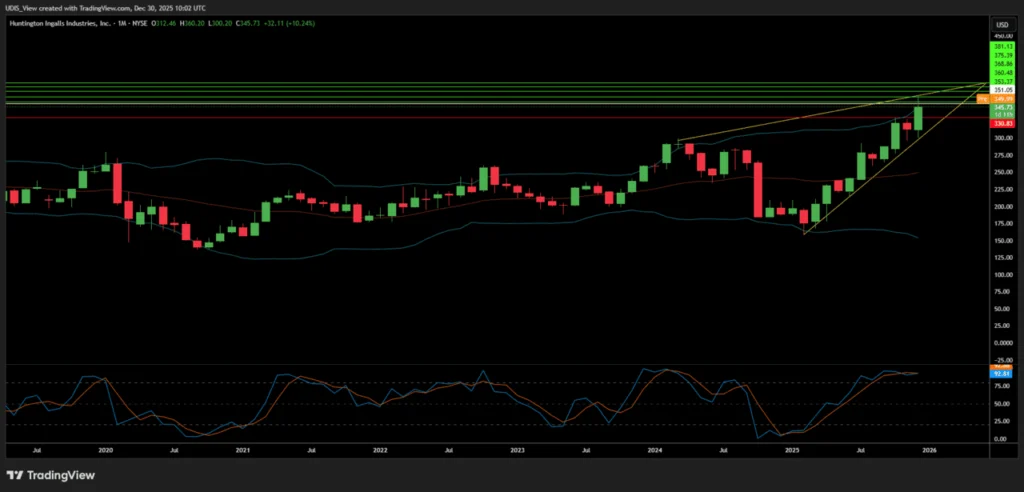
Huntington Ingalls Industries Long (Buy)
Enter At: 351.05
T.P_1: 353.37
T.P_2: 360.48
T.P_3: 368.86
T.P_4: 375.39
T.P_5: 381.13
S.L: 330.83