

Honeywell Quantum Navigation reached a milestone this month that no competitor has matched. The company separated from its parent on June 29 and opened as high as $238.19. It last closed near $158.50, down roughly 41% over ninety days.
In that same period, the company flew an aircraft for four hours and twenty-three minutes with no GPS, using the Earth’s crustal magnetic field to navigate, and improved position accuracy by 89% over conventional backup systems. The technology is genuinely ahead of anything a competitor has fielded. The financial performance since the spin-off has been the opposite, with profit margins falling from 16.8% to 10.9% and adjusted operating profit declining 7%. This analysis weighs both.
The Debut and What Followed
Start with the separation, because the timeline explains the sentiment.
Honeywell distributed one share of Honeywell Aerospace for every two shares of Honeywell common stock held on the June 15 record date. Regular-way trading on Nasdaq under HONA began June 29, following a when-issued close of $221.01. The stock opened higher and reached $238.19 intraday. The parent renamed itself Honeywell Technologies and retained the HON ticker.
| HONA since separation | Figure |
|---|---|
| Regular-way trading began | June 29, 2026 |
| Distribution ratio | 1 HONA per 2 HON shares |
| When-issued close | $221.01 |
| Debut intraday high | $238.19 |
| Recent close | ~$158.50 |
| 90-day return | Down 41.3% |
| Year-to-date return | Down 20.8% |
Chief executive Jim Currier and chief financial officer Josh Jepsen lead a company employing more than 36,000 people across more than 10,000 customers, headquartered in Phoenix. HONA entered both the Nasdaq-100 and the S&P 500 on separation.
The Quarter That Broke the Story
The first results as an independent company landed on August 5, and the market reacted harshly.
Backlog reached $18.2 billion, up 9% year over year, with trailing twelve-month orders up 8% led by defense and space, a pattern also visible at GE Aerospace. Sales grew mid-single digits. But adjusted operating profit fell 7%, including roughly $100 million of separation-related costs, and management cited supply constraints limiting output.
| Honeywell Aerospace Q2 2026 | Result |
|---|---|
| Backlog | $18.2 billion, up 9% |
| Trailing twelve-month orders | Up 8% |
| Sales growth | Mid single digits |
| Adjusted EBIT | Down 7% |
| Separation costs included | ~$100 million |
| Defense and Space revenue | $1.817 billion |
| Profit margin trend | 16.8% to 10.9% |
The margin compression is the number that matters. A pure-play aerospace supplier is supposed to earn better margins once freed from conglomerate overhead, not worse ones. Management attributes the pressure to supply chain constraints and expects recovery from 2027, supported by investments in supplier tooling and multi-sourcing, the same bottleneck affecting aerospace component suppliers broadly.
Balance sheet observations add to the caution. Analysis of the post-separation accounts notes that liabilities exceed assets and that debt is not well covered by operating cash flow.
The Honeywell Quantum Navigation Breakthrough Is Genuine
Here is what the share price decline obscures. Honeywell quantum navigation achieved a legitimate technical first.
Honeywell flew a commercial Embraer 170 from Seattle north through the Gulf of Alaska and back, navigating for four hours and twenty-three minutes without GPS. The Defense Innovation Unit reported an 89% improvement in aircraft position accuracy compared with conventional inertial backup.
The physics is straightforward in principle. Earth’s crust carries a unique magnetic signature at every coordinate, created by tectonic structure, volcanic basalt and mineral deposits, and those anomalies remain stable over geological timescales. Honeywell’s quantum magnetometers use optical vapor cells containing rubidium atoms, illuminated by tuned lasers to detect atomic spin-state shifts, measuring nanotesla fluctuations in the ambient field. The system compares live readings against preloaded crustal charts held in avionics memory.
| Navigation method | Signal dependence | Jamming exposure | Long-flight accuracy |
|---|---|---|---|
| GPS | Orbital satellites | Severe | High while signal holds |
| Inertial navigation | None | None | Drifts over time |
| Quantum MagNav | None, passive sensing | None, cannot be spoofed | 89% drift reduction |
Because the system reads a natural field rather than receiving a broadcast, it cannot be jammed or spoofed. Adversaries cannot alter the magnetic properties of the Earth’s crust.
Pentagon Demand for Honeywell Quantum Navigation
Defense demand for Honeywell quantum navigation and its rivals has become explicit, and Honeywell holds several positions.
The Defense Innovation Unit launched its Transition of Quantum Sensing program in early 2024, seeking prototypes delivering positioning in contested theaters. Honeywell competed against 72 rival firms and won the flagship prototype award. Rivals including Infleqtion are pursuing the same requirement. Honeywell subsequently secured two further research initiatives, QUEST, advancing quantum-enabled magnetic anomaly algorithms, and CRUISE, developing miniature quantum inertial measurement units with Vector Atomic.
| Defense program | Scope |
|---|---|
| DIU Transition of Quantum Sensing | Flagship prototype, won against 72 rivals |
| QUEST | Quantum-enabled magnetic anomaly algorithms |
| CRUISE | Miniature quantum IMUs with Vector Atomic |
| Next validation | Boeing C-17 demonstration flights |
| FY2027 Air Force budget | $391.1 billion, up 38% |
| Proposed 2026 NDAA total | $1.15 trillion |
Following prototype testing, demonstration flights are scheduled aboard a military Boeing C-17 transport, extending validation from a regional jet to a strategic airlifter relevant to Indo-Pacific missions.
The budget backdrop is unusually favorable, and it is lifting order books across the sector, including at RTX. The 2026 National Defense Authorization Act proposes a record $1.15 trillion US defense budget, and the fiscal 2027 Department of the Air Force budget stands at $391.1 billion, a 38% increase lifting munitions, sustainment, and readiness spending.
The Software Layer Behind Honeywell Quantum Navigation
Making Honeywell quantum navigation work on a flying aircraft is harder than making it work in a laboratory.
Jet engines, hydraulic actuators and avionics generate intense magnetic interference inside an airframe, and traditional calibration requires maneuvers that burn fuel and disrupt schedules. Honeywell addresses this by integrating software from Q-CTRL, whose Ironstone Opal engine cancels platform self-interference in real time using AI.
Q-CTRL reports the software improves sensor resilience in motion roughly twenty-fold and maintains bounded positioning uncertainty near 0.03% of distance traveled. Notably, the technology carries no ITAR or EAR export restrictions, which permits sales to allied airlines and defense partners without licensing friction.
Honeywell has also designed for retrofit economics. Pilots view magnetic navigation data on standard cockpit tablets rather than integrated displays, avoiding structural rewiring and the regulatory recertification that would otherwise ground aircraft.
The Problem Being Solved
Demand exists because satellite navigation has become unreliable in exactly the places aviation cannot avoid.
Conflicts across Eastern Europe, the Middle East and the Persian Gulf have made electronic warfare routine. GPS satellites orbit roughly 12,500 miles above Earth broadcasting weak signals, and commercial jammers costing very little can blind receivers from miles away. Over 1,000 commercial flights face satellite navigation disruption daily, and one study cited by Business Insider values a single-day GPS outage at $1 billion.
Spoofing is the more dangerous variant. Rather than denying signal, adversaries inject fraudulent position data into autopilots and flight computers, causing aircraft to stray toward closed airspace or trigger spurious terrain warnings. Crews must then manually cross-check beacons.
Portfolio and Intellectual Property
Honeywell’s broader positioning extends beyond navigation.
The company acquired CAES Systems for $1.9 billion, adding radio frequency components and electromagnetic countermeasures for defense platforms. Its patent estate spans avionics, sensors and propulsion, including US Patent 12,560,433 covering methods for reconciling ground-level magnetic survey charts with readings taken at altitude, a computational step without which airborne sensors cannot match terrestrial anomaly maps. US Patent 11,300,639 covers an integrated photonics tensor magnetometer connecting laser distribution waveguides across multiple quantum sensors on a single wafer, reducing package volume, weight and power draw.
Honeywell Technologies, the former parent, retains its interest in Quantinuum, the trapped-ion quantum computing venture formed with Cambridge Quantum in 2021. That holding sits with the parent rather than with HONA.
Valuing Honeywell Quantum Navigation Against the Fall
The gap between analyst targets and the share price is unusually wide.
HONA last closed near $158.50 against an average twelve-month target of $211 across fifteen analysts, implying roughly 26% upside, with some published mean targets as high as $245. In June, the stock traded near 22 times forward earnings. Simply Wall St notes the price-to-earnings ratio now sits below both industry and peer averages.
| Valuation marker | Figure |
|---|---|
| Recent close | ~$158.50 |
| Average analyst target | $211 across 15 analysts |
| Implied upside | ~26% |
| Higher published mean target | $245 |
| Forward P/E, June | ~22x |
| Current P/E versus peers | Below industry average |
The bull case is an $18.2 billion backlog growing 9%, orders up 8%, defense and space strength against a record proposed defense budget, a demonstrated navigation capability no competitor has flown, and management guidance for margin recovery from 2027.
The bear case is that margins halved from 16.8% to 10.9%, adjusted operating profit fell 7%, supply constraints persist, liabilities exceed assets, debt coverage from operating cash flow is weak, and the shares have lost 41% in ninety days while all of this was disclosed.
The Risks That Matter
- Margin compression. Profit margins fell from 16.8% to 10.9%, with adjusted operating profit down 7%.
- Supply constraints. Management cited limited output as the primary drag, with recovery guided only from 2027.
- Balance sheet. Liabilities exceed assets, and debt is not well covered by operating cash flow.
- Separation costs. Roughly $100 million of one-time charges hit the first standalone quarter.
- Commercial cyclicality. Exposure to aircraft production rates, airline profitability and delivery pace remains.
- Revenue timing. MagNav is validated but not yet a disclosed revenue line, and C-17 demonstrations come first.
- Momentum. A 41% ninety-day decline indicates institutional repositioning rather than a temporary dislocation.
- Budget dependence. The defense case assumes the proposed $1.15 trillion budget survives appropriation intact.
Closing Thoughts
Honeywell quantum navigation has achieved something no competitor has matched. It flew a commercial aircraft for more than four hours without GPS, improved position accuracy 89% against conventional backup, beat 72 rivals to the Defense Innovation Unit’s flagship prototype award, and packaged the result so pilots read it on a tablet rather than requiring an avionics refit. The threat it addresses is documented daily across contested airspace.
The verdict rests on one question the technology cannot answer: can a supplier whose margins fell from 16.8% to 10.9% convert an $18.2 billion backlog into profit before investors lose patience? Watch four markers into 2027: whether operating margin recovers toward the 26.5% level posted in the first quarter, whether supply constraints ease as management projects, whether MagNav appears as a disclosed revenue contributor, and whether the C-17 demonstration proceeds on schedule. The science is proven. The income statement is not.
NFA. DYOR. This analysis is for informational purposes only and is not investment advice. Sources include Honeywell Aerospace SEC filings, including its Form 8-K of June 14, 2026, second quarter 2026 results reported August 5, Defense Innovation Unit and Department of War statements; Aviation International News; Q-CTRL technical disclosures; and Simply Wall St and stockanalysis.com data as cited.
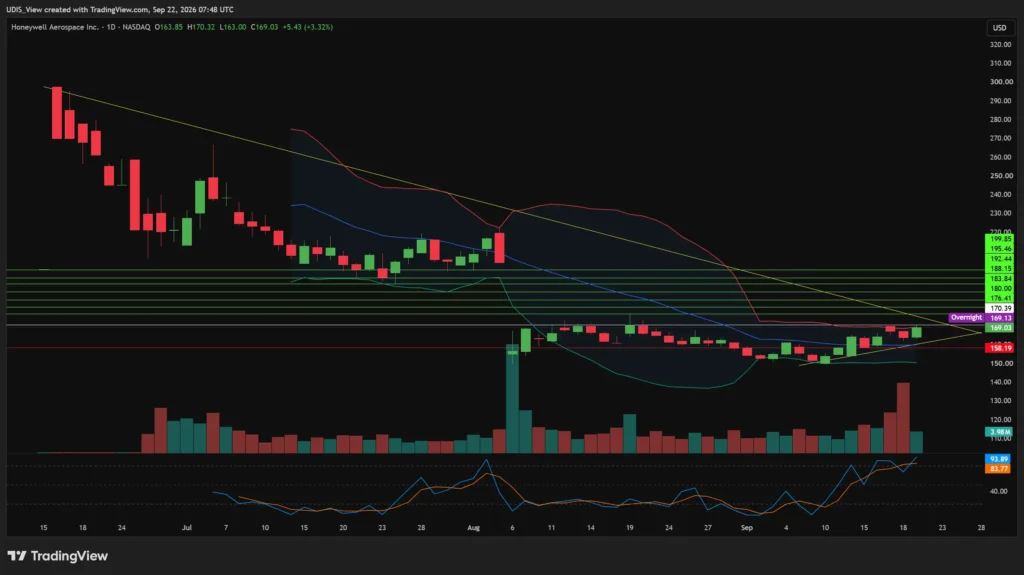
Honeywell Long (Buy)
Enter At: 170.39
T.P_1: 176.41
T.P_2: 180.00
T.P_3: 183.84
T.P_4: 188.15
T.P_5: 192.44
T.P_6: 195.46
T.P_7: 199.85
S.L: 158.19