

Overview
Eaton Corporation (NYSE: ETN) has fundamentally reshaped its identity, moving beyond its legacy as a cyclical machinery manufacturer to become a critical enabler of the AI and electrification super-cycles. This transformation places the company at the intersection of three massive secular trends: the energy transition, the re-industrialization of North America, and the explosive growth of artificial intelligence. Investors once viewed Eaton through the lens of GDP-linked industrial cycles, but the current market environment demands a new framework focused on long-duration infrastructure spending and technological moats.
The convergence of these trends has decoupled the stock from traditional industrial peers, driven by the “electrification of everything.” Large-scale drivers, such as the doubling of global grid capacity required by 2050 and the urgent need to power AI “factories,” provide a structural floor for revenue growth. Management refers to this as a “growth super-cycle,” where demand is dictated by physics and policy rather than consumer sentiment. Therefore, understanding Eaton today requires analyzing it not as a machinery stock, but as a critical technology enabler for the digital economy.
“What are the best AI infrastructure stocks to buy right now and in 2026 as grid modernization and data center demand accelerate?”
This article categorizes and evaluates the opportunity by dissecting Eaton’s financial performance, its strategic spinoff of the Mobility Group, and its valuation relative to peers.
- Key Growth Segments: How AI and grid modernization drive revenue.
- Valuation Frameworks: Comparing ETN to pure-play data center stocks.
- Strategic Catalysts: The impact of the 2026 Mobility Group spinoff.
- Risk Management: Navigating geopolitical trade friction and supply chains.
The Macro-Strategic Landscape: Riding the Super-Cycle
Convergence of Secular Megatrends
Eaton’s strategic thesis is predicated on the simultaneous acceleration of electrification, energy transition, and digitalization. Unlike previous industrial upcycles driven by general GDP growth, this cycle is structural, driven by physics and policy. The fundamental driver is the “electrification of everything,” where energy consumption shifts from molecules to electrons. This requires a massive expansion of the electrical grid, which must double or triple in capacity to accommodate electric vehicles (EVs) and industrial electrification. Eaton’s portfolio has been curated to serve this specific need, moving away from generating power to managing it through distribution, protection, and optimization.
Simultaneously, the “re-industrialization” of Western economies, specifically the United States, has created a capital expenditure boom not seen since the post-WWII era. Driven by national security concerns and supply chain fragility, corporations are reshoring manufacturing capacity. Each new semiconductor fab, battery plant, or assembly line requires complex electrical infrastructure: switchgear, transformers, and power quality systems. Eaton, with its deep entrenchment in the North American industrial base, is the primary beneficiary of this trend.
Policy as a Tailwind: The IIJA and IRA
Macroeconomic policy in the United States has transitioned from laissez-faire to active industrial policy, creating a floor for Eaton’s revenue streams. The Infrastructure Investment and Jobs Act (IIJA) allocates significant funding specifically for grid modernization and billions more for EV charging and water infrastructure. The Inflation Reduction Act (IRA) provides tax credits that subsidize both the manufacturing of clean energy equipment and its deployment. These legislative packages act as a counter-cyclical buffer; even if the broader economy softens, the deployment of federal funds for infrastructure projects is legally mandated. Eaton has actively capitalized on this, securing millions in tax credits for its own manufacturing expansions, directly linking its capacity growth to federal industrial strategy.
Best AI Infrastructure Stocks: Why Eaton Leads
The AI and Data Center Singularity
Superimposed on these trends is the explosive emergence of Artificial Intelligence (AI) as a dominant consumer of power. AI is not merely a software phenomenon; it is a physical infrastructure challenge. Training large language models (LLMs) requires massive computational power, which translates directly into electrical load and heat. Traditional data centers operate at power densities of 5–10 kilowatts (kW) per rack, but AI “factories” utilizing next-generation architectures demand densities exceeding 100 kW per rack. This order-of-magnitude increase necessitates a complete retrofit of the power train, from the utility substation down to the chip-level voltage regulator. Eaton’s “Grid to Chip” strategy positions it as an indispensable partner in this build-out.
800-Volt DC Architecture
To address these power density challenges, Eaton is pioneering a fundamental shift in how electricity is distributed within data centers. The standard for decades has been 480V AC (Alternating Current), but the physics of AI workloads make this legacy standard inefficient. Eaton, in collaboration with NVIDIA, is driving the adoption of 800V DC (Direct Current) architectures. The shift to higher voltage DC offers critical advantages in efficiency and space optimization. By distributing DC power at higher voltages closer to the chip, Eaton eliminates conversion steps, reducing energy waste in facilities that consume hundreds of megawatts. This technology also allows for thinner cabling, freeing up valuable space in server racks for more compute capacity.
Modular Data Centers: The Industrialization of Construction
To address the desperate need for speed in deploying AI capacity, Eaton has moved into the “prefabricated” or “modular” data center space. Through strategic acquisitions and investments, Eaton offers containerized power modules that can be deployed rapidly. Instead of building a stick-built electrical room on-site, which takes months and requires scarce skilled labor, Eaton builds the entire power block in a factory. It is shipped to the site on skids, integrated with cooling and IT racks, and plugged in. This “industrialization of construction” reduces deployment timelines by 30–50% and bypasses the bottleneck of local labor shortages, a critical advantage in the race to build AI infrastructure.
Financial Performance and Valuation
Fiscal Year 2025 Performance Review
The fiscal year 2025 served as a validation of Eaton’s strategic pivot, delivering financial results that decoupled from the broader industrial sector. The company delivered strong earnings per share (EPS) growth, reflecting its ability to drive pricing power and operational efficiency. More significantly, organic growth accelerated, driven primarily by volume rather than just inflationary pricing. The quality of this earnings growth is evident in the margin profile; segment margins reached record levels, expanding significantly year-over-year. This performance underscores the company’s ability to capitalize on the high demand for electrical infrastructure.
Segment Analysis: The Divergence of Fortunes
A granular analysis of segment performance reveals the “two-speed” nature of Eaton’s portfolio before the Mobility spinoff. The Electrical Americas segment is the engine of Eaton’s growth, benefiting directly from the US data center and re-industrialization boom. Sales and operating margins in this segment have surged, with backlogs growing substantially, providing exceptional visibility into future revenues. In stark contrast, the legacy Vehicle segment has faced headwinds, with sales declines and margin compression seen in Q4 2024 results. This divergence underscores the strategic imperative behind the spinoff; the cyclical drag of the vehicle business was masking the compounding growth of the electrical franchises.
Valuation Re-Rating and Peer Comparison
The market has recognized Eaton’s transformation, rewarding it with a significant valuation multiple expansion. Eaton now trades at a Price-to-Earnings (P/E) ratio that represents a profound shift from its historical trading range, where it was grouped with slow-growth machinery conglomerates. Eaton is now priced in a “hybrid” category higher than traditional industrials but lower than pure-play data center proxies. Investors are effectively paying a premium for Eaton’s “quality” and lower volatility compared to pure-plays, while still accessing the same secular growth themes.
Table 1: Valuation and Peer Benchmarking (Feb 2026)
| Company | Ticker | P/E Ratio (Est.) | Primary Thesis Driver | Risk Profile |
| Eaton Corp | ETN | 37.2x | Grid & AI Power | Medium (Balanced) |
| Vertiv Holdings | VRT | ~65x | Pure-Play Data Center | High (Concentrated) |
| Schneider Electric | SBGSY | ~30x | Digital Automation | Medium (Global) |
| Emerson Electric | EMR | ~22x | Industrial Automation | Low (Cyclical) |
Source: Nasdaq and Seeking Alpha Peer Comparison
Strategic Catalyst: The Mobility Spinoff
The Mechanics of Separation
In early 2026, Eaton announced the definitive spinoff of its Mobility Group into a standalone public company. This separation is the capstone of a decade-long portfolio optimization strategy. The logic is rooted in “multiple arbitrage,” where Eaton’s electrical business deserves a tech-like valuation multiple, while its vehicle business drags down the aggregate multiple. By separating them, the market can value the “New Eaton” purely on its electrical growth thesis, likely resulting in a higher sum-of-the-parts valuation. This move frees the electrical business to focus entirely on the high-growth opportunities in data centers and grid modernization.
The Future of “Mobility Co.”
The spun-off entity will be a formidable player in its own right, retaining leadership in commercial vehicle transmissions and engine air management. Crucially, it takes with it the “eMobility” unit, the division responsible for EV gearing, inverters, and power distribution units for electric trucks. While this business faces secular headwinds in internal combustion engines (ICE), it is a cash cow. The strategy for the new company will likely focus on maximizing free cash flow from the legacy ICE business to fund the transition to EV components. It will be an attractive asset for value-oriented investors, contrasting with the growth-oriented profile of the remaining Eaton.
Geopolitics and Risks: Navigating a Fragmented World
The Return of Protectionism
As of 2026, the global trading environment has deteriorated into a regime of neo-mercantilism, often referred to as “Trump 2.0.” The resurgence of “America First” policies has instituted a baseline of high tariffs and trade friction. For a global corporation like Eaton, this presents a complex duality of risk and opportunity. Eaton’s heavy investment in US manufacturing insulates it from the worst effects of protectionism, allowing it to adhere to “Buy American” mandates and qualify for federal contracts. However, universal tariffs on imports raise the Cost of Goods Sold (COGS), and if the global economy slows due to trade wars, margin compression becomes a tangible risk.
Supply Chain Vulnerability
Eaton has navigated the US-China decoupling by adopting a rigorous “In Region, For Region” strategy. The company maintains a significant presence in China, exemplified by its Changzhou smart factory, but increasingly ring-fences this capacity to serve the domestic Chinese market. To serve North American and European markets, Eaton has aggressively expanded its “China Plus One” footprint, scaling manufacturing in Mexico and India. This redundancy comes at a capital cost but provides essential resilience. If a geopolitical crisis were to sever trans-Pacific trade, Eaton’s regionalized supply chains would theoretically allow it to continue operations in the West, albeit with disruption to electronic components.
Cybersecurity as a Safety-Critical Function
As the grid digitizes, it becomes a vector for cyber warfare, making cybersecurity a core engineering discipline. Eaton established a “Cybersecurity Center of Excellence” and was the first in the industry to achieve UL 2900 certifications for its connected products. These rigorous standards verify that the device’s firmware is hardened against penetration and uses secure encryption. For customers in critical infrastructure, these certifications are becoming mandatory procurement requirements. By standardizing on UL 2900, Eaton creates a barrier to entry for lower-cost competitors who cannot meet these stringent security benchmarks.
Conclusion and Outlook
Capitalizing on the Electric Era
Eaton Corporation stands as a paragon of industrial adaptability, positioning itself as the indispensable “arms dealer” of the energy transition. In a world fragmenting along geopolitical lines and scrambling to electrify, Eaton has successfully insulated itself from traditional industrial cycles by tethering its fortunes to long-duration capital expenditure super-cycles. The “New Eaton,” freed from its combustion-engine legacy through the Mobility spinoff, is poised to be a defining industrial titan of the electric age.
Actionable Next Steps
For the professional investor, Eaton offers a rare combination of defensive infrastructure characteristics and aggressive technology-led growth. While the stock is priced for perfection, the underlying physics of the energy transition suggest that the demand for Eaton’s solutions will outpace global GDP for the next decade. Investors should monitor the Electrical Americas backlog and the execution of the spinoff as key indicators of continued momentum.
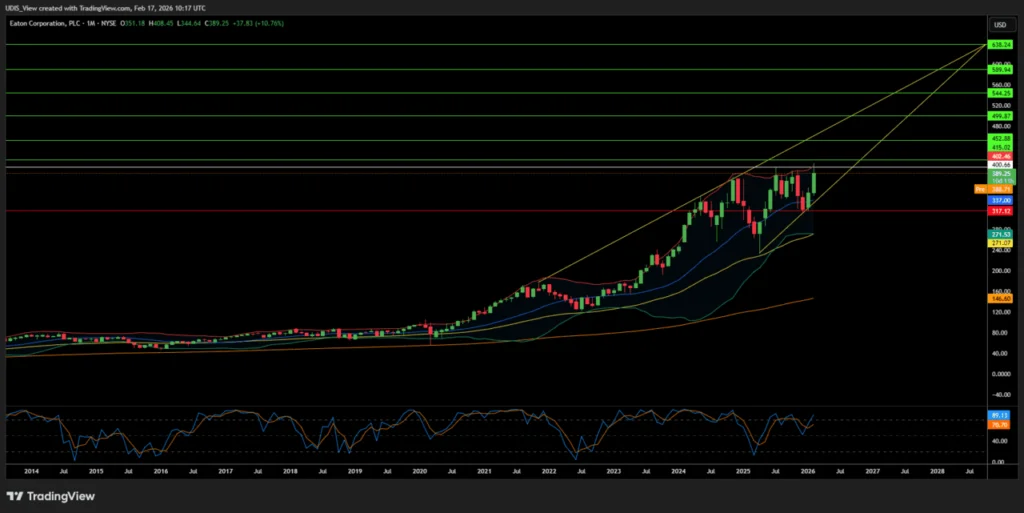
Eaton Long (Buy)
Enter Aat: 400.66
T.P_1: 415.02
T.P_2: 452.88
T.P_3: 499.87
T.P_4: 544.25
T.P_5: 589.94
T.P_6: 638.24
S.L: 317.12