

1. The Convergence of Conflict and Innovation
The global security architecture is fracturing. We are witnessing the definitive end of the post-Cold War peace dividend. Nations are aggressively pivoting from counter-insurgency operations to preparation for high-intensity, peer-to-peer conflict. In this volatile arena, Elbit Systems Ltd. (NASDAQ: ESLT) has emerged as a singular force. It is not merely a participant in the defense industry; it is a primary architect of modern survival.
Elbit Systems operates at the precise intersection of geopolitical instability and technological maturation. Its diverse portfolio aligns perfectly with the harsh lessons learned from recent battlefields in Eastern Europe and the Middle East. Modern armies require active protection for their vehicles. They demand secure, jam-resistant communications. They urgently need directed energy solutions to counter swarming drone threats. Elbit Systems provides all of these capabilities today.
Financial results from 2024 and 2025 confirm this upward trajectory. The company has secured record-breaking order backlogs exceeding $25 billion. It has closed massive multi-year contracts, including a cryptic yet transformative $2.3 billion strategic agreement. Revenue growth is accelerating across all operational vectors: land, air, cyber, and space.
This report offers an exhaustive analysis of Elbit Systems. We dissect the financial architecture driving its stock valuation. We analyze proprietary technologies, from the Iron Beam laser to the Iron Fist active protection system, which create wide competitive moats. We explore the geopolitical currents lifting the company’s order book. This is the definitive guide to the strategic ascent of Elbit Systems.
| Metric | Q3 2025 Performance | Implication |
| Revenue | $1.92 Billion | sustained double-digit growth |
| Backlog | $25.2 Billion | unprecedented revenue visibility |
| Non-GAAP EPS | $3.35 | Liquidity crisis concerns are resolved |
| Cash Flow | $461 Million (9mo) | liquidity crisis concerns are resolved |
2. Geostrategy: The End of Attrition
2.1 The Shift to Large-Scale Combat Operations (LSCO)
The fundamental nature of warfare is changing. Recent conflicts have exposed the severe limitations of legacy military platforms. Heavy armor is vulnerable without active protection. Unencrypted communications are death sentences for command posts. Air superiority is no longer guaranteed for Western powers.
Elbit Systems thrives in this chaotic environment. The company specializes in asymmetric solutions that alter the cost-benefit analysis of combat. It does not just build platforms; it builds the neural networks that make legacy platforms survivable. The market is aggressively shifting away from “heavy metal” toward digital lethality. Elbit’s focus on C4I (Command, Control, Communications, Computers, and Intelligence) places it at the center of this revolution.
2.2 The European Re-Armament
European defense budgets are expanding at rates unseen since the 1980s. The NATO guideline of spending 2% of GDP on defense is now a floor, not a ceiling. By 2025, virtually all NATO allies are expected to meet or exceed this benchmark. Germany has committed to a €100 billion special defense fund. Poland is targeting a massive 4.5% of GDP for defense spending.
This spending is not uniform; it is highly targeted. European nations are prioritizing three specific areas where Elbit dominates:
- Ammunition stockpiles: Replenishing stocks drained by aid to Ukraine.
- Digitization: Modernizing antiquated analog command structures.
- Force Protection: Shielding vehicles from Anti-Tank Guided Missiles (ATGMs).
Elbit Systems has deeply entrenched itself in the European industrial base. It operates active subsidiaries in Germany, the UK, and Sweden. This local presence allows it to bypass “buy American” preferences. It secures contracts as a domestic entity. The recent $150 million contract for CV90 protection in Europe serves as a prime example of this strategy.
2.3 The Asian Maritime Pivot
The Asia-Pacific region represents the world’s maritime powder keg. Nations here face a distinctly different threat profile compared to Europe. The focus is on naval skirmishes, island defense, and long-range surveillance. Elbit has successfully adapted its portfolio for this theater.
Recent wins in the region demonstrate this adaptability. A $275 million electronic warfare contract highlights the demand for maritime survival tools. Analysis suggests this contract likely equips the Philippines Navy’s AW159 Wildcat helicopters. This upgrades their survivability against increasingly sophisticated regional threats. The demand signal from Asia is clear. They need maritime patrol capabilities. They need airborne surveillance. They need robust helicopter self-protection. Elbit’s agnostic approach to platform integration allows it to upgrade Western and Eastern platforms alike.
3. Macroeconomics: The “War Premium”
3.1 Inflation and Fixed-Price Contracts
The defense sector has struggled with inflation. Long-term fixed-price contracts can become liabilities if material costs soar. Elbit Systems has navigated this macroeconomic minefield with surprising agility. The company’s margin expansion suggests effective supply chain management. Non-GAAP operating margins rose to 9.7% in Q3 2025, up from 8.2% the previous year. This indicates that Elbit is passing costs on to customers or finding internal efficiencies. The shift to software-defined solutions helps here. Software has high initial R&D costs but near-zero marginal replication costs. This insulates the company from raw material inflation.
3.2 Currency Fluctuations and Hedging
Elbit reports in US Dollars but incurs costs in New Israeli Shekels (NIS). A weakening Shekel often benefits Elbit by lowering its local labor costs relative to its dollar revenue. Conversely, a strong Shekel can compress margins. The current financial results show a sophisticated hedging strategy. Financial expenses decreased in Q3 2025. This reduction was mainly due to a lower average net debt. This effective capital management protects the bottom line from currency volatility.
3.3 The Valuation Multiple Expansion
Elbit trades at a premium compared to typical industrial stocks. The forward P/E ratio hovers around 53x. This is significantly higher than the broader market average. However, this premium is justified by the “defense super-cycle.”
Investors are paying for three distinct attributes:
- Security: The $25.2 billion backlog ensures revenue stability for years.
- Growth: Double-digit top-line expansion is rare in mature industrials.
- Technology: Elbit is priced more like a tech firm than a manufacturer.
The market recognizes that Elbit is selling software, algorithms, and lasers. These high-margin technologies command higher multiples than bending steel for tanks. The stock’s performance reflects a fundamental repricing of defense assets.
4. Financial Analysis: A Fortress Balance Sheet
4.1 Revenue Velocity
The company is not just booking orders; it is executing them. Revenue in Q3 2025 hit $1.92 billion. This represents a solid 12% increase year-over-year.
Segment Performance (Q3 2025):
- Land Systems: +41% growth. This is the star performer, driven by ammunition and vehicle upgrades.
- C4I and Cyber: +14% growth. Digital army contracts in Europe are accelerating deliveries.
- Aerospace: -3% decline. This was due to lower PGM sales in Asia, offset by gains in Israel.
The massive growth in Land Systems validates the strategic focus on artillery and ammunition. High-intensity warfare consumes munitions at staggering rates. Elbit is feeding this hunger.
4.2 Cash Flow Resurrection
The most critical financial improvement is in liquidity. Defense contracts are capital-intensive. Companies must often front the cash for materials. In the first nine months of 2025, operating cash flow hit $461 million. This is a 458% increase from the $82.5 million generated in the same period of 2024. This massive jump indicates that Elbit has overcome supply chain bottlenecks. They are delivering products and getting paid faster. This liquidity allows for aggressive R&D reinvestment without relying on expensive debt.
4.3 The Backlog Composition
Financial visibility is the holy grail of defense investing. Elbit has achieved it. The $25.2 billion backlog represents years of guaranteed production. Crucially, 38% of this backlog is scheduled for execution before the end of 2026. This provides a concrete floor for revenue projections. The backlog acts as a powerful buffer against short-term economic fluctuations. Even if global orders slow, Elbit has enough work to sustain growth for years.
5. Technology: The Iron Beam Revolution
5.1 Breaking the Cost Curve
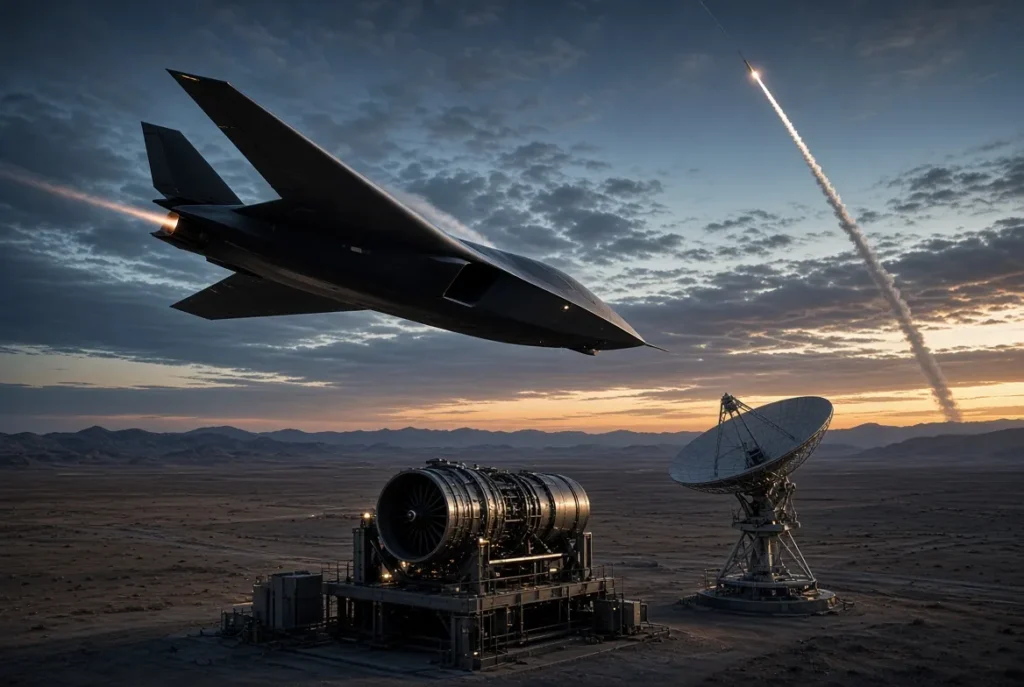
Air defense has traditionally suffered from a fatal cost asymmetry. An attacker fires a $1,000 rocket. The defender fires a $50,000 interceptor. The attacker wins the economic war even if every rocket is intercepted. Elbit Systems, in partnership with Rafael, has solved this equation. The Iron Beam High Energy Laser Weapon System (HELWS) changes the paradigm. It offers a “cost per shot” of approximately $3.50. This is effectively zero in defense economics.
5.2 The Physics of Lethality
The Iron Beam is not science fiction. It is a 100kW-class solid-state laser. It focuses a beam of intense energy onto an area the size of a coin. It can do this from kilometers away.
Core Capabilities:
- Power Output: 100kW+ (Scalable).
- Range: Up to 10km.
- Magazine: Unlimited (as long as power is available).
- Targets: Rockets, Mortars, UAVs, Anti-Tank Missiles.
Elbit provides the high-power laser source. Their fiber laser technology allows for beam combination. This scales power levels while maintaining beam quality. The system uses adaptive optics to correct for atmospheric turbulence. This ensures the laser remains focused despite heat, dust, or humidity.
5.3 Strategic Integration Layers
Iron Beam is not a replacement for Iron Dome; it is a complement. It creates a multi-layered defense architecture.
- Radar detection: Identifies the threat.
- Algorithm sorting: Determines if the threat will hit a populated area.
- Weapon assignment:
- Short-range / Salvo: Use Iron Beam (Low cost).
- Long-range / Bad Weather: Use Iron Dome (Kinetic interceptor).
This hybrid model preserves expensive interceptors for the most critical threats. It denies the enemy the ability to deplete Israel’s ammunition stocks. By late 2025, this system is expected to be fully operational. This technology places Elbit at the forefront of the global directed energy market.
5.4 The “Lite Beam” Variant
Elbit is not stopping at static defense. The “Lite Beam” is a smaller, mobile variant. It offers 10kW of power. It can be mounted on light vehicles. Its purpose is to destroy drones and IEDs. This brings laser protection to the maneuvering force, not just the home front.
6. Active Protection: The Iron Fist
6.1 The Armor Crisis
The tank is besieged. Proliferating drone threats and advanced ATGMs have made passive armor insufficient. Adding more steel makes vehicles too heavy to move. The only solution is Active Protection Systems (APS). Elbit’s Iron Fist is a “hard-kill” APS. It detects incoming projectiles. It launches a counter-munition. It destroys the threat before impact.
6.2 Defeating Kinetic Energy (KE) Rounds
Historically, APS could only stop missiles. Missiles fly slowly. Stopping a Kinetic Energy (KE) tank round was considered impossible. These are solid metal darts moving at hypersonic speeds. In September 2025, Elbit shattered this technological ceiling. The Iron Fist successfully intercepted over a dozen 120mm KE APFSDS rounds in a live-fire NATO demonstration.
The Interception Mechanism:
- Detection: AESA radar and passive IR sensors track the hypersonic dart.
- Computation: Algorithms calculate an intercept point in milliseconds.
- Interception: A blast warhead is launched.
- Effect: The blast does not stop the dart. It hits it from the side. This creates a “yaw” effect. The dart turns sideways. When it hits the tank’s armor, it shatters instead of penetrating.
6.3 Dominating the Medium Armor Market
This capability has immediate commercial value. BAE Systems Hägglunds awarded Elbit a $150 million contract. This will equip CV90 Infantry Fighting Vehicles (IFVs) with Iron Fist. This is a strategic foothold. The CV90 is the standard IFV for many European armies. Securing this platform makes Iron Fist the de facto standard for NATO’s medium armor. Unlike competitors, Iron Fist is optimized for Size, Weight, and Power (SWaP). It is the only viable option for lighter vehicles that cannot carry heavier systems like Trophy.
7. Cyber and C4I: The Digital Nervous System
7.1 The “Casino Model” of Defense
Cyber warfare is no longer limited to networks. It targets the weapons themselves. Elbit has pioneered the “Casino Model” of cyber defense. Real-world casinos have elaborate security. They assume thieves are already inside. Elbit applies this logic to tanks and planes. They assume the malware is already in the system.
- Air-Gapped Defense: Solutions like CyberShield Endpoint protect isolated systems.
- Tactical SOCs: Security Operations Centers are moved to the field. They operate on the edge.
- Anomaly Detection: AI monitors the internal bus of the vehicle. If a radio starts behaving strangely, the system isolates it immediately.
7.2 The Digital Army Contract
In mid-2025, Elbit signed a massive $1.635 billion contract with a European country. This deal is transformative. It encompasses the full “Digital Army” suite: PULS artillery rocket systems, reconnaissance drones, Electronic Warfare, and C4I battle management systems. This contract validates Elbit’s ability to supply entire capability sets. They are modernizing a nation’s entire ground force in a single deal. The integration of artillery with drones creates a “sensor-to-shooter” loop. This reduces target engagement time from minutes to seconds.
7.3 E-LynX: The Sovereignty Radio
European nations are wary of “black boxes.” They want control over their communications cryptography. Elbit’s strategy is “Digital Sovereignty.”
- Spain: Elbit partnered with Telefonica to manufacture E-LynX radios in Spain.
- Switzerland: A $338 million contract for E-LynX involves deep industrial cooperation.
By transferring technology and allowing local manufacturing, Elbit overcomes political barriers. The E-LynX radios are self-healing. They form a Mobile Ad-Hoc Network (MANET). If one radio is destroyed, the data finds another path. This ensures communication continuity in combat.
8. Electronic Warfare: Mastering the Spectrum
8.1 The Asia-Pacific Helicopter Deal
Elbit recently secured a $275 million contract in Asia-Pacific. Analysis points to the Philippines Navy as the customer. The platform is likely the AW159 Wildcat helicopter. This deal highlights Elbit’s unique value proposition. Smaller nations cannot afford massive new fleets. They need to upgrade existing assets. Elbit provides an “asymmetric equalizer.” By equipping a standard helicopter with world-class Electronic Warfare (EW) suites, they make it survivable against advanced threats.
8.2 The MUSIC Family
Shoulder-fired missiles (MANPADS) are a ubiquitous threat. Elbit’s solution is the MUSIC (Multi-Spectral Infrared Countermeasure) family.
The Mechanism:
- Warning: UV or IR sensors detect the missile plume.
- Tracking: A high-speed thermal camera locks onto the missile.
- Jamming: A laser turret fires a beam into the missile’s seeker head.
The missile is blinded and veers off course.
Mini-MUSIC Specs:
- Weight: Only 19kg.
- Power: <1000 Watts.
- Application: Optimized for helicopters.
This compact form factor allows it to be fitted on light aircraft without compromising performance. Recent contracts to protect NATO European fleets confirm its market dominance.
9. Patent Analysis: The Innovation Moat
9.1 Wafer-Scale Night Vision
Elbit is revolutionizing how sensors are made. Patent US11810747 describes “Wafer scale enhanced gain electron bombarded CMOS imagers”.
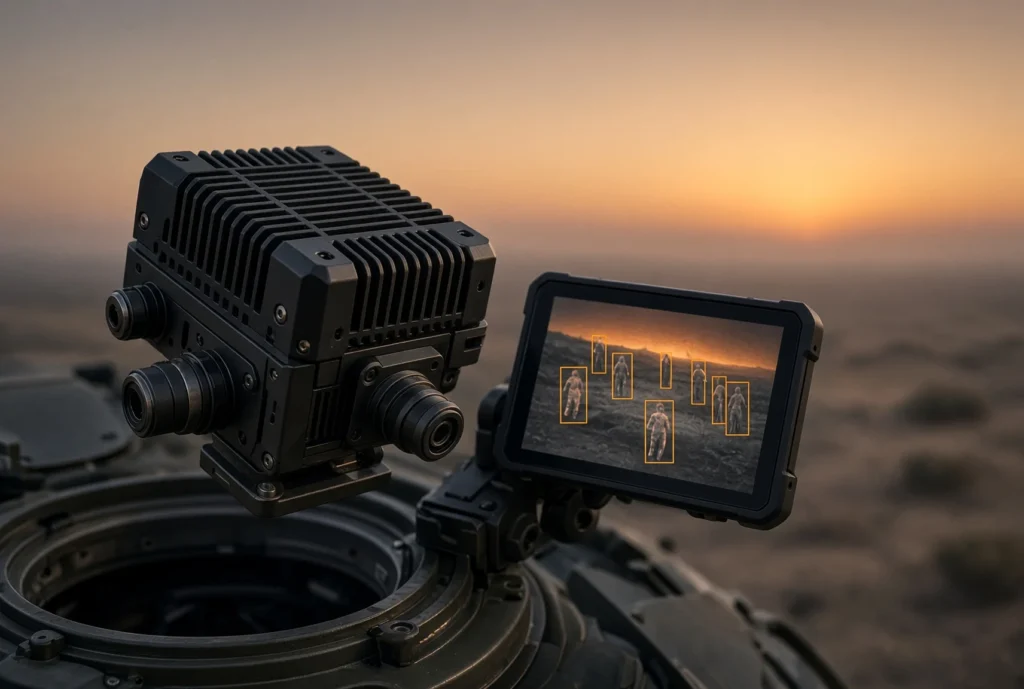
Significance: Traditional night vision tubes are handmade. They are expensive and fragile. Making them on a semiconductor wafer (like computer chips) drastically lowers cost. It improves durability. This allows Elbit to put high-end night vision on every soldier and drone, not just elite units.
9.2 Combat Touchscreens
Patent US12032793B2 covers touchscreens that detect “direct light paths” with “physical obstacles”.
Significance: Standard capacitive touchscreens (like an iPhone) fail in rain. They fail when the user wears tactical gloves. Elbit’s patented optical touch technology ensures screens work in mud, blood, and rain. This is critical for the “Digital Army” tablets carried by infantry in the field.
9.3 Color Night Vision
Patent US6570147B2 details systems for fusing multiple image intensifiers. This creates true color night vision.
Significance: Moving from green phosphor to full color allows pilots to distinguish terrain features instantly. It reduces cognitive load. In a high-speed dogfight or low-level helicopter flight, this split-second recognition saves lives.
10. Strategic Risks and Mitigation
10.1 Supply Chain Fragility
The global defense industrial base is strained. Snippets mention “supply-chain disruptions” and “elevated transportation costs”. Elbit is mitigating this by holding higher inventory levels. They are localizing production in Europe (Germany, UK) to shorten supply lines.
10.2 Geopolitical Backlash
As an Israeli company, Elbit faces political headwinds. Divestment campaigns are a risk. Mitigation: Elbit operates through local subsidiaries (Elbit Systems of America, Elbit UK). These entities are firewalled. They are staffed by locals. This allows them to contract directly with host governments, bypassing some political friction.
10.3 The Talent War
High-tech defense requires engineers, not mechanics. There is a global shortage of cyber and RF engineers. Elbit’s continued growth depends on its ability to recruit top talent. They are competing directly with the civilian tech sector for these minds.
11. Conclusion: The Investment Thesis
Elbit Systems stands at the apex of the modern defense industry. It has successfully transitioned from a niche electronics supplier to a prime systems integrator. Its valuation is supported by a massive $25 billion backlog.
The reasons for its ascent are clear and structural:
- Technological Superiority: From Iron Beam lasers to Iron Fist active protection, Elbit owns the “hard tech” that defines survivability.
- Strategic Agility: The company moves faster than giants like Lockheed Martin. It adapts civilian tech (AI, touchscreens) for military use with remarkable speed.
- Geopolitical Alignment: Its product mix, artillery, drones, and C4I, is perfectly matched to the requirements of the rearming West.
The data indicate that the “war premium” in Elbit’s stock is not a bubble. It is a reflection of a new reality. In a world of drone swarms and hypersonic threats, the old rules of defense no longer apply. The future belongs to those who can master the spectrum, the laser, and the algorithm. Elbit Systems has mastered all three.
Recommendations for Investors
- Monitor the $2.3B Contract: Watch for disclosures regarding the customer identity. A foothold in a new major Asian or Arab market would warrant a valuation re-rating.
- Track Iron Beam Deployment: Operational success in late 2025 will open a massive export market for Directed Energy systems.
- Watch Margins: If operating margins break 10% consistently, the stock has significant upside room. The fortress of the future is digital. Its walls are made of lasers and code. Elbit Systems holds the keys.
Appendix: Key Data Tables
Table 1: Financial Snapshot (Q3 2025)
| Metric | Value | YoY Growth | Source |
| Revenue | $1.92 Billion | +12% | Elbit Reports |
| Backlog | $25.2 Billion | +12% | Elbit Reports |
| Non-GAAP Net Income | $159.8 Million | +62% | Elbit Reports |
| GAAP EPS | $2.80 | +58% | Q3 PDF |
| R&D Expenses | $129.1 Million | +7.6% | Q3 PDF |
Table 2: Major Contract Wins (2024-2025)
| Contract | Value | Region | Tech Focus | Source |
| Strategic Solution | $2.3 Billion | Intl (Undisclosed) | Multi-Domain | PR Newswire |
| Defense Solutions | $1.6 Billion | Europe | Artillery/UAVs | Elbit News |
| E-LynX Network | $338 Million | Switzerland | C4I / SDR | Elbit News |
| Helicopter EW | $275 Million | Asia-Pacific | DIRCM / EW | Globes |
| Iron Fist APS | $150 Million | Europe | Active Protection | Elbit News |
| Comms Systems | $130 Million | Israel | Digital Army | Elbit News |
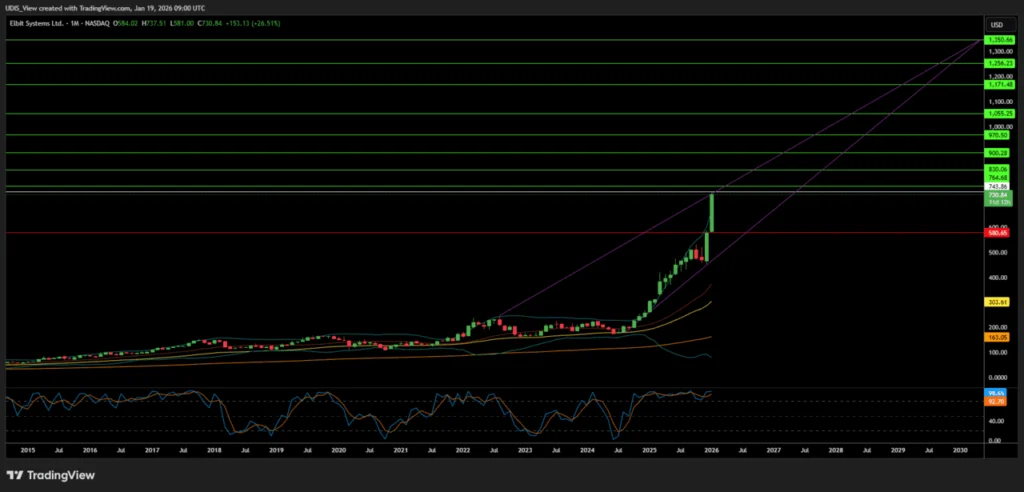
Elbit Systems Long (Buy)
Enter At: 743.86
T.P_1: 764.68
T.P_2: 830.06
T.P_3: 900.28
T.P_4: 970.50
T.P_5: 1055.25
T.P_6: 1171.48
T.P_7: 1256.23
T.P_8: 1350.66
S.L: 580.65