


HeartBeam stock trades far below what its regulatory progress suggests. On October 5, the FDA granted HeartBeam a Breakthrough Device designation for home heart attack assessment. Three weeks later, the agency accepted the program into its Total Product Life Cycle Advisory Program. On November 1, a University of Washington cardiologist presented its ALIGN-ACS pilot data at TCT 2026. Yet the market values the whole enterprise at roughly $31 million.
The shares closed at $0.55 on October 30. They have traded below $1 for months, and Nasdaq has set a December 28 compliance deadline. The company reported no revenue in the first half of 2026. It also carries a going-concern warning in its latest 10-Q filing.
That gap between regulatory momentum and the HeartBeam stock valuation is the real story. Behind it sits a quieter one. HeartBeam builds much of its clinical evidence in Belgrade and Jakarta, not in Boston or Houston. Its most strategic potential customer may be a national health system on an archipelago, not a US cardiology practice.
The Physics Behind a Credit-Card 12-Lead
A standard 12-lead ECG needs ten electrodes placed on precise points across the chest and limbs. That requirement ties heart attack diagnosis to ambulances, clinics, and emergency rooms. Patients must reach the machine before a doctor can read the signal.
HeartBeam inverts that sequence. Its credit-card-sized device captures the heart’s electrical activity from three non-coplanar directions, forming a 3D vector. Software then synthesizes a 12-lead waveform that cardiologists already know how to read. The patient holds the device against the chest, with no cables involved.
| Milestone | Date | Scope |
|---|---|---|
| 510(k) clearance, 3D ECG system | December 2024 | Arrhythmia assessment |
| 510(k) clearance, 12-lead synthesis software | December 2025 | Arrhythmia assessment, after review and appeal |
| Breakthrough Device designation | October 5, 2026 | Heart attack assessment at home (investigational) |
| Acceptance into FDA TAP | October 26, 2026 | Heart attack assessment program |
| Planned US pivotal study | Q1 2027 (company target) | Support for a heart attack indication |
The December 2025 clearance came only after what then-CEO Robert Eno called a “review and appeal process.” HeartBeam submitted in January 2025, so the software took nearly a year to clear. The regulatory path has worked, but it has never been fast. FDA outcomes can also turn, as uniQure’s gene therapy setback showed. The current clearances cover arrhythmia only. Heart attack detection, the indication that justifies the Breakthrough status, remains investigational.
The Evidence Trail Runs Through Belgrade and Jakarta
The most robust published data come from a June 2026 paper in JACC: Advances. The prospective study enrolled 212 chest-pain patients and analyzed 184. An algorithm combining one HeartBeam reading with risk factors and symptoms reached an AUC of 86.5%. Adding a personal, symptom-free baseline reading lifted the AUC to 92.9%.
The false-positive figure matters more for health systems. The algorithm flagged false alarms 19.8% of the time, against 55.6% for an expert physician panel. Fewer false alarms mean fewer unnecessary emergency transfers. In an underserved region, that translates directly into ambulance time and hospital beds.
| Study | Location | Patients | Status |
|---|---|---|---|
| JACC: Advances proof of concept | Emergency department setting | 184 analyzed | Published June 2026 |
| ALIGN-ACS pilot | Two sites, Belgrade, Serbia | 132 | Presented at TCT, November 1, 2026 |
| 12-lead patch pilot | Two hospitals, Belgrade | About 50 | Started May 2026 |
| HEADSTART-ACS | Harapan Kita, Jakarta, Indonesia | 486 | Enrollment complete; results expected 2027 |
At the time of writing, HeartBeam had not released the ALIGN-ACS performance figures in a press release. Investors in HeartBeam stock should treat the pilot as directional until the full data appear. Clearances alone can move small device stocks, as Microbot Medical’s rally showed.
The geography of this evidence deserves attention. Serbian and Indonesian sites can enroll chest-pain patients quickly and at lower cost. HEADSTART-ACS finished enrollment ahead of schedule at Indonesia’s National Cardiovascular Center Harapan Kita. HeartBeam effectively outsources its proof to health systems that need the technology most. The trade-off is clear. The FDA will still want a multicenter US pivotal study before any heart attack indication.
What the Patent Moat Means for HeartBeam Stock
HeartBeam reports 26 issued patents worldwide, with 11 US and 22 foreign applications pending. Its 10-Q breakdown of 17 US and 8 foreign grants sums to 25, a small inconsistency worth noting. The core asset is US Patent 11,445,963, announced in September 2022. It covers signal transformation from a vector ECG to a 12-lead ECG. A European counterpart followed, and a July 2026 US patent added acoustic sensing and thoracic impedance.
The moat protects a mathematical translation, not the idea of portable ECG. That distinction carries legal weight. Under the Supreme Court’s Alice standard, patents that rest on mathematical relationships face higher invalidity risk. A rival could also reconstruct missing leads with a neural network rather than a transformation matrix.
The cardiac wearables field shows how expensive these fights become. AliveCor sued Apple in 2021 over ECG features in the Apple Watch. In March 2025, the Federal Circuit upheld the invalidation of three AliveCor patents. The court also vacated the ITC import ban recommendation. A smaller innovator spent years in litigation and still lost its core claims to a larger rival.
| Holder | Representative patent | Technology | Relevance to HeartBeam |
|---|---|---|---|
| HeartBeam | US 11,445,963 | VECG to 12-lead transformation | Core differentiation |
| Apple | US 8,615,290 (2013) | Heart rate monitor embedded in a device | Big Tech owns the wrist |
| AliveCor | Three patents invalidated, affirmed 2025 | Wearable ECG and arrhythmia detection | Precedent for litigation risk |
The practical conclusion is uncomfortable for a $31 million company. HeartBeam’s patents likely deter casual copying, but not a determined, well-funded rival. That reality explains the June pivot toward licensing. A large partner can defend a patent estate; a micro-cap cannot easily do so.
The Geostrategy of the Golden Hour
Indonesia illustrates the social problem HeartBeam addresses. Health Minister Budi Gunadi Sadikin said in July that heart attacks kill about 260,000 Indonesians a year. When he took office, only 43 of 514 districts and cities could perform stenting. That number has since risen to 151.
| Indonesia indicator | Figure |
|---|---|
| Heart attack deaths per year | About 260,000 |
| Districts and cities with PCI capability | 151 of 514 (from 43) |
| PCI target | 200 locations in 2026; nationwide by end-2027 |
| Free screening target, 2026 | 136 million people |
Jakarta is building catheterization labs as fast as budgets allow. Cath labs, however, do not solve the first problem: knowing who needs one. Across thousands of islands, a false alarm can mean a costly boat or air transfer. A missed heart attack can mean death in a village clinic. A cheap, accurate triage signal makes survival depend less on where patients live.
That makes cardiac diagnostics a matter of national capacity, not just consumer health. Governments with dispersed populations are increasingly willing to adopt diagnostics that skip hospital infrastructure. HeartBeam’s study sits inside Indonesia’s national cardiac referral hub. The company says it shares a vision with the Ministry of Health for community health centers. The company has announced no formal deployment agreement.
Europe’s Data-Sovereignty Layer
Europe adds a second strategic thread. In October, the EXIT-CVD consortium launched its clinical program. The EUR 27.6 million project draws co-funding from the EU’s Innovative Health Initiative and industry partners. It includes 42 organizations from 17 countries and more than 14,000 patients across 22 studies. University Medical Center Groningen and Philips lead it, and HeartBeam participates as an industry partner.
Proximity to Philips, a dominant ECG incumbent, matters for a company seeking licensees. Europe also brings friction. The European Health Data Space regulation and national privacy rules govern cross-border health data. A cloud-based synthesis model must keep patient signals where regulators require. Indonesia’s 2022 personal data protection law raises similar questions. For HeartBeam, data residency becomes a product requirement in every sovereign market.
From Device Seller to Signal Licensor
On June 24, HeartBeam announced a strategic shift and a leadership change. CEO Robert Eno moved to a consulting role. Founder Branislav Vajdic and Executive Chairman Rich Ferrari now lead focused implementation teams. Vajdic designed early Flash memory at Intel and led Pentium architecture teams. He approaches the heart as a signal-processing problem.
The new strategy targets five channels:
- Governments and national health systems
- ECG equipment makers
- Holter and patch manufacturers
- Health systems and integrated delivery networks
- Consumer wearable companies
The logic is sound for a cash-constrained innovator. It echoes Nano-X Imaging’s commercial pivot, another device maker that leaned on partners. Direct device sales require a sales force, reimbursement codes, and years of physician education. The arrhythmia launch began through concierge and preventive cardiology groups in four US metro areas. The 10-Q still shows no revenue for the first half of 2026.
Reimbursement remains the hidden barrier in the US. A new diagnostic signal needs a payment pathway before physicians adopt it at scale. CMS and FDA have proposed a RAPID pathway for Breakthrough devices. It could pair clearance with a proposed national coverage decision. That pathway remains a proposal, not policy. Licensing lets partners carry the reimbursement fight that HeartBeam cannot fund alone. Large incumbents such as Medtronic already own the hospital relationships. Diagnostics buyers have also paid for proven platforms, as Abbott’s Exact Sciences deal showed.
The Cash Clock Behind HeartBeam Stock
The science may be advancing, but the balance sheet sets the timetable.
| Financial indicator | Figure |
|---|---|
| FY2025 net loss | $21.0 million |
| FY2025 operating cash used | $14.0 million |
| Cash, June 30, 2026 | $8.7 million |
| Operating cash used, H1 2026 | $7.0 million |
| 2026 guidance | Below $14.0M outflow; Q4 below $2.5M |
| Shares outstanding, August 11, 2026 | 56.3 million |
| April 2026 offering | 14.375M shares at $0.80; $11.5M gross |
A simple runway estimate uses: Cash at year-end = June cash − Q3 outflow − Q4 outflow. Management guided Q3 near Q2’s $3.3 million and Q4 below $2.5 million. That implies roughly $2.9 million or more at year-end, before any new funding. This figure is our estimate, not company guidance. Management says its runway extends into 2027.
The Nasdaq clock runs in parallel. HeartBeam received a minimum bid price notice on June 30. It must close at or above $1.00 for ten consecutive business days by December 28. A second 180-day period may be available if it meets other listing standards. A reverse split is a common remedy, though the company has not announced one.
| Scenario | Trigger | Likely implication |
|---|---|---|
| Partnership | Licensing or OEM deal with upfront payment | Extends runway; validates the signal |
| Base | Positive data, further equity raise | Progress with more dilution |
| Stress | No partner, weak pilot data, listing pressure | Reverse split and deeper discount financing |
These scenarios reflect our judgment, not company guidance. Every quarter without a partner raises the odds that existing holders fund the pivotal trial.
The Risks That Matter for HeartBeam Stock
- Liquidity. The 10-Q cites substantial doubt about the company’s ability to continue as a going concern.
- Dilution. Further equity raises appear likely without a partner payment.
- Listing. The Nasdaq bid-price deadline falls on December 28, 2026.
- Regulation. Heart attack assessment remains investigational and needs a US pivotal study.
- Patents. Algorithm-based claims face Alice-related invalidity and design-around risk.
- Reimbursement. No dedicated payment pathway exists yet for the heart attack use.
- Execution. Leadership changed in June, during the first commercial rollout.
- Data rules. Cross-border cloud processing faces sovereign privacy regimes.
Closing Thoughts
HeartBeam has turned an elegant piece of signal mathematics into two FDA clearances and a Breakthrough designation. Its strongest published data show far fewer false alarms than an expert panel. That matters most where transfers are costly and cardiologists are scarce.
The untold story is geographic. The evidence comes from Belgrade and Jakarta, and the natural customers may be health ministries. Their challenge is distance, not a shortage of devices. In our view, the technology addresses a genuine social need in dispersed and underserved populations. The open question for HeartBeam stock is whether a partner arrives before the cash runs low.
Sources
- HeartBeam Q2 2026 Form 10-Q (SEC)
- HeartBeam Form 8-K: Nasdaq bid price notice (SEC)
- HeartBeam: Q2 2026 results
- HeartBeam: Q4 and FY2025 results
- HeartBeam: Breakthrough Device designation (Finviz/Business Wire)
- HeartBeam: ALIGN-ACS presentation at TCT 2026
- HeartBeam: Strategic shift and leadership transition
- HeartBeam: JACC: Advances peer-reviewed article
- HeartBeam: 12-lead patch pilot study
- Barchart: HEADSTART-ACS completes enrollment
- HeartBeam: Patent for VECG to 12-lead transformation
- MassDevice: 12-lead synthesis software clearance
- MassDevice: First FDA clearance, December 2024
- MacRumors: Federal Circuit rules for Apple in AliveCor case
- Google Patents: US 8,615,290 (Apple)
- Antara: Indonesia pushes heart screening to lower mortality
- GlobeNewswire: EXIT-CVD consortium launches clinical studies
- Yahoo Finance: BEAT quote
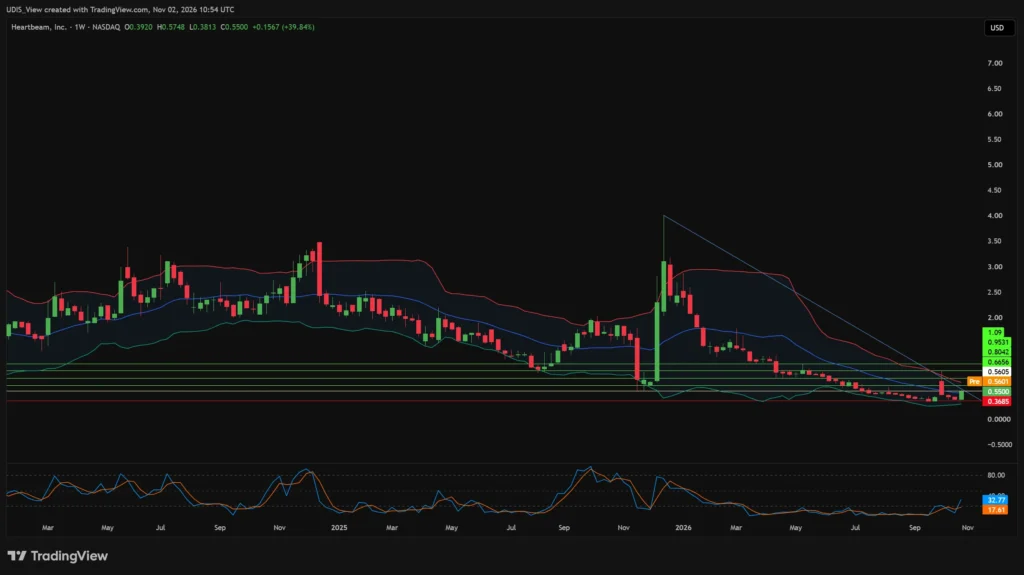
HeartBeam Long (Buy)
Enter At: 0.5605
T.P_1: 0.6656
T.P_2: 0.8042
T.P_3: 0.9531
T.P_4: 1.09
S.L: 0.3685