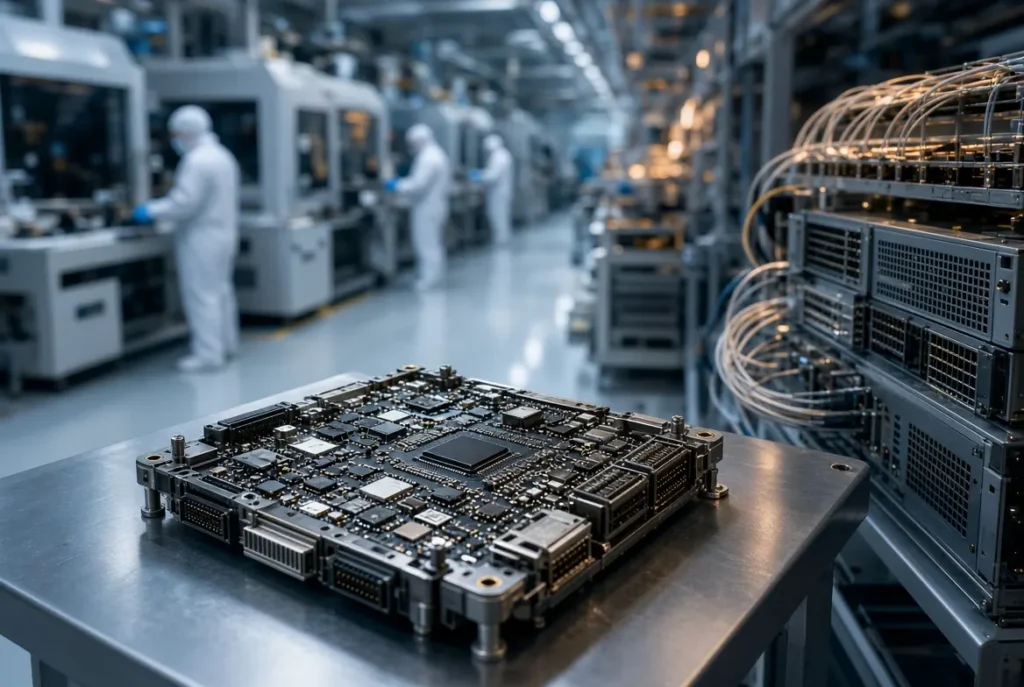


Fortinet custom silicon has quietly become the engine behind the sharpest revenue acceleration in the company’s recent history. Yet the market barely blinked. The stock rose about 2% on results that beat consensus by 9% on revenue and 20% on earnings.
That muted reaction has a simple explanation. Fortinet shares have already more than doubled this year, which means the second quarter had to be exceptional simply to justify where the stock already trades. This analysis examines whether the acceleration is durable, what the Intel Foundry partnership actually commits to, and where the risks sit.
The Quarter That Beat Everything
Start with the numbers, because they were strong on every line.
Fortinet reported second-quarter 2026 revenue of $2.05 billion, up 26% year over year against a consensus near $1.89 billion. Product revenue jumped 52% to $773 million, the sharpest acceleration the company has shown in years. Service revenue rose 14% to $1.27 billion, and management indicated the first quarter marked the trough for service growth.
| Fortinet Q2 2026 | Result | Change |
|---|---|---|
| Total revenue | $2.05 billion | Up 26% |
| Product revenue | $773 million | Up 52% |
| Service revenue | $1.27 billion | Up 14% |
| Total billings | $2.37 billion | Up 33% |
| Non-GAAP gross margin | 80.9% | Above guidance |
| Non-GAAP operating margin | 38.0% | Up 490 bps, Q2 record |
| Non-GAAP EPS | $0.90 | Up 41% |
| Free cash flow | $966 million | More than tripled |
Profitability was the standout. Non-GAAP operating margin reached 38.0%, a second-quarter record, expanding 490 basis points. Free cash flow more than tripled year over year to $966 million on improved linearity and working capital discipline. Operating cash flow reached $1.04 billion.
Where the Growth Came From
The segment detail reveals a business benefiting from three simultaneous tailwinds.
Secure Networking billings grew 34%, Unified SASE billings grew 35%, and AI-driven Security Operations billings rose 25%. Within Unified SASE, FortiSASE billings specifically more than doubled. Operational technology security billings grew more than 55%, driven by industrial and utility deployments facing tightening regulation.
| Business line | Billings growth |
|---|---|
| Secure Networking | 34% |
| Unified SASE | 35% |
| FortiSASE specifically | Over 100% |
| OT security | Over 55% |
| AI-driven Security Operations | 25% |
| Service billings | 26% |
The company’s newly defined SASE Firewall category, which merges firewall, SD-WAN and secure access into one platform, now exceeds $2 billion in revenue, growing 34%. The strategic logic is convergence: rather than defending firewall market share against cloud-native competitors, Fortinet is redefining the firewall to include the cloud security functions those competitors sell separately. That puts it in direct contention with Cloudflare and other edge-native platforms.
Total deferred revenue reached $7.68 billion, up 17%, providing visibility into future recognized revenue.
The Intel Foundry Deal, Precisely
On July 21, 2026, Intel and Fortinet announced that Intel Foundry will co-develop, package, and fabricate Fortinet’s sixth-generation Security Processor on the Intel 4 process node. The framing in most coverage was a supply chain revolution. The reality is narrower and worth stating carefully.
Fortinet becomes the first publicly named external customer for Intel 4, and the first cybersecurity vendor to commit to Intel Foundry. Founder, chairman and chief executive Ken Xie said the partnership would help Fortinet accelerate and strengthen its ASIC strategy.
Three qualifications matter and are frequently omitted. Neither company disclosed a production timeline. Neither disclosed financial terms. And Intel did not identify which factory will build SP6. Intel 4 runs in high-volume manufacturing at Fab 34 in Leixlip, Ireland, so European production is a reasonable inference, but it has not been confirmed.
Context on the node also matters. Intel 4 was Intel’s first process using extreme ultraviolet lithography and entered production in September 2023. It is a mature, roughly 7-nanometer-class process well suited to cost-sensitive networking ASICs. It is not Intel’s leading edge, which is 18A. For Intel, whose foundry unit generated $307 million of external revenue in fiscal 2025 against an operating loss exceeding $10 billion, Fortinet is a validating customer rather than a financially transformative one.
Why Fortinet Custom Silicon Is the Moat
The deeper question behind Fortinet custom silicon is why a security company designs its own chips at all.
Most network security vendors build appliances around commodity x86 or Arm processors and do the security work in software. Fortinet builds application-specific integrated circuits that process security traffic in hardware at line rate, following the same custom-silicon logic that underpins Broadcom. The performance gap widens precisely where modern traffic is heaviest, in deep inspection of encrypted flows, where software-only platforms incur latency penalties.
| Generation | SP5 | SP6 |
|---|---|---|
| Process | 7nm, Arm-based | Intel 4, EUV |
| Architecture | Monolithic system-on-chip | Expected chiplet, disaggregated |
| Launched | 2023 | Timeline not disclosed |
| Foundry | Asian foundries | Intel Foundry |
| Target | Entry and mid-range FortiGate | AI and high-speed SASE workloads |
The architectural shift from SP5’s monolithic design to a disaggregated chiplet approach is the substantive engineering change. Chiplets improve manufacturing yields, because smaller dies suffer fewer defects, and they allow different functions to be built on different processes.
Scale justifies the investment. IDC ranked Fortinet first in firewall appliance unit shipments as of early 2023, with a 48% unit share, though that figure predates several competitive cycles.
Securing AI, and Selling Into It
The fastest-emerging demand driver is enterprises trying to secure their own AI deployments.
Fortinet expanded its integration with NVIDIA around FortiAIGate, which applies runtime security to large language model traffic. The system integrates with NVIDIA Blackwell and Hopper GPUs and the NVIDIA Dynamo distributed inference framework, and incorporates NVIDIA Nemotron safety models to inspect prompts. It enforces guardrails on model inputs and outputs and logs suspicious activity, with deployment options spanning appliances, virtual machines, and containers.
The problem it addresses is real. Enterprises are discovering unsanctioned AI agents and unauthorized model servers inside their networks, creating data exfiltration paths that traditional controls do not see, a challenge reshaping network-visibility vendors too.
Separately, Fortinet introduced FortiSASE Outpost to address data sovereignty. It places a local point of presence inside customer facilities so latency-sensitive or legally restricted traffic can be inspected on premises, while general traffic routes through global cloud nodes. That directly targets a weakness of pure cloud security vendors in jurisdictions with strict data residency rules.
The Demand Backdrop
Fortinet’s own research illustrates why enterprises keep buying, and it doubles as marketing.
The company’s threat research reports that 86% of organizations experienced breaches recently, that 52% of those breaches cost over $1 million, and that average breach costs in North America reached $2 million. On the staffing side, 49% of IT leaders report pushback when requesting cybersecurity hiring approvals, even though 50% of executives face personal consequences after a breach. Fifty-six percent cite skills shortages as a contributing cause, and 60% struggle specifically to recruit AI security talent.
These figures come from vendor research and should be read with that in mind. The underlying dynamic, however, is corroborated across the industry: security teams are understaffed while attack surfaces expand, which pushes buyers toward consolidated platforms that reduce administrative burden rather than adding more point tools.
Valuation and the Bear Case
Here the enthusiasm needs a counterweight, and management supplied part of it.
Fortinet raised full-year 2026 guidance to revenue of $8.02 billion to $8.18 billion, implying roughly 19% growth, with billings of $9.35 billion to $9.55 billion and non-GAAP earnings of $3.41 to $3.47 per share. Third-quarter revenue is guided to $2.01 billion to $2.10 billion.
| FY2026 guidance | Range |
|---|---|
| Revenue | $8.02bn to $8.18bn |
| Service revenue | $5.18bn to $5.22bn |
| Billings | $9.35bn to $9.55bn |
| Non-GAAP operating margin | 35% to 37% |
| Non-GAAP EPS | $3.41 to $3.47 |
Note what the guidance implies. Full-year revenue growth of about 19% is well below the 26% just delivered, and the guided operating margin range of 35% to 37% sits below the 38% achieved in the quarter. Management also flagged memory component price volatility creating high-single-digit billings headwinds in the second half.
The bull case is straightforward: accelerating growth, record margins, tripling free cash flow, a Moody’s upgrade to A3 that Fortinet describes as the highest rating of any public cybersecurity company, and $972.8 million of stock repurchased in the first half.
The bear case is the setup. The stock has more than doubled this year, so expectations are elevated. Product revenue growth of 52% partly reflects a hardware refresh cycle, and refresh cycles end. Memory costs are rising. And the guided deceleration is management’s own forecast, not a bearish analyst’s.
The Risks That Matter
- Refresh cycle timing. A 52% product revenue surge suggests a hardware upgrade wave that will eventually normalize, creating difficult comparisons.
- Memory cost inflation. Management flagged high-single-digit billings headwinds from component price volatility in the second half.
- Guided deceleration. Full-year guidance implies roughly 19% growth against 26% delivered, and margins below the quarter’s 38%.
- Valuation. Shares have more than doubled this year, leaving limited cushion for disappointment.
- Foundry execution. The SP6 partnership has no disclosed timeline, terms or confirmed fab, and depends on Intel Foundry delivering.
- Competitive pressure. Cloud-native security vendors continue attacking the firewall franchise from the software side.
- AI security is unproven revenue. FortiAIGate and related products are early and contribute little today.
Closing Thoughts
Fortinet delivered a quarter that validated its entire strategy. Fortinet custom silicon and platform consolidation drove a 52% product revenue surge, margins hit a second-quarter record, and free cash flow more than tripled. The Intel Foundry partnership adds supply chain diversification and gives Fortinet a Western manufacturing path, while the NVIDIA integration positions it for enterprise AI security before that market fully forms.
The verdict rests on one question: is 26% revenue growth the new baseline, or the peak of a hardware refresh cycle that management’s own 19% full-year guidance already anticipates fading? Watch the markers into 2027: whether product revenue growth holds as comparisons harden, how much memory costs actually compress billings in the second half, whether OT and FortiSASE momentum continues at current rates, and whether Intel and Fortinet disclose an SP6 timeline. The execution has been excellent. The stock has already paid for a good deal of it.

Fortinet Long (Buy)
Enter At: 163.55
T.P_1: 165.63
T.P_2: 170.42
T.P_3: 177.11
T.P_4: 184.59
T.P_5: 190.49
T.P_6: 196.40
S.L: 153.68