

The GoPro Starman merger announced on September 1 sees GoPro sell 90% of itself for $285 million. Shareholders receive $1.14 per share in cash and keep roughly 10% of the combined company.
The stock trades above that cash figure. That gap is the entire investment question, because the market is pricing the retained stub at somewhere between eleven and forty-four cents per share, and nobody has explained what it should be worth. This analysis works through why the sale happened, what Starman brings, and how to think about the residual stake.
Why GoPro Sold Before the Starman Merger
Start here, because the reason determines everything downstream.
GoPro’s second quarter showed revenue falling 31% to $104.9 million with a net loss of $51 million. More seriously, the company disclosed substantial doubt about its ability to continue as a going concern, and auditor PricewaterhouseCoopers subsequently included a similar warning in its report. GoPro is cutting roughly 23% of its workforce, a reduction expected to be substantially complete by the end of 2026.
| GoPro standalone position | Figure |
|---|---|
| Q2 2026 revenue | $104.9 million, down 31% |
| Q2 2026 net loss | $51 million |
| Going concern | Substantial doubt disclosed |
| Auditor position | PwC included similar warning |
| Workforce reduction | ~23% |
| Outstanding debt | ~$92 million |
| 2014 IPO price | $24.00 per share |
| Cash consideration now | $1.14 per share |
Public filings document the sequence clearly. On April 13, GoPro announced it had hired Oliver Wyman to explore opportunities in defense and aerospace. Then, on May 11, the board disclosed it had begun a strategic process that could result in a sale or merger. Finally, that process concluded on September 1.
This was not a company engineering a pivot from strength. It was a board running a sale process while its auditor flagged going-concern doubt, and the outcome was a distressed transaction at $1.14 against a 2014 listing price of $24.
What the GoPro Starman Merger Actually Says
The GoPro Starman merger terms are specific, and two details are frequently omitted.
Starman Optical, a subsidiary of the privately held, family-controlled Starman Holding, will own approximately 90% of the combined company. GoPro shareholders receive $285 million in aggregate cash, or $1.14 per share, and retain about 10%. Starman repays GoPro’s roughly $92 million of debt at closing, and the combined entity remains listed on Nasdaq. Both boards have approved.
| Deal term | Detail |
|---|---|
| Aggregate consideration | $285 million |
| Per-share cash | $1.14, subject to adjustment |
| Adjustment basis | GoPro net working capital at closing |
| Starman ownership | ~90% |
| Retained by GoPro holders | ~10% |
| Debt repaid | ~$92 million |
| Listing | Remains on Nasdaq |
| Expected close | End of 2026 |
| Conditions | Regulatory clearance and stockholder vote |
The $1.14 is not fixed. It is subject to adjustment based on GoPro’s net working capital at closing, which for a company burning cash means the figure could move down as easily as up. Closing also requires both regulatory approval and an affirmative GoPro stockholder vote, neither of which has occurred.
Houlihan Lokey and Fenwick and West advised on the transaction.
The GoPro Starman Merger and the Markiplier Coincidence
The timing invited a narrative that the filing record does not support.
Bloomberg reported on August 30 that Mark Fischbach, the YouTube creator known as Markiplier, had become GoPro’s largest individual shareholder with an 8.5% passive stake. Fischbach told Bloomberg he believed the stock was undervalued and wanted the company to succeed. Shares jumped 46% on the Monday, then 51% on Tuesday after the merger announcement, roughly doubling in two sessions.
The sequence matters. Fischbach filed his Schedule 13G on August 20, disclosing a position he held as of July 13, well before the merger agreement existed. The two events are unrelated in origin, even though they surfaced in the same week. A passive 8.5% stake carries no board seat and no governance influence, and Starman will dilute it to a fraction of that once the deal closes.
What Starman Brings to the Merger
Here is the part of the story that determines whether the stub has value.
Starman Optical manufactures high-speed optical transceivers, devices that convert electrical signals into optical pulses for data transmission. It produces 800G transceivers and is developing 1.6T architectures, the same market served by Applied Optoelectronics. Critically, it manufactures domestically in the United States at a moment when AI data centers require enormous optical bandwidth to link distributed GPU clusters, and when federal procurement increasingly favors domestic sourcing for dual-use components.
Starman Holding chief executive Charles Tebele has framed the plan as bringing production of critical optical components back to the United States. GoPro founder Nicholas Woodman described the merger as positioning the company as a leading American imaging supplier addressing national security in cameras, optics and AI infrastructure.
| Combined capability | Contribution |
|---|---|
| Starman optical transceivers | 800G shipping, 1.6T in development |
| Manufacturing base | US domestic facilities |
| GoPro patent portfolio | Over 2,500 granted US patents |
| GoPro imaging technology | Image signal processing, stabilization |
| Target markets | AI data centers, defense, aerospace, robotics, government |
The Consumer Business Continues
There is a further wrinkle worth noting. GoPro is not being wound down. The announcement states the consumer camera line, subscription service, and cloud business all continue, and the Mission 1 series introduced in April keeps shipping, with the interchangeable-lens ILS model opening pre-orders at $699.99. Subscription revenue has been the healthier part of the business, growing to roughly $47 million in the second quarter.
That matters for the stub calculation. The combined entity is not purely an optical components business. It carries a declining consumer hardware operation alongside a growing transceiver franchise, and the consumer side has been consuming cash rather than generating it.
The Patents Are the Prize
The acquisition rationale becomes clearer when you look at what Starman is actually buying.
GoPro has accumulated more than 2,500 granted United States patents over 24 years, covering image processing, sensor stabilization, optical enclosures and wireless protocols. Starman’s stated intention is to apply that portfolio to expand production of military and AI-related products at its existing American factories.
That is a different proposition from buying a camera brand. Starman already has factories and customers. What it lacked was two decades of imaging intellectual property, and acquiring it through a distressed public company was cheaper than developing it, a pattern visible across defense sector consolidation.
GoPro’s hardware has demonstrated relevant durability. Four cameras operated on the exterior solar arrays of the Orion spacecraft during NASA’s Artemis II mission, which is a credential defense buyers understand.
| Sale process timeline | Date |
|---|---|
| Oliver Wyman engaged for defense and aerospace review | April 13, 2026 |
| Board discloses strategic process, sale or merger possible | May 11, 2026 |
| Bloomberg reports Markiplier 8.5% stake | August 30, 2026 |
| Definitive merger agreement announced | September 1, 2026 |
| Expected closing | End of 2026 |
Valuing the GoPro Starman Merger Stub
Now the arithmetic that the coverage has skipped.
Shares have traded roughly between $1.25 and $1.58 following the announcement, against cash consideration of $1.14. That implies the market values the retained 10% stake at approximately eleven to forty-four cents per share, or very roughly $28 million to $110 million for the whole stub.
| Stub valuation | Figure |
|---|---|
| Cash consideration | $1.14 per share |
| Recent trading range | ~$1.25 to $1.58 |
| Implied stub value per share | ~$0.11 to $0.44 |
| Retained ownership | ~10% |
| Implied value of combined company | Roughly $280m to $1.1bn |
Read the right-hand column carefully. At the upper end of the trading range, the market is implying the combined entity is worth around a billion dollars, which requires Starman’s transceiver business to be substantially larger and more profitable than anything publicly disclosed. Starman is private, so investors have no financial statements, no revenue figures and no margin data to test that against.
The bull case is that domestic optical transceiver capacity commands a premium, the patent portfolio unlocks defense contracts, and a debt-free Nasdaq-listed vehicle with US manufacturing is worth considerably more than GoPro alone.
The bear case is that minority holders own 10% of a company controlled by a private family group, with no disclosed financials, no dividend, no influence, and a cash payment subject to downward adjustment.
The Risks That Matter
- Deal completion. Closing requires regulatory clearance and a GoPro stockholder vote, neither yet obtained.
- Working capital adjustment. The $1.14 is subject to adjustment based on net working capital at closing, and GoPro is consuming cash.
- Going concern. Substantial doubt was disclosed and echoed by the auditor, so the standalone downside if the deal fails is severe.
- No Starman financials. Investors cannot assess revenue, margins or backlog for the business that determines the stub’s value.
- Minority position. A 10% stake in a company 90% controlled by a private family group carries minimal governance influence.
- Execution risk. Converting consumer imaging patents into qualified defense hardware requires certifications and compliance frameworks GoPro does not hold.
- Consumer decline continues. Revenue fell 31% year over year, and a 23% workforce reduction constrains the ability to reverse that.
- Narrative premium. Part of the recent move reflects attention from a celebrity shareholder whose stake predates the deal and carries no control.
Closing Thoughts
The industrial logic of the GoPro Starman merger is sounder than most distressed pivots. Starman genuinely manufactures 800G optical transceivers in American factories, AI data centers genuinely need domestic optical supply, and GoPro’s 2,500 patents genuinely have applications beyond action cameras. The Artemis II deployment demonstrates the hardware survives conditions defense buyers care about.
But the honest verdict is that this is a company with a going-concern warning selling 90% of itself at $1.14, ten years after listing at $24. The question for anyone buying today is narrower than the headlines suggest: what is a 10% minority stake in a private family-controlled optical business actually worth? Watch three things into 2027: whether the stockholder vote and regulatory clearance proceed without complication, whether the working capital adjustment moves the $1.14, and whether Starman discloses any financial detail before closing. The cash is close to certain. Everything above it is a bet on a business the public cannot yet examine.
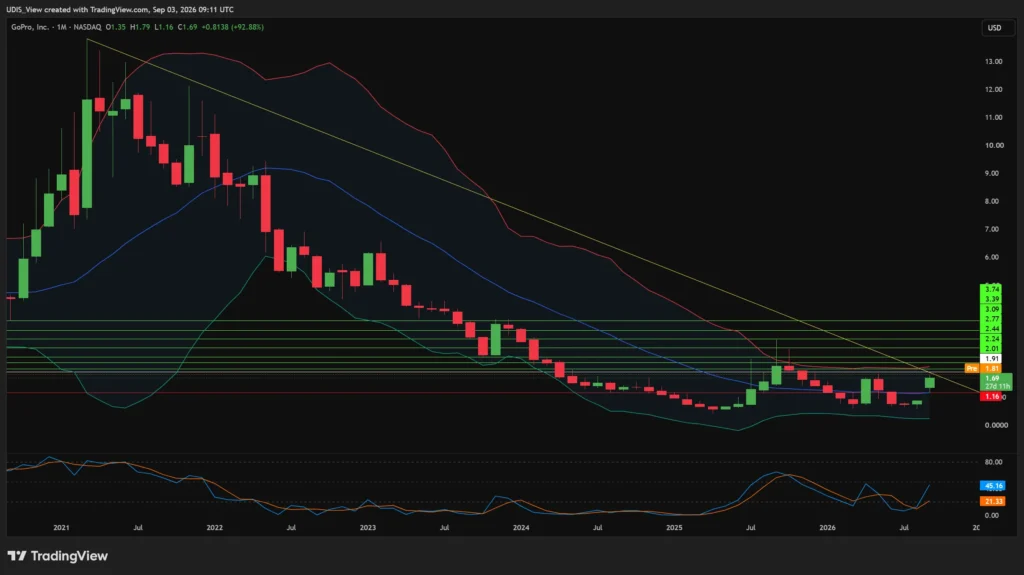
GoPro Long (Buy)
Enter At: 1.91
T.P_1: 2.01
TP_2: 2.24
T.P_3: 2.44
T.P_4: 2.77
T.P_5: 3.09
T.P_6: 3.39
T.P_7: 3.74
S.L: 1.16