

Moog Inc. has entered a transformative era in 2026. The company recently reported record-breaking financial results. These results highlight a significant shift in the aerospace and defense landscape. Moog reported an adjusted earnings per share of $2.63 for Q1 2026. This figure crushed analyst expectations of $2.21 by 19%. Revenue surged to $1.1 billion, representing a 21% year-over-year increase. This performance signals Moog’s resilience in a volatile global economy.
The company now holds a record backlog exceeding $5 billion. This backlog provides clear visibility into future revenue streams. Management has raised the full-year 2026 EPS guidance to $10.20. Investors reacted positively, driving the stock to new heights near $305. Moog is now a central player in the global rearmament cycle.
Macroeconomic Performance and Financial Momentum
Moog’s fiscal 2026 opening quarter displays exceptional operational strength. Every operating segment achieved record quarterly sales simultaneously. Space and Defense led with 31% revenue growth. Commercial Aircraft followed with a 23% gain. Military Aircraft grew by 16%. Industrial sales increased by 14%.
The company’s adjusted operating margin reached 13.0%. This is a 90-basis point improvement over the prior year. Moog is leveraging high-margin defense wins to boost profitability. The industrial segment also saw significant margin expansion. Business optimization efforts are finally yielding tangible results.
Q1 2026 Segment Financial Performance
| Segment | Revenue ($M) | YoY Growth (%) | Adjusted Margin (%) |
| Space and Defense | 324 | 31% | 14.8% |
| Commercial Aircraft | 268 | 23% | 10.6% |
| Military Aircraft | 247 | 16% | 11.4% |
| Industrial | 261 | 14% | 13.9% |
| Total | 1,100 | 21% | 13.0% |
The company raised its full-year revenue outlook to $4.3 billion. This reflects strong bookings across all major platforms. Space and Defense bookings were particularly robust. They included $100 million for PAC-3 missile components. Another $100 million came from a new space vehicle contract.
Dividend Growth and Capital Allocation
Moog recently increased its quarterly cash dividend by roughly 3%. This move demonstrates confidence in long-term cash flow generation. The company maintains a conservative leverage ratio of 2.0x. This balance sheet strength allows for strategic investments. It also supports ongoing research and development in high-tech domains.
Management targets a 60% free cash flow conversion rate for 2026. Physical inventory growth currently uses significant cash. This inventory supports the rapid ramp-up in production programs. Capital expenditures reached $34 million in the first quarter. These funds support facility upgrades and manufacturing advancements.
Geostrategy: Decoupling from the Chinese Supply Chain
The U.S. defense industrial base faces a critical challenge. China dominates 90% of global rare earth processing. This creates a dangerous strategic vulnerability for American weapons. In 2025, China restricted exports of heavy rare earth metals. These metals are essential for high-performance magnetic actuators.
Moog is leading the charge toward supply chain independence. The company partnered with Niron Magnetics in late 2025. This collaboration focuses on rare-earth-free actuators for guided munitions. These actuators use Iron Nitride instead of neodymium. This move proactively addresses potential geopolitical chokepoints.
The Iron Nitride Breakthrough
Iron Nitride offers a domestic alternative to Chinese magnets. Niron Magnetics produces these magnets in its Minnesota facility. The process uses abundant materials like iron and nitrogen. It bypasses the decade-long development cycles of new mines. Iron Nitride production can scale in just 18 to 24 months.
| Material | Geographic Source | Production Cycle | Supply Risk |
| Neodymium ($NdFeB$) | Primarily China | 10-15 Years (Mining) | High |
| Iron Nitride Fe16N2 | United States | 1.5-2 Years (Synthetic) | Low |
Moog is evaluating Iron Nitride for mission-critical hardware. This includes actuators for missiles, satellites, and aircraft. The technology ensures uninterrupted support to the warfighter. It reinforces Moog’s commitment to national security and innovation. This strategic hedge weakens the assumption that rare earths are irreplaceable.
Geopolitical Defense Spending Cycles
Global geopolitical tensions are driving a massive rearmament cycle. Total defense spending could reach $3.6 trillion by 2030. This is a 33% increase from 2024 spending levels. European defense spending is growing faster than any other sector. NATO recently confirmed new spending targets of 5% of GDP.
Moog is capturing this growth through multi-year prime programs. The company sees increased demand in Australia, Europe, and Japan. Canada is also focusing on Arctic sovereignty and surveillance. These regional budgets will likely remain elevated for decades. Moog’s global footprint allows it to serve these diverse markets.
Economics: Navigating Tariffs and Inflationary Pressures
Moog’s financial success occurs despite significant economic headwinds. Tariffs emerged as a major margin pressure in early 2026. Management estimated a 300-basis point hit to commercial aircraft margins. Total tariff costs impacted first-quarter margins by roughly $30 million. The company is actively restructuring its supply chain to mitigate this.
Mitigation efforts include alternate routing and supplier changes. Moog is also improving its customs and import paperwork. These actions should free tens of millions in working capital. Despite these costs, commercial sales volume remains incredibly high. OE production for major aircraft programs continues to ramp up.
Sector-Wide Rerating and Valuation
The defense sector is undergoing a valuation rerating. Investors now view defense companies as techno-industrial entities. This shift reflects the increasing importance of software and AI. Moog’s stock price reached $305.35 in early 2026. This represents a one-month return of over 22%. The annual total shareholder return reached nearly 70%.
| Valuation Metric | Moog (MOG.A) | A&D Industry Average |
| P/E Ratio | 37.8x | 40.6x |
| Peer Average P/E | 37.8x | 48.5x |
| Fair Value Estimate | ~$275.25 | N/A |
Some analysts view the recent rally as slightly stretched. However, Moog still trades at a discount to many peers. The company’s EPS growth remains exceptionally strong. Continued mix shifts toward high-margin software will drive further growth. High-growth defense names are outperforming the broader market significantly.
Inflation and Fixed-Price Contracts
Inflation remains a persistent concern for long-cycle manufacturers. Moog uses pricing benefits to offset some inflationary pressure. The company is also focusing on operational excellence. This includes alleviating labor shortages and supply chain constraints. Improved production efficiency helps maintain margins on fixed-price contracts. Record sales in all segments suggest high pricing power.
Technology: Advancing Integrated Weapon Systems
Moog is moving beyond components into full systems integration. A key example is the 2026 partnership with Echodyne Corp. This collaboration advances integrated hardware and software for defense. It combines Moog’s turret capabilities with Echodyne’s advanced radar. The goal is to deliver field-ready systems for global markets.
The partnership targets Integrated Air and Missile Defense (IAMD). It also focuses on airfield safety and combat vehicles. These systems provide essential situational awareness for modern combat. High-fidelity data allows for pinpoint activity tracking. This integration allows both companies to progress faster together.
Reconfigurable Integrated-weapons Platform (RIwP)
The RIwP is Moog’s flagship turreted weapon system. It serves as a modular “weapons hub” for vehicles. The RIwP can perform counter-drone and anti-armor roles. It also supports short-range air defense (SHORAD) missions. Moog launched a lightweight version (LW RIwP) in 2025.
| RIwP Platform | Vehicle Integration | Weapon Options |
| RIwP Standard | Stryker, Foxhound 4×4 | 30mm Bushmaster, XM914 |
| LW RIwP | Small Tactical Vehicles | Dual-defeat Kinetics, EW |
| MCCO Program | British Army HMT | Anti-Armor, Counter-Drone |
The RIwP integrates Leonardo DRS EO/IR sensors. It also utilizes Northrop Grumman’s XM914 30mm cannon. Successful live-fire tests have proven its effectiveness. The platform is now a key part of the U.S. Army’s M-SHORAD program. Moog is also tailoring variants for the British Army.
Hypersonic and Naval Innovations
Moog is a leader in precision steering for hypersonics. These missiles travel at over five times the speed of sound. Moog’s technology optimizes size, weight, and power ($SWaP$). This is critical for the extreme environments of hypersonic flight. The company supplies these systems to the global defense industry.
In naval defense, Moog focuses on quiet undersea actuation. This technology is vital for the U.S. Navy’s operational availability. The company offers electrohydraulic and electromechanical options. These systems ensure reliability in demanding maritime environments. Moog’s naval solutions support the integrated deterrence of the fleet.
Cyber: Resilience in the Age of Hybrid Threats
Cybersecurity is now a core element of geopolitical competition. In 2026, 64% of organizations accounted for politically motivated attacks. Chief executives rate cyber-enabled fraud as a top concern. Disruption of critical infrastructure remains a constant threat. Sovereignty-driven regulations are fragmenting the digital landscape.
Moog must comply with the Cybersecurity Maturity Model Certification (CMMC). CMMC 2.0 became a contractual obligation in November 2025. In 2026, compliance is enforceable and tied to award eligibility. Moog must demonstrate “continuous assurance” of its security posture. This is a shift from point-in-time checklist compliance.
CMMC 2.0 Implementation Levels
| Level | Focus | Requirement | Assessment |
| Level 1 | FCI Protection | 15 Security Practices | Annual Self-Assessment |
| Level 2 | CUI Protection | 110 Practices (NIST 800-171) | 3rd-Party (C3PAO) |
| Level 3 | Expert Defense | 130+ Practices (NIST 800-172) | Government-Led Audit |
Level 2 is mandatory for any contractor handling sensitive data. This includes technical drawings and ITAR-regulated information. Level 3 applies to major weapons systems and satellite tech. It requires proactive threat hunting and advanced monitoring. Moog’s senior leaders must now legally attest to these safeguards.
Supply Chain Risk Management
Prime contractors now bear legal responsibility for subcontractors. Moog must ensure its entire supply chain meets cyber standards. This includes small shops and consultants. Vetting new partners for cyber hygiene is now essential. A single weak link can disqualify a prime contractor from awards.
Moog utilizes advanced GRC platforms to maintain compliance. These tools provide evidence-driven risk visibility. Automated reporting helps validate vendor adherence to standards. This operational rigor reduces risk in the defense ecosystem. Cybersecurity is now an economic and societal imperative.
Science: The Physics of Iron Nitride Magnets
Iron Nitride (Fe16N2) is the current “holy grail” of magnet science. It achieves high performance without expensive rare earth elements. The Fe16N2 phase has a remarkably high saturation magnetization. Theoretically, it reaches 2.4 Tesla (2.4T), surpassing neodymium. This allows for smaller, more powerful electric motors.
The unique properties stem from a tetragonal crystal structure. Nitrogen atoms occupy interstitial sites within the iron lattice. This arrangement enhances the magnetic coupling between iron atoms. Manufacturing requires precise temperature control to stabilize this phase. Methods include gas nitriding and rapid cooling processes.
Scientific Comparison of High-Performance Magnets
| Property | Neodymium (NdFeB) | Iron Nitride (Niron) | Advantage |
| Saturation (Bs) | ~1.6 Tesla | Up to 2.4 Tesla | Iron Nitride |
| Remanence (Br) | ~1.3 Tesla | Up to 1.5 Tesla | Iron Nitride |
| Max Temperature | ~80°C – 100°C | Up to 180°C | Iron Nitride |
| Resistivity | Low | 1,000x Higher | Iron Nitride |
| Tensile Strength | <80 MPa | Enhanced Resistance | Iron Nitride |
Iron Nitride magnets demonstrate extraordinary thermal stability. Neodymium magnets lose significant strength above 80°C. Iron Nitride maintains its properties through 180°C. This is critical for aerospace and EV motor applications. Higher resistivity also reduces heat from eddy currents.
Mechanical and Environmental Benefits
Neodymium magnets are inherently brittle and prone to fracture. They also require protective coatings to prevent corrosion. Iron Nitride demonstrates improved mechanical properties. It has enhanced resistance to cracking under shock loads. This makes it more durable in combat environments.
Iron Nitride is also much more sustainable. Rare earth mining creates significant environmental damage. Niron’s magnets use common elements that do not run out. They are the world’s first powerful permanent magnets free of critical minerals. This aligns with global ESG goals for industrial manufacturing.
High-Tech: Hercules C-130 Avionics Modernization
Moog is a key player in the C-130 Hercules upgrade market. The C-130 is the primary tactical airlifter for 60 nations. Many fleets still use aging analog cockpits. These systems are expensive to sustain and hard to fix. Moog’s Genesys Avionics Suite offers a comprehensive digital modernization.
The Genesys suite replaces outdated gauges with glass EFIS displays. It provides synthetic vision and highway-in-the-sky navigation. This improves situational awareness and reduces pilot workload. The system is Mil-Std qualified and NVG compatible. It extends the operational life of the airframe for decades.
Safran Partnership and Navigation Tech
In late 2025, Moog selected Safran Federal Systems for navigation. Safran provides the SkyNaute navigation solution for the suite. SkyNaute uses HRG Crystal technology for resilient performance. It is ultra-compact and weighs only 6.6 pounds. It provides precise inertial data in demanding environments.
Avionics Component Table
| Component | Technology | Performance Metric |
| IDU-680 EFIS | Large Glass Displays | Comprehensive Integrated Flight System |
| SkyNaute | HRG Crystal Hybrid | >1 Million Hour MTBF |
| GDR Radio | Software-Definable | Combined VOR/LOC/GS/UHF/VHF |
| S-TEC 5000 | Digital Autopilot | Reduced Workload, 3D Synthetic Vision |
The modernization effort supports National Defense Strategy priorities. Over 80 Reserve and Guard C-130H aircraft will receive upgrades. Each upgrade costs roughly $7 million per aircraft. This is much cheaper than buying new aircraft. Modernization restores reliability to trusted airframes.
Operational Impact of Digital Upgrades
Digital upgrades completely change crew interface with the C-130. Pilots can now search for navigation points by name. Flight plan changes take less than 30 seconds to execute. The new ITAWS provides advanced ground and object avoidance. Six brightly lit displays replace dozens of independent gauges.
Upgraded aircraft meet global CNS/ATM requirements. This allows C-130s to operate safely in any airspace. Compliance is critical for globally deployed fleets. Modernized cockpits enhance mission effectiveness from the first flight. This ensures the Hercules remains mission-ready for future threats.
Patent Analysis: Building an Intellectual Property Moat
Moog’s patent portfolio provides a strong competitive advantage. The company consistently files for modular actuator controls. These systems use redundant electronics to ensure reliability. A 2024 patent covers a preloaded torque shaft for flight controls. This design mitigates lateral deflection and improves precision.
Moog also holds patents for variable reluctance resolvers. These use surface-mounted inductors on printed circuit boards. This high-tech approach improves angular position sensing. The company’s patents span air, land, naval, and space domains. This intellectual property is critical for maintaining high margins.
Autonomous Navigation and Sensing Patents
Moog is aggressively expanding into autonomous technologies. A February 2025 patent covers an autonomous navigation system for vehicles. Another patent describes a camera system with a built-in-test. This test presents images to the camera to verify its functionality. This ensures the safety of semi-autonomous operations.
Key Patents Table
| Patent Number | Title | Innovation Focus |
| 12232450 | Autonomous Navigation System | Vehicle Autonomy and Control |
| 12368839 | Camera System Built-in-Test | Self-Diagnostic Optical Systems |
| 12151803 | Preloaded Torque Shaft | Flight Surface Driveline Precision |
| 12231016 | Electric Motor Fluid Barrier | Subsea and High-Pressure Usage |
| 12061100 | Reluctance Resolver | Inductor-Based Position Sensing |
The company also patents technology for harsh environments. One 2025 patent covers an electric motor for pressurized fluid. It uses a metal sleeve to barrier the rotor and stator. Overmolded resin reinforces the design against high pressure. This technology is essential for deep-sea and oil-field applications.
Robotics and Future-Facing Patents
Recent filings highlight Moog’s interest in robotics and humanoids. A patent for a “Head and Neck Assembly of a Humanoid Robot” was granted in early 2026. Moog is also exploring network-level platform linking. These patents suggest the company is looking beyond traditional aerospace. They are positioning for the next generation of robotic labor.
Policy: The Acquisition Transformation Strategy (ATS)
The U.S. Department of Defense launched the ATS in November 2025. This strategy overhauls the legacy “Warfighting Acquisition System”. It prioritizes rapid fielding and industrial-base expansion. The ATS aims to get equipment to warfighters faster. It emphasizes longer-term awards and stable demand signals.
Moog is a primary beneficiary of this policy shift. The ATS favors high performers who deliver on time. It uses performance scorecards to inform portfolio decisions. Contractors with resilient supply chains receive a distinct advantage. This encourages the type of decoupling Moog is pursuing with Niron.
Streamlining and Regulatory Reform
The DoD is proposing to streamline FAR and DFARS requirements. It plans to move toward commercial GAAP accounting. This reduces the regulatory load on high-tech manufacturers. The strategy also increases the use of Other Transaction Authority (OTA). OTAs allow for faster contracting of innovative solutions.
ATS Policy Impact Table
| Policy Initiative | Change to Legacy System | Impact on Industry |
| Rapid Fielding | Shorter development cycles | Faster Revenue Recognition |
| Protest Penalties | Penalties for unsuccessful protests | Fewer Legal Delays |
| Commercial Preference | Bias for readily adaptable tech | Advantages for Modular Systems |
| Portfolio Executives | Broad authority for PEOs | Simplified Decision Making |
The ATS also introduces penalties for unsuccessful bid protests. This is intended to speed up award timelines. Losing protesters may have to pay costs or lose profits. This reduces the financial risk of awards being tied up in court. Contractors must now carefully analyze their likelihood of success.
Exportability and FMS Pathways
The ATS requires programs to incorporate “exportability by design”. This supports Foreign Military Sales (FMS) and Direct Commercial Sales. Moog’s global defense systems are perfectly suited for this. The DoD is also realigning its security cooperation agencies. This will lead to speedier approvals for international sales.
Analysis: The “Techno-Industrial” Future of Moog
Moog is no longer a traditional industrial manufacturer. It is evolving into a high-margin technology provider. This evolution is driven by record demand and technological innovation. The center of gravity in defense is shifting toward software. AI-enabled systems and digital networks are now the standard.
The company’s fundamentals are stronger than ever. Order books sit at multi-year highs. This provides high cash-flow visibility and predictability. Moog enters 2026 with a highly constructive setup. EPS growth should remain strong as the mix shifts toward tech.
Conclusion: Moog Inc. as a Strategic Asset
Moog Inc. represents the new standard for the defense industrial base. The company successfully navigates complex geopolitical and economic shifts. Its record Q1 2026 results are just the beginning. With a record backlog and a focused strategy, Moog is built for growth.
The pivot to Iron Nitride magnets secures Moog’s future supply chain. The partnership with Echodyne advances the front line of C-UAS. Modernization programs like the C-130 upgrade ensure stable, long-term revenue. Moog’s aggressive patent strategy protects its mechanical and digital moats.
In a fragmented and contested security environment, Moog is essential. The company empowers those who defend freedom and explore space. Its financial health is a direct result of its technical excellence. Moog is not just a participant in the defense market; it is defining its future. Investors can expect Moog to remain a top-tier performer throughout 2026 and beyond.
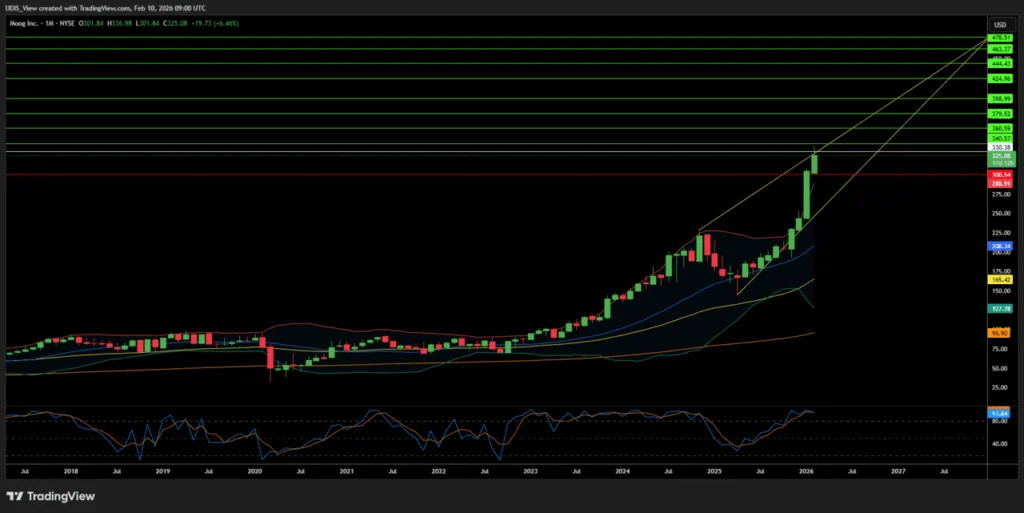
Moog Inc. Long (Buy)
Enter At: 330.38
T.P_1: 340.57
T.P_2: 360.59
T.P_3: 379.52
T.P_4: 398.99
T.P_5: 424.96
T.P_6: 444.43
T.P_7: 463.37
T.P_8: 478.51
S.L: 300.54