

Ondas stock (Nasdaq: ONDS) tells two stories at once. On November 12, Ondas reported record third-quarter revenue of $167.5 million. That figure ran more than 16 times above a year earlier. Backlog also climbed to $835 million. Yet four days later, the shares traded near $4.71, roughly 69% below their 52-week high of $15.28. The market now prices the share count, not the drones.
However, a quieter story sits underneath that disconnect. Ondas has turned a small rail-radio company into a multi-domain defense group in under two years. Today, its best contracts come from the U.S. Army, Israel’s Ministry of Defense and a European munitions program. However, those same wins pull margins down, while a falling share price creates accounting profits. This analysis follows the technology, the patents and the money behind that paradox.
Ondas Stock at a Glance
| Indicator | Figure |
|---|---|
| Price, November 16, 2026 | About $4.71 |
| 52-week high | $15.28 |
| Market value | About $2.7 billion |
| Shares outstanding, September 30 | 590.2 million |
| Q3 2026 revenue | $167.5 million |
| Backlog, September 30 | $835 million |
| Cash and short-term investments | $820.3 million |
| 2026 revenue guidance | At least $550 million |
| 2027 revenue target | At least $1.1 billion |
Sources: company Q3 release; MarketBeat; Investing.com.
The Untold Story: Why Winning Lowers Ondas Stock Margins
At first glance, most investors read the margin drop as a warning. The third-quarter release shows GAAP gross margin falling to 21.8% from 43.1% in the second quarter. Adjusted gross margin fell to 34.8% from 50.4%. In response, management blamed intangible amortization, acquired-inventory step-ups and early production inefficiencies.
Then the earnings call added a sharper detail. A higher share of lower-margin precision-strike work drove the decline. Most of that work, in turn, comes from Mistral, which supplies the U.S. Army’s Lethal Unmanned Systems program. In August, Mistral won an order of more than $50 million under a $982 million IDIQ contract.
In other words, Ondas’s most strategic win carries its thinnest margin. After all, lethal hardware sells in volume, but it rarely sells at software margins. Every new munitions order can lift revenue and pressure margins at the same time. For now, management expects fourth-quarter gross margin near third-quarter levels. Over 12 to 24 months, however, it targets 45% to 50%.
| Q3 2026 metric | Q2 2026 | Q3 2026 |
|---|---|---|
| Revenue | $83.8M | $167.5M |
| GAAP gross margin | 43.1% | 21.8% |
| Adjusted gross margin | 50.4% | 34.8% |
| Operating loss | $162.9M | $189.5M |
| Adjusted EBITDA | Minus $46.2M | Minus $59.7M |
| Net loss | $89.7M | $64.7M |
The Warrant Mirror: When Ondas Stock Falls, Profits Rise
Meanwhile, the filing hides its strangest number elsewhere. Ondas carried a $918.6 million warrant liability on September 30. Because of accounting rules, the company must revalue those warrants each quarter. When the share price drops, the liability shrinks, and the company books a gain.
That mechanism produced $125.1 million of non-cash gains in the third quarter. As a result, the net loss came in far smaller than the $189.5 million operating loss. In fact, for the first nine months, Ondas reported net income of $206.9 million. A falling stock price flattered the bottom line, while operations burned cash.
Therefore, investors should ignore headline net income here. Operating loss, adjusted EBITDA, and cash use tell the real story. Management now targets company-wide adjusted EBITDA breakeven in the third quarter of 2027. Previously, it aimed for the fourth quarter of 2027.
Geopolitics: Three Fronts Feeding One Backlog
Ondas now sells into three conflict-driven markets at once, each tied to Middle East and global security risk. Yet each one carries different politics and different economics.
First, Israel. On August 11, the Israeli Ministry of Defense picked Ondas for “Digital Bat,“ a low-cost tactical attack drone program. On November 10, Ondas announced an initial purchase order, without disclosing its value. For production, the company plans to use ARAN Defense. Ondas expects to acquire that Israeli manufacturer in the fourth quarter.
Second, the United States. Here, the Army’s LUS program and DZYNE’s counter-drone products give Ondas direct Pentagon exposure. Meanwhile, Sentrycs won selection to protect 2026 FIFA World Cup venues against rogue drones.
Third, Europe. On October 5, Ondas received a $56 million order for electronic safe-and-arm devices. Specifically, these units control the arming of a European loitering munition. Ondas’s Bron unit manufactures them in Poland, outside U.S. ITAR export rules. That Polish base lets Ondas sell munition components into NATO without American export licenses.
Ondas Stock and the Barnea Signal
In August, former Mossad director David Barnea joined Ondas as global president, according to The Times of Israel. He left the Mossad in June 2026. From now on, he will focus on the Middle East, Europe and Asia. Notably, Ondas stated that he will not use or disclose classified information.
Similarly, other senior hires follow the same pattern. Former Rafael CEO Yoav Har-Even joined an advisory board in November 2025. Retired U.S. Army Brigadier General Patrick Huston became chief operating officer in December 2025. Rafael veteran Oshri Lugassy now serves as co-CEO of Ondas Autonomous Systems.
In our view, these appointments open doors, but they do not guarantee contracts. Our research inputs claimed Ondas beat Elbit and Rafael for Digital Bat. However, neither the company release nor Israeli press coverage names any rival. Therefore, that claim stays unverified.
The Science of Taking Over a Drone
Counter-drone defense usually means jamming or shooting. Sentrycs, which Ondas bought for about $225 million, takes a third path. Its system reads the radio protocol a hostile drone uses. Then it impersonates the controller and lands the drone in a safe zone.
That approach matters in crowded places. Broadband jamming can disrupt nearby police radios, phones, and aircraft links. By contrast, protocol takeover targets one aircraft and leaves the rest of the spectrum alone. Hence, stadiums and city venues favor it. On the earnings call, management said Sentrycs’ pro forma revenue grew more than 3.5 times year over year.
Still, the method has a ceiling. It works only against drones whose protocols the system recognizes. Fiber-optic drones and fully autonomous drones emit no control link to hijack. Protocol takeover wins in cities, but kinetic interceptors still decide the battlefield. That gap explains why Ondas also bought DZYNE’s IonStrike. Larger contractors such as CACI chase the same counter-drone budgets.
Technology: The Cost-Exchange Math Behind the Game Changer
Above all, the strongest technology argument concerns cost, not capability. The DZYNE deal, valued at $875.8 million, brought ULTRA, a long-endurance autonomous ISR aircraft. On the earnings call, management compared ULTRA with General Atomics’ MQ-9 Reaper.
| One continuous ISR orbit (management estimates) | MQ-9 Reaper | ULTRA |
|---|---|---|
| Upfront cost | About $200M | About $25M |
| Annual operating cost | Over $50M | About $23M |
| Production target | Not applicable | 10 aircraft per month by 2028 |
Admittedly, these figures come from Ondas, not from independent audits. Still, the direction matters. If an air force can buy several orbits for the price of one, procurement math shifts.
Similarly, DZYNE’s IonStrike interceptor targets Shahed-class drones. Ondas aims for a unit price below $50,000. Management expects output of hundreds per month in early 2027, then thousands by late 2027. So far, it has also received a $10 million integration order. A sub-$50,000 interceptor could change who wins the drone-defense budget.
Likewise, the supply chain follows the same logic. Ondas agreed to buy Stemme, the German company that builds ULTRA’s airframe. Stemme’s European plant runs at only about 25% utilization. Consequently, Ondas can scale without building every factory from scratch.
Ondas Stock Patents: The Moat That Belongs to Someone Else
Patents reveal the biggest gap between narrative and record. Our research inputs credited Ondas’s Airobotics unit with US 11,829,162. That patent covers locking a drone onto a ground vehicle. However, public records disagree. Justia lists Teledyne FLIR Detection as its assignee. In fact, Teledyne FLIR competes directly in unmanned ground systems.
Likewise, the cited 2015 docking application names Brisbane inventor Paul Pounds, not Airobotics. As a result, neither patent supports an Ondas docking moat. By contrast, Ondas Networks does own US 12,021,767. This patent covers subchannel bit maps for private land mobile radio bands used by railroads.
| Patent | Owner per public records | Subject | What it means for Ondas |
|---|---|---|---|
| US 12,021,767 | Ondas Networks | Subchannel allocation for rail radio | Real, but tied to a minor unit |
| US 11,829,162 | Teledyne FLIR Detection | Drone locking pad on a ground vehicle | A rival’s patent, not an Ondas moat |
| US 9,577,445 | Inventor Paul Pounds | Vehicle replenishment docking | Not an Ondas asset |
| Airobotics filings | Airobotics | Docking and battery-swap stations | About 25 applications, per GoodIP |
Why Integration Beats Patents for Ondas
In our view, Ondas’s moat does not live in patent claims. Instead, it lives in production capacity, export-friendly factories and customer relationships. For example, ARAN brings Israeli machining and assembly. Stemme brings German airframe capacity. Bron brings a NATO-based, non-ITAR munitions line. For Ondas stock, manufacturing scale matters more than intellectual property. Yet scale is replicable, and well-funded rivals can buy their way in too.
Capital Structure: The Price of Building an Empire
Ultimately, the share count explains the stock’s fall. Ondas reported about 105.7 million shares in March 2025. By September 30, 2026, the figure reached 590.2 million. That marks more than a fivefold increase in 18 months.
Meanwhile, acquisitions consumed much of the capital. Cash fell from roughly $1.4 billion at the end of June to $820.3 million. About $431 million went to acquisitions during the third quarter alone. In addition, Ondas owes $268.2 million in accrued purchase and contingent consideration.
| Major deal | Approximate value | Capability |
|---|---|---|
| Sentrycs (Nov 2025) | About $225M | Protocol-based counter-drone control |
| DZYNE Technologies (Jul 2026) | $875.8M | ULTRA, IonStrike, Blitz |
| Mistral | Not verified | U.S. Army LUS supplier |
| GATE and Bron | Not disclosed | Electronic safe-and-arm devices |
| ARAN Defense | Pending | Israeli production for Digital Bat |
| Stemme | Pending | German airframes for ULTRA |
Now, management promises a “more measured” acquisition pace. It may also seek non-dilutive capital for the ULTRA ramp. Therefore, shareholders should hold management to both statements.
What the CEO’s Sale Really Shows
In June, CEO Eric Brock appeared to sell $31.9 million of stock. However, his Form 4 shows the company sold 2,378,245 shares to cover tax withholding. That followed the vesting of 4.5 million RSUs. Brock still holds about 4.7 million shares, plus 9 million unvested RSUs. Those RSUs vest through 2029, so his incentives stay tied to the share price.
Scenarios for Ondas Stock
The scenarios below reflect our judgment, not forecasts.
| Scenario | What happens | Implication |
|---|---|---|
| Bull | Margins recover toward 45%, IonStrike scales, dilution stops | The market re-rates revenue it already sees |
| Base | Revenue hits targets, but margins recover slowly | Shares track execution with high volatility |
| Bear | Integration stumbles, cash falls, new equity follows | Per-share value erodes despite growth |
In addition, macro conditions add pressure. The Federal Reserve held rates at 3.75% to 4.00% on October 28 after a September hike. Meanwhile, Ondas carries a beta near 3.1. Smaller peers covered in our drone component stocks guide show similar swings. By contrast, established contractors such as L3Harris and Leidos fund growth from cash flow. Israeli suppliers like T3 Defense face similar dilution trade-offs at a far smaller scale. Middle East conflict, as seen during the 2026 VIX surge, can lift demand and volatility together.
Key Risks for Ondas Stock
- Dilution. The share count rose more than fivefold in 18 months.
- Margins. Lethal hardware mix may keep gross margins low.
- Integration. More than 15 deals in two years strain management.
- Cash. Acquisitions cut liquidity by roughly $600 million in one quarter.
- Accounting. Warrant revaluations distort net income in both directions.
- Geopolitics. A ceasefire or export restriction could slow orders.
- Validation. Key cost claims for ULTRA and IonStrike come from management.
Closing Thoughts
Ondas has assembled real defense capabilities at remarkable speed. These include Army loitering munitions, Israeli attack drones, NATO munition components and low-cost ISR aircraft. Moreover, the geopolitical demand behind them looks durable. However, the untold story cuts against the headline growth. Its most strategic wins dilute margins. Its showcased docking patent belongs to a rival. Meanwhile, its falling share price inflates reported profits. For Ondas stock, the next phase depends on margins and share discipline, not on new deals.
Sources
- SEC: Ondas Q3 2026 results release (Form 8-K, Exhibit 99.1)
- Motley Fool: Ondas Q3 2026 earnings call transcript
- Ondas IR: Digital Bat purchase order and ARAN Defense
- Ondas IR: Selected for Israel’s Digital Bat program
- Ondas IR: U.S. Army Lethal Unmanned Systems order
- Ondas IR: $56 million European safe-and-arm order
- Ondas IR: Counter-drone protection for the 2026 FIFA World Cup
- Ondas IR: Eric Brock Form 4, June 2026
- Ondas IR: Patrick Huston appointed COO
- Ondas IR: Yoav Har-Even joins advisory board
- The Times of Israel: Former Mossad chief David Barnea joins Ondas
- CTech: Ondas selected for Digital Bat
- Inside Unmanned Systems: DZYNE acquisition for $875.8 million
- Ondas IR: Sentrycs acquisition completed
- Justia Patents: Teledyne FLIR Detection (US 11,829,162)
- Justia Patents: Ondas Networks application 20220103316 (US 12,021,767)
- Justia Patents: Application 20150069968 (US 9,577,445)
- GoodIP: Airobotics Ltd patent portfolio
- Ondas 10-K for 2024 (shares outstanding, March 2025)
- Investing.com: Stifel lowers Ondas target to $15
- The Cerbat Gem/MarketBeat: Ondas shares fall 8.7%
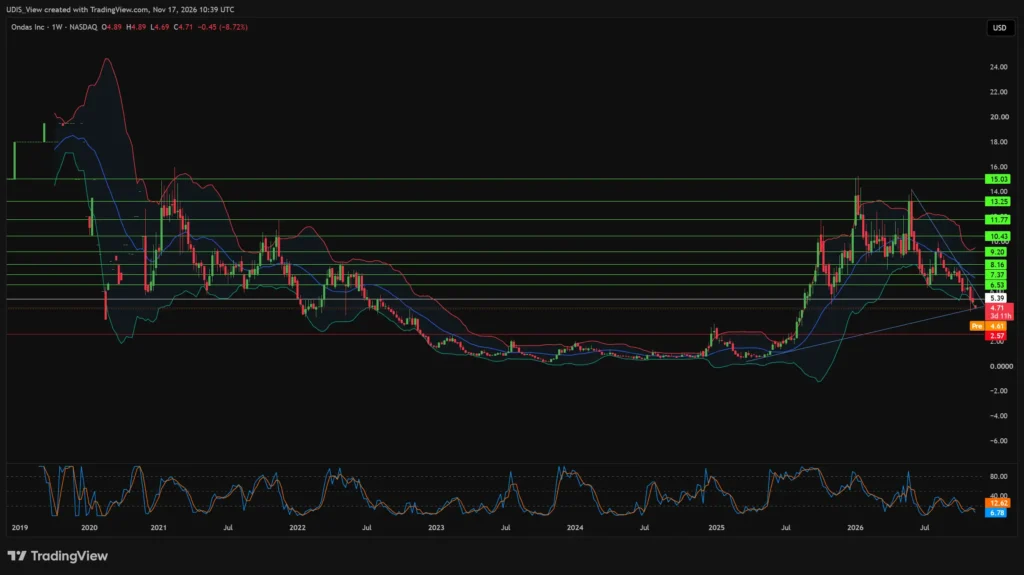
Ondas Long (Buy)
Enter At: 5.39
T.P_1: 6.53
T.P_2: 7.37
T.P_3: 8.16
T.P_4: 9.20
T.P_5: 10.43
T.P_6: 11.77
T.P_7: 13.25
T.P_8: 15.03
S.L: 2.57