

T3 Defense stock trades like a lottery ticket, yet its factories build parts for Israel’s air-defense machine. Shares closed at $2.48 on November 11, 2026. That price sits more than 99% below a split-adjusted 52-week high of $930. Meanwhile, its subsidiaries ship power systems, precision rotators and command shelters to Israel’s top defense primes. The untold story is a split between useful defense factories and a fragile public shell.
Until February 9, 2026, the company traded as Nukkleus, a fintech shell. Since then, it has bought or invested in eight Israeli defense businesses. This analysis follows the technology, the science and the patents behind them. It also shows why common shareholders carry most of the risk.
T3 Defense Stock at a Glance
| Indicator | Figure |
|---|---|
| Ticker and exchange | DFNS, Nasdaq |
| Close, November 11, 2026 | $2.48 (up 12.7% on the day) |
| Split-adjusted 52-week high | $930 |
| Shares outstanding, November 4 | 4,600,369 |
| Approximate market value | About $11 million (our calculation) |
| First-half 2026 revenue | $7.65 million |
| First-half 2026 net loss to stockholders | $109.6 million, mostly non-cash |
| Next catalyst | Special meeting, November 30, 2026 |
The Untold Story Behind T3 Defense Stock: Boring Parts, Vital Roles
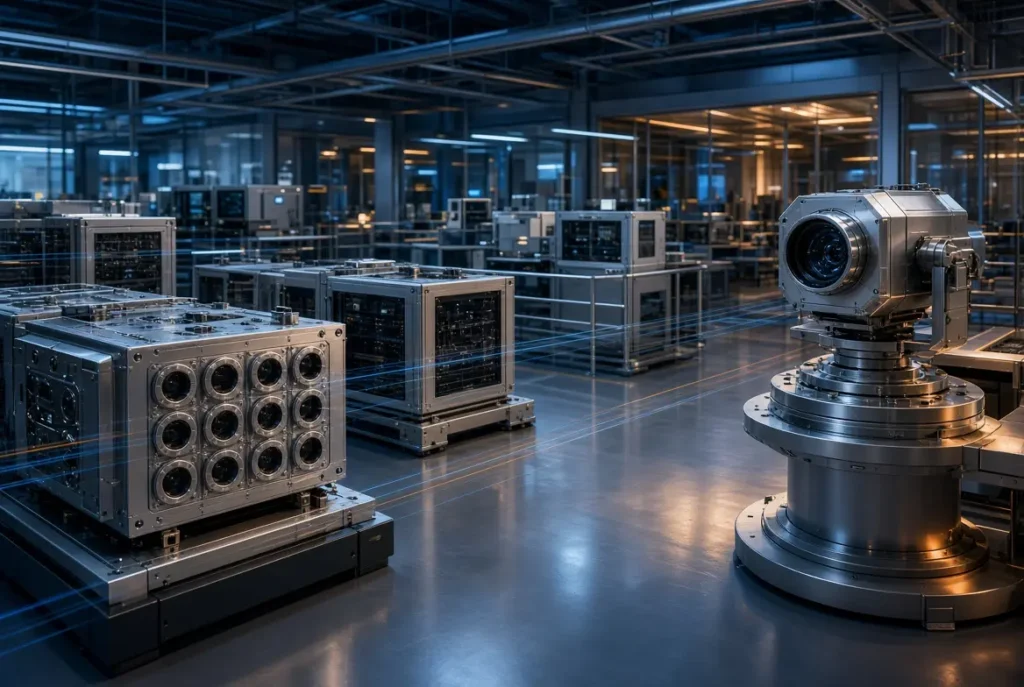
Most drone stocks sell airframes. T3 sells the layers beneath them. Rimon Agencies, founded in 1988, works as a tier-two and tier-three supplier. In February 2026, it won multi-year contracts worth about $4.1 million for Iron Dome power and subsystem parts. Its customers include Rafael Advanced Defense Systems.
Then, in September, Rimon won a $1.3 million order for power-generation systems. These units serve a European air-defense production line for a large Israeli contractor. Rimon’s CEO called it “a production-line order, not a one-off delivery.” That phrase matters, because production lines repeat.
Similarly, Positech builds gearless, direct-drive single-axis rotators. These rotators point radars, electro-optical sensors and counter-drone equipment. Positech reported $4.9 million in active deliveries in June. In October, it shipped the first batch of a $3.9 million order. It expects to finish that order in the first quarter of 2027.
Meanwhile, Rimon delivered a mobile UAV command container to BlueBird Aero Systems on November 5. BlueBird holds a strategic partnership with Israel Aerospace Industries. A first command vehicle went to B.K. Vision in October. These components rarely make headlines, but air-defense batteries cannot run without them.
The Contracts Behind T3 Defense Stock
| Subsidiary | Recent award or delivery | Value | Date |
|---|---|---|---|
| Rimon | Iron Dome power and subsystem parts | About $4.1M, multi-year | Feb 2026 |
| Rimon | European air-defense power generation | About $1.3M | Sep 2026 |
| Positech | Active single-axis rotator deliveries | $4.9M | Jun 2026 |
| Positech | First shipment, heavy-duty rotator order | $3.9M | Oct 2026 |
| Tiltan | Simulation for an Israeli UAS program | $1.3M | 2026 |
| Rimon | UAV command container for BlueBird | Not disclosed | Nov 2026 |
| Nimbus | Exclusive Israeli rights, Falkon-BOS | Not disclosed | Nov 2026 |
Why Cheap Drones Rewrote Air-Defense Math
Geopolitics explains why these niches suddenly matter. CSIS analysis cites a $2 million Standard Missile-2 fired at $2,000 Houthi drones. On its own, however, that ratio misleads. CSIS argues the defended asset, not the drone, sets the real value. Still, no military can sustain million-dollar shots against swarms forever.
As a result, ministries now buy layered and cheaper defenses. They want sensors on precise mounts, persistent overhead surveillance, and low-cost interceptors. The 2026 Iran conflict, which drove a sharp VIX surge, reinforced that demand. Therefore, suppliers of rotators, tethered drones and power units gain relevance.
In July 2026, T3 bought 60% of Project35, an Israeli drone and counter-drone developer. Project35 completed live-fire trials of an autonomous, AI-guided aerial interceptor. Its customers include IAI, ELTA, Elbit, Rafael and Israel’s Ministry of Defense. If cheap interceptors prove reliable at scale, they could become the real game changer in drone defense.
Persistent Eyes Above the Battlefield
On November 11, Nimbus secured exclusive Israeli rights to Copting’s Falkawn-BOS tethered drone. A tethered drone draws power through a cable, so it can hover for long periods. It suits fixed sites and mobile command vehicles. T3’s CEO expects a “meaningful” contribution to Nimbus revenue in 2027. Shares rose 12.7% that day. Yet the release disclosed no deal value. Readers comparing small suppliers can review our drone component stocks guide.
Geostrategy: How T3 Defense Stock Rides Israel’s Export Corridor
T3 rides a larger trend. Israel’s Defense Ministry reported a record $19.2 billion in 2025 defense exports. That marked the fifth straight annual record. Government-to-government deals reached about $10 billion.
However, Europe’s share fell to 36% in 2025, from 54% in 2024. That shift weakens the simple “Europe buys everything” thesis. Political pressure in several capitals can slow export licenses. Social stress also matters, as our analysis of European market stress shows. Therefore, T3’s European order works more as a door than as a revenue engine.
| Israeli defense exports | 2024 | 2025 |
|---|---|---|
| Total value | $14.8B | $19.2B |
| Europe’s share | 54% | 36% |
| Missiles, rockets and air defense | 48% | 29% |
| Annual record streak | Fourth year | Fifth year |
Sources: Defense News on 2024 exports; Israel Ministry of Defense for 2025.
The Rollup as a Geostrategic Tool
Large primes such as Elbit, IAI and Rafael carry heavy backlogs. Overflow work flows to smaller qualified suppliers. T3 buys those suppliers and funds them through US equity markets. In effect, American retail capital finances Israeli defense capacity. Unlike L3Harris, though, T3 lacks the scale to fund growth internally.
Notably, the KeepZone AI deal shows a smarter structure. T3 paid $1.54 million in stock at closing on November 4. The seller, Nexera Technologies, can earn up to $5 million more in cash. That earn-out equals half of KeepZone’s profits over 24 months. T3 pays extra only if the unit actually earns money.
The Hidden Science Inside T3 Defense Stock
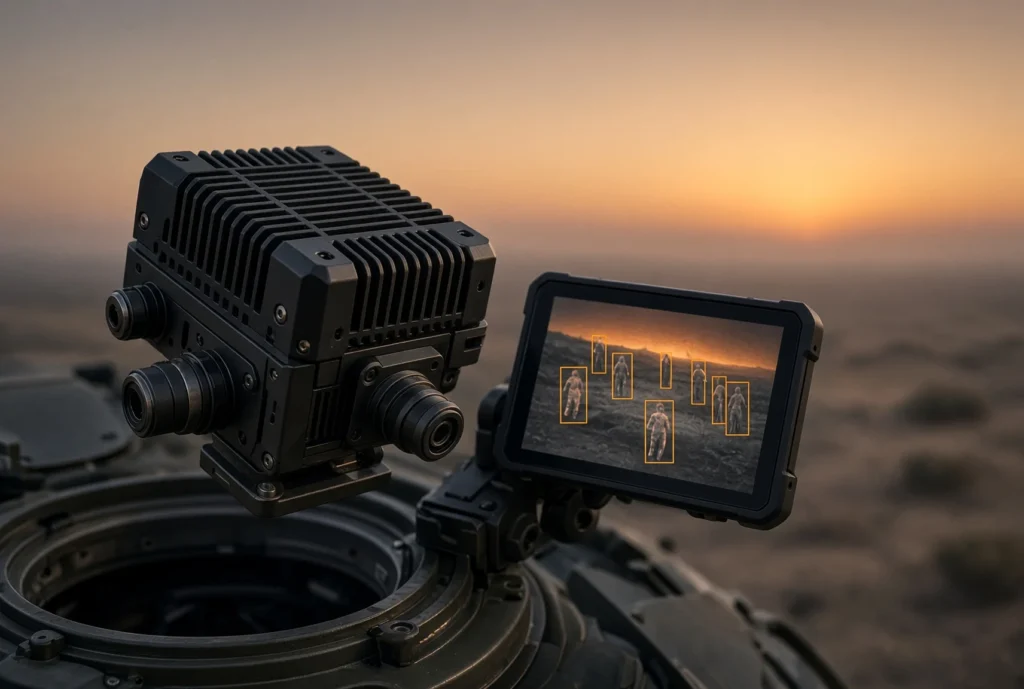
Tiltan will launch TOPS-NX Studio and SILOS at I/ITSEC, from November 30 to December 3 in Orlando. Organizers call it the world’s largest modeling, simulation and training event. TOPS-NX Studio models sensors in visible, thermal infrared, SAR, and LiDAR bands. Its infrared engine uses a validated library of more than 250 materials.
That physics matters. Thermal sensors see heat, and every material emits heat differently. Accurate material libraries let AI models train on synthetic scenes before costly field tests. Next, SILOS plugs real sensors, platforms, and autonomy into a “battle lab.” It then scores live simulations against ground truth.
Consequently, Tiltan sells something autonomous drones cannot work without: validated training data. Synthetic data cuts the time and cost of collecting real imagery. Tiltan also exhibited at MSPO 2026 in Poland, a NATO market. The Orlando launch tests whether an Israeli simulation niche can win Pentagon-scale customers. Still, T3 itself warns that long qualification cycles and export controls may delay orders.
T3 Defense Stock Patents: Thin, Misread and Revealing
Patents tell a quieter story. Our research inputs credited Tiltan with WO2005099386A2 and CA2902349C. Public records do not support that link. WO2005099386A2 covers a holographic projector. Instead, Justia lists Tiltan Systems Engineering as assignee of US 8,244,026. That patent covers processing of LiDAR point-cloud data. The USPTO granted it in August 2012 after a January 2009 filing. Without extensions, it should expire around 2029.
Competitor patents also needed correction. AeroVironment does own US 11,029,684, a UAV controller safety patent. However, US 10,946,960 belongs to Vantage Robotics, not Red Cat. It detects unauthorized payloads through flight-power data.
| Patent | Owner per public records | Subject | Relevance to T3 |
|---|---|---|---|
| US 8,244,026 | Tiltan Systems Engineering | LiDAR point-cloud processing | Real but aging asset |
| US 11,029,684 | AeroVironment | Controller safety and return-to-launch logic | Matters for handheld controllers |
| US 10,946,960 | Vantage Robotics | Payload detection via flight power | OEMs can reject third-party add-ons |
| WO2005099386A2 | Not Tiltan | Holographic projector | Misattributed in research |
Why Qualification Beats Patents Here
In our view, T3’s moat does not sit in patents. Instead, it sits in supplier approvals, clearances, and delivery records with Rafael, IAI, and Elbit. Those approvals take years to earn. A new rival cannot copy them through a patent filing. For T3 Defense stock, trust inside the supply chain matters more than intellectual property. Yet trust stays intangible, and outside investors cannot easily verify it.
T3 Defense Stock Financials: Factories Versus the Shell
The June 30 Form 10-Q shows the split clearly. First-half revenue reached $7.65 million, with gross profit of $1.38 million. The net loss to stockholders hit $109.6 million. However, warrant revaluations caused $107.6 million of that loss, a non-cash charge.
Here is a detail most coverage skipped. First-quarter revenue reached about $3.65 million, with roughly $0.37 million of gross profit. That implies second-quarter revenue near $4.0 million and gross margin near 25%. By contrast, first-quarter margin ran near 10%. These figures are our estimates, derived from reported totals. Moreover, Rimon alone booked a record $2.6 million of revenue in July.
| Operating metric | Q1 2026 | Q2 2026 (derived) | H1 2026 |
|---|---|---|---|
| Revenue | About $3.65M | About $4.0M | $7.65M |
| Gross profit | About $0.37M | About $1.01M | $1.38M |
| Gross margin | About 10% | About 25% | About 18% |
| Balance sheet, June 30, 2026 | Figure |
|---|---|
| Cash and equivalents | $4.1M |
| Current assets | $21.2M |
| Current liabilities | $153.2M |
| Warrant liabilities | $124.4M |
| Goodwill | $99.0M (year-end 2025: $7.7M) |
| Operating cash flow, first half | Minus $9.8M |
Dilution Is the Real Risk
The share count rose from 758,660 on June 30 to 1,663,806 by August 14. It then reached 4,600,369 by November 4. That marks roughly a sixfold rise in about four months. Acquisitions, placements and warrant activity all fed that growth.
Next, the November 30 special meeting adds new tools. Shareholders will vote on reverse splits from 1-for-2 up to 1-for-250. They will also vote on a 1,275,000-share equity plan. Another proposal keeps CEO Menachem Shalom at 8% ownership, fully diluted, for seven quarters. If he leaves, the award tops him up to 15%. Each proposal shifts value from today’s holders toward management and future capital providers.
The Human Network Behind the Rollup
People explain T3’s access. In February, Emil Blumer joined as chief business officer. He brings more than 25 years in defense, including senior program roles at Rafael. He later held leadership roles at Avnon and Magal. Jordan Buchler became CEO of the manufacturing division, overseeing ITS and Positech. His mandate focuses on turning backlogs into repeatable production.
In October, Shlomo Zakai replaced Roy Cohen as CFO. Zakai previously served as CFO of Duke Robotics. Meanwhile, Shalom, a financial structurer, drives the acquisition strategy. Noble Financial rates the shares Buy with a $30 target, raised in August. In contrast, short seller Fugazi Research called the company “uninvestable.” The operators bring credibility, while the capital structure keeps eroding it.
Scenarios for T3 Defense Stock
The scenarios below reflect our judgment, not forecasts.
| Scenario | What happens | Implication for common holders |
|---|---|---|
| Bull | Orders repeat, margins hold near 25%, dilution slows, Tiltan wins US work | Re-rating possible from a tiny base |
| Base | Revenue grows, but placements and splits continue | Business grows while per-share value lags |
| Bear | Liquidity tightens, new shares flood supply, another split follows | Further steep per-share losses |
In addition, the Federal Reserve held rates at 3.75% to 4.00% on October 28. Expensive capital punishes cash-burning micro-caps that rely on equity. Compared with larger contractors like CACI, T3 has almost no room for financing mistakes. Broader Middle East market risk adds another layer of volatility.
Key Risks for T3 Defense Stock
- Dilution. Shares rose about sixfold between June 30 and November 4.
- Reverse splits. The board seeks authority up to 1-for-250.
- Liquidity. Current liabilities far exceed current assets.
- Governance. The CEO award could lift his stake to 15% after departure.
- Integration. Eight deals in about a year strain reporting and controls.
- Concentration. Israeli defense demand drives most revenue.
- Geopolitics. A ceasefire or European license curbs could slow orders.
- Volatility. A float of a few million shares invites extreme swings.
Closing Thoughts
T3 Defense owns real, unglamorous capabilities. These include Iron Dome power parts, precision rotators, command shelters and physics-based simulation. Those niches sit exactly where drone warfare creates new demand. The untold story, however, runs in two directions. The factories look healthier than the headline losses suggest. Yet the public shell keeps transferring value away from common holders. For T3 Defense stock, the case depends on whether dilution stops before the factories can scale.
Sources
- SEC: T3 Defense Form 10-Q, June 30, 2026
- SEC: T3 Defense definitive proxy statement, special meeting November 30, 2026
- Israel Ministry of Defense: 2025 defense export record
- Defense News: Israel’s 2024 defense export record
- CSIS: Cost and value in air and missile defense intercepts
- Justia Patents: Tiltan Systems Engineering
- Justia Patents: US 10,946,960, Vantage Robotics
- Stock Titan: Copting tethered drone distribution deal
- Finviz: BlueBird command center delivery
- Finviz: Tiltan TOPS-NX Studio and SILOS at I/ITSEC 2026
- GlobeNewswire: Positech first deliveries on $3.9 million order
- Stock Titan: Rimon multi-year Iron Dome component contracts
- Finviz: $1.3 million European air-defense power order
- Army Technology: T3 Defense takes 60% of Project35
- Finviz: Nexera completes KeepZone AI sale
- GlobeNewswire: Rafael and Avnon veterans join T3 Defense
- Finviz: Noble Financial Buy rating
- Webull/Benzinga: Fugazi Research short report
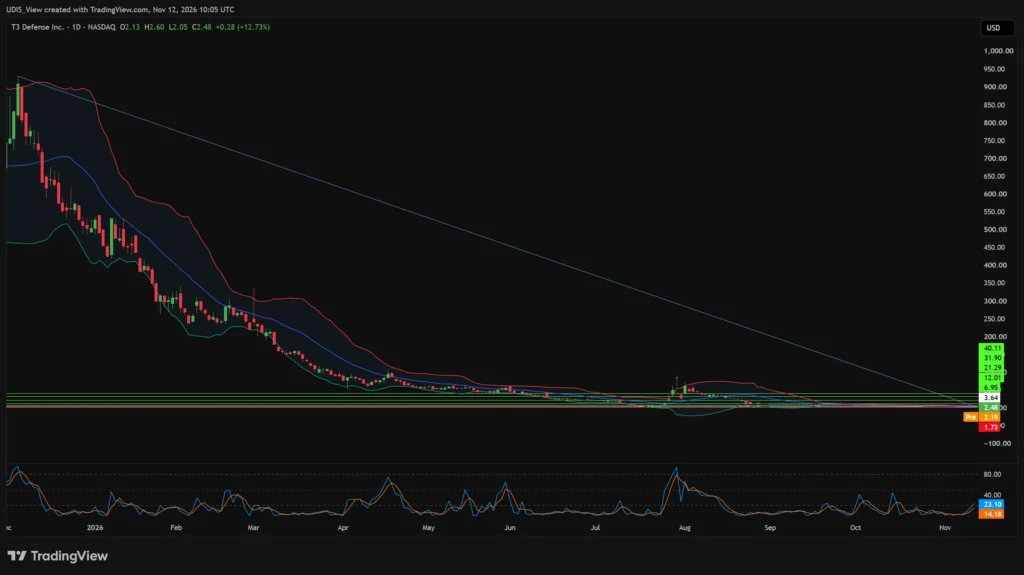
T3 Defense Long (Buy)
Enter At: 3.64
T.P_1: 6.95
T.P_2: 12.01
T.P_3: 21.29
T.P_4: 31.90
T.P_5: 40.11
S.L: 1.73