

SELLAS stock (Nasdaq: SLS) closed at $19.15 on November 17, 2026, up 156% in one session. That morning, SELLAS reported that its leukemia vaccine, galinpepimut-S (GPS), extended survival in a pivotal Phase 3 trial. By the afternoon, it had launched a $150 million share offering. The headline says breakthrough, but the filings tell a more complicated story.
Still, three threads sit beneath the rally. First, several of the original U.S. patents covering GPS peptides expire between 2026 and 2029. Second, SELLAS’s second drug comes from a Shanghai company, which also manufactures it. Third, the survival data look strong, yet key statistics remain unpublished. This analysis connects the science, the patents, and the geopolitics behind the move.
SELLAS Stock at a Glance
| Indicator | Figure |
|---|---|
| Close, November 16, 2026 | $7.47 |
| Close, November 17, 2026 | $19.15 (up 156.4%) |
| Shares outstanding, September 30 | 203.5 million |
| Implied market value at $19.15 | About $3.9 billion (our calculation) |
| Cash, September 30, 2026 | $134.7 million |
| Q3 2026 net loss | $10.1 million |
| Proposed offering | $150 million, plus a $22.5 million option |
| Product revenue | None |
Sources: SELLAS Q3 release; preliminary prospectus supplement; Investing.com.
The REGAL Result Behind SELLAS Stock
Specifically, REGAL enrolled 126 patients with acute myeloid leukemia (AML) in second remission. These patients could not undergo a stem cell transplant. Then investigators randomized them to GPS or to the best available treatment. That comparator included observation, hypomethylating agents, venetoclax or low-dose cytarabine.
According to the company’s topline release, median overall survival reached 24.0 months with GPS. By comparison, the control arm reached 14.7 months. The hazard ratio of 0.59 implies a 41% lower risk of death, with a two-sided p-value of 0.035. Most side effects involved mild injection-site reactions.
Importantly, no approved maintenance therapy exists for this setting. Bristol Myers Squibb’s Onureg covers maintenance only after a first remission. If the FDA accepts the data, GPS would enter a market with no direct approved rival. SELLAS plans to meet the FDA in the first half of 2027 to discuss a Biologics License Application.
| REGAL topline data | GPS | Best available treatment |
|---|---|---|
| Patients randomized | 126 in total (1:1) | 126 in total (1:1) |
| Median overall survival | 24.0 months | 14.7 months |
| Hazard ratio | 0.59 | Reference |
| Two-sided p-value | 0.035 | Not applicable |
| Confidence interval | Not disclosed | Not disclosed |
What the Survival Data Do Not Yet Show
The release omits the confidence interval, Kaplan-Meier curves, and secondary endpoints. That matters, because a p-value of 0.035 clears the bar with little room to spare. In addition, REGAL ran open-label, so patients and doctors knew the assignments.
Meanwhile, the trial’s history adds context. In 2022, SELLAS cut the final analysis trigger from 105 deaths to 80. Then, in January 2025, a 60-event interim analysis passed futility, and management expected the final count “later this year.” Yet the 80th death arrived only in late October 2026.
That slow accrual cut both ways. On one hand, patients lived longer than planned. On the other hand, the stock fell almost 15% on October 28, as traders feared a diluted effect. The control arm beat the roughly eight months assumed in planning, according to TechTimes. So GPS had to clear a higher bar. In our view, that detail strengthens the result, but only full data can confirm it.
The Science: Why This WT1 Vaccine Works Where Others Failed
At its core, WT1 is a protein that many leukemias overproduce. However, the body treats WT1 as “self,” so the immune system largely ignores it. GPS uses heteroclitic peptides, meaning chemists swap specific amino acids to provoke a stronger T-cell response. Those T cells then recognize the natural WT1 protein on cancer cells.
Yet not every WT1 vaccine has succeeded. In December 2021, Sumitomo Dainippon stopped its Phase 3 DSP-7888 trial in glioblastoma for low odds of success. That failure involved a bulky solid tumor.
By contrast, SELLAS chose a setting with little visible disease. Patients in second remission carry only residual leukemia cells. Peptide vaccines appear to work best when chemotherapy has already cleared most of the tumor. Therefore, REGAL validates a niche strategy, not a universal cancer vaccine. Management’s broader ambitions in mesothelioma and myeloma remain unproven.
SELLAS Stock Patents: The Untold Clock
Next comes the least discussed part of the story. GPS’s patents mostly belong to Memorial Sloan Kettering Cancer Center (MSK), which licenses them to SELLAS. Justia lists MSK as assignee of US 11,033,613, which covers WT1 peptides combined with checkpoint inhibitors.
The 2025 Form 10-K reveals the timing problem. For instance, several U.S. patents on the original long WT1 peptides expire from 2026 to 2029. In contrast, newer composition patents run to 2034 and 2035. Meanwhile, PD-1 combination claims extend to 2037, and co-owned seven-peptide applications could reach 2040.
| GPS and SLS009 patent family | Owner | Expected expiry |
|---|---|---|
| Original long WT1 peptides (several U.S. patents) | MSK, licensed | 2026 to 2031 |
| Newer WT1 peptide compositions | MSK, licensed | 2034 to 2035 |
| WT1 plus PD-1 combination | MSK, licensed | 2037 (U.S.) |
| Seven-peptide compositions (pending) | Co-owned with MSK | 2040, if granted |
| SLS009 composition and use | GenFleet, licensed | 2038 |
| SLS009 polymorphs | GenFleet, licensed | 2042 (U.S.) |
| ASXL1-mutated cancer use (pending) | SELLAS | 2045, if granted |
Regulatory Exclusivity Beats Patents for SELLAS Stock
In our view, regulatory exclusivity matters more than these patents. Orphan drug status brings seven years of U.S. exclusivity for the approved indication. Additionally, U.S. law grants new biologics 12 years of reference-product exclusivity, if the FDA licenses GPS through a BLA. Patent term extension can add up to five years to one patent.
However, SELLAS owes MSK milestones of up to $17.4 million per product, plus mid-single-digit royalties. SELLAS controls the commercial rights, but MSK owns most of the scientific foundation. That arrangement suits a single product, yet it limits the platform value investors may assume.
Geopolitics: A Shanghai Molecule Inside a New York Company
SELLAS’s second drug, SLS009 (tambiciclib), adds a geostrategic layer. SELLAS licensed this CDK9 inhibitor in 2022 from GenFleet Therapeutics of Shanghai. The deal covers all territories outside Greater China. It included $10 million upfront and up to $140 million in milestones, plus tiered royalties.
Above all, the critical detail sits in the supply terms. GenFleet manufactures and supplies all SLS009 quantities. In other words, SELLAS depends on a Chinese partner for both the science and the physical drug.
As a result, that dependency now carries political weight. The BIOSECURE Act became law on December 18, 2025, inside the defense budget bill. It restricts federal procurement of biotechnology equipment and services from designated “companies of concern.” The government must publish that list by December 2026.
So far, nothing indicates GenFleet will appear on that list. Still, the law signals Washington’s direction. A drug made in China faces political risk even when the trials run in America. For now, SELLAS runs SLS009 trials in U.S. centers and through Europe’s IMPACT-AML network. Similar supply dependence on China shapes other sectors, as our analysis of China’s clean-tech windfall shows.
Why SLS009 Could Become the Second Act
Meanwhile, the CDK9 field has thinned. Vincerx Pharma, developer of the rival enitociclib, began winding down in April 2025. In SELLAS’s own trial, SLS009 combinations produced a 57% response rate in TP53-mutated relapsed AML. Median survival reached 8.8 months, against about 2.5 months historically. SELLAS will present updated data at the ASH meeting on December 12 to 15.
Admittedly, these results come from small, single-arm cohorts. A first-line AML trial, with 40 of 80 patients enrolled, should report preliminary data this quarter.
| SLS009 data point | Result | Context |
|---|---|---|
| TP53-mutated relapsed AML, response rate | 57% | Combination regimen, small cohort |
| TP53-mutated relapsed AML, median survival | 8.8 months | About 2.5 months historically |
| Monocytic relapsed AML, response rate | 54% | Median survival 5.8 months |
| First-line AML trial enrollment | 40 of 80 patients | Preliminary data expected Q4 2026 |
Source: SELLAS Q3 2026 release.
The Manufacturing Chain Behind SELLAS Stock
Technology also shapes the business model. GPS ships as an off-the-shelf vial for injection under the skin. By contrast, CAR-T therapies require custom manufacturing for each patient. Therefore, GPS could reach community clinics without specialized cell-therapy centers.
However, the supply chain runs through single suppliers. According to the 10-K, Polypeptide Group makes the GPS peptides as sole contract manufacturer. Likewise, a PCI Pharma Services unit performs the sole fill-and-finish step. SELLAS held no commercial supply contracts when it filed that report.
One manufacturing failure could delay launch, regardless of the clinical data. Consequently, scaling commercial supply ranks among the least visible tasks before any approval. Investors who track small-cap healthcare rallies know execution often matters more than headlines.
Capital: The Price of Reaching the Finish Line
Because SELLAS has no product revenue, equity funds everything. The share count reached 179.6 million in March 2026 and 203.5 million by September 30. Now, the company plans a $150 million offering through J.P. Morgan and TD Cowen. Underwriters hold an option for another $22.5 million. In addition, a $150 million at-the-market program with TD Securities remains in place.
At $19.15, the base offering would equal roughly 7.8 million shares, about 4% of the count. Raising money after good news costs far less than raising it before. Consequently, this raise may cause less dilution than earlier rounds. Even so, shares slipped about 10% after hours on the announcement.
Meanwhile, insider data offer a modest counterweight. For example, director Katherine Bach Kalin bought shares on the open market in 2025. She paid $1.80 in May and $1.59 in November. However, our research inputs cite larger totals, which we could only partly verify.
Who Connects SELLAS to MSK
Board member David Scheinberg chairs MSK’s Center for Experimental Therapeutics and helped develop the WT1 science. SELLAS discloses that MSK and Scheinberg hold financial interests in the company. On the plus side, that link speeds scientific collaboration. Yet it also makes independent review of REGAL data especially important.
Scenarios for SELLAS Stock
The scenarios below reflect our judgment, not forecasts.
| Scenario | What happens | Implication |
|---|---|---|
| Bull | Full data confirm benefit, FDA agrees on a 2027 BLA, SLS009 shines at ASH | Market prices a commercial-stage company |
| Base | FDA requests more analysis, BLA slips, offering funds the wait | Shares consolidate with high volatility |
| Bear | Confidence interval disappoints or FDA demands another trial | Much of the rally reverses |
In addition, biotech remains sensitive to rates. The Federal Reserve held its policy range at 3.75% to 4.00% on October 28. Pre-revenue companies depend on open equity markets, as our coverage of uniQure’s FDA reversal showed. Large acquirers also watch these readouts closely, as the Abbott and Exact Sciences deal illustrated. For broader context on event risk, see our analysis of geopolitical market volatility.
Key Risks for SELLAS Stock
- Regulatory. The FDA has not agreed to a filing route or approved GPS.
- Statistics. The p-value of 0.035 leaves little margin, and the confidence interval remains undisclosed.
- Trial design. REGAL ran open-label, which invites scrutiny.
- Patents. Early GPS patents expire from 2026 onward.
- Supply. Sole suppliers make GPS, and GenFleet makes all SLS009.
- Geopolitics. U.S.-China biotech rules may tighten further.
- Dilution. The offering, the option, and the ATM program add new shares.
Closing Thoughts
Ultimately, SELLAS delivered what few small biotechs ever achieve: a positive pivotal survival trial. The science fits a clear niche, and no approved therapy competes in that setting. Yet the untold story complicates the celebration. The founding patents are aging, the second drug depends on a Chinese manufacturer, and the full data remain unpublished. For SELLAS stock, the next gains depend on regulators and exclusivity, not on patents or headlines.
Sources
- SELLAS: Positive pivotal Phase 3 REGAL topline data (November 17, 2026)
- SELLAS: Third quarter 2026 financial results
- SELLAS: Proposed $150.0 million underwritten public offering
- SELLAS: 80th event reached in REGAL
- SEC: SELLAS Form 10-K for 2025
- Stock Titan: SELLAS preliminary prospectus supplement (424B5)
- Justia Patents: US 11,033,613 (Memorial Sloan Kettering)
- Targeted Oncology: REGAL interim analysis, January 2025
- The Pharma Letter: DSP-7888 Phase 3 halted
- Baker McKenzie: The BIOSECURE Act becomes law
- TipRanks: Vincerx Pharma initiates wind-down
- Investing.com: SELLAS shares fall on $150M offering
- RTTNews: REGAL reaches final analysis trigger
- TechTimes: REGAL data released without a confidence interval
- EDGAR Lookup: SELLAS insider transactions
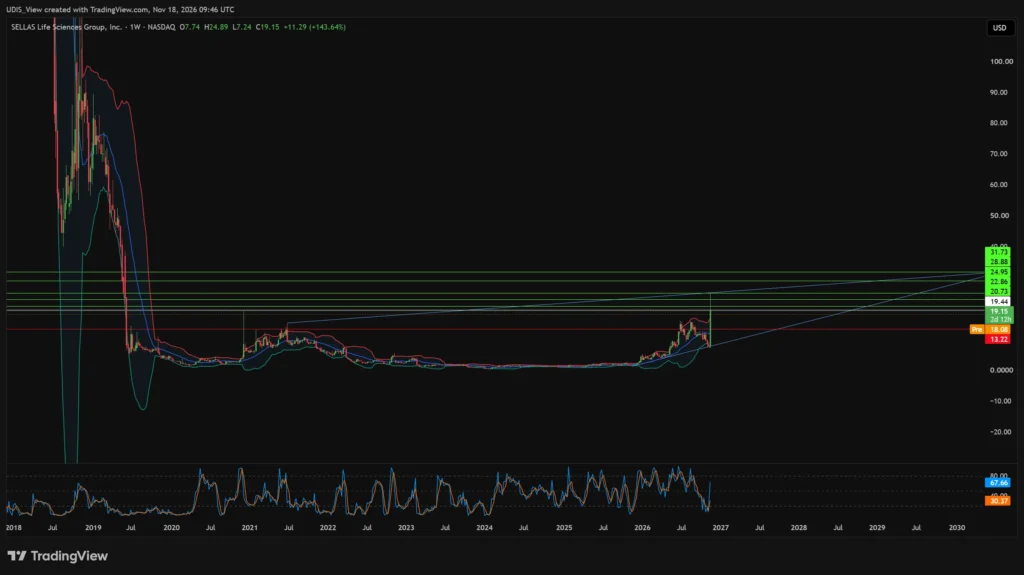
SELLAS Life Sciences Long (Buy)
Enter At: 19.44
T.P_1: 20.73
T.P_2: 22.86
T.P_3: 24.95
T.P_4: 28.88
T.P_5: 31.73
S.L: 13.22