
Genmab stock (Nasdaq: GMAB) closed at $50.60 on November 20, 2026. That sits near the top of its $23.62 to $59.97 annual range. Three positive Phase 3 cancer trials in 23 days powered the move. Yet one line in Genmab’s annual report rarely appears in the coverage. Its contract manufacturer for Rina-S, a key new cancer drug, operates in China. Genmab’s most promising new drug runs through the supply chain Washington now targets.
That detail captures a larger shift. For two decades, Genmab earned royalties on drugs that partners made and sold. Royalties stayed geopolitically invisible. Now Genmab wants to launch its own medicines, financed with $5.5 billion of debt. As a result, tariffs, procurement laws, pricing rules and patent cliffs suddenly matter far more. This analysis connects the science, the patents and the geopolitics behind the rally.
Genmab Stock at a Glance
| Indicator | Figure |
|---|---|
| ADS close, November 20, 2026 | $50.60 |
| 52-week range | $23.62 to $59.97 |
| Market value | About $31.2 billion |
| 9M 2026 revenue | $3,238 million (up 22%) |
| 9M 2026 royalties | $2,699 million (83% of revenue) |
| 9M 2026 net profit | $698 million (down 25%) |
| Borrowings, September 30 | $4,992 million |
| Cash, September 30 | $1,860 million |
| 2026 revenue guidance | $4,325 to $4,525 million |
Sources: Genmab Q3 2026 interim report (Form 6-K); Heygotrade market data.
The October Trifecta Behind Genmab Stock
The science explains the rerating. On October 28, petosemtamab plus Merck’s Keytruda cut the risk of death by 50%. The trial treated first-line head and neck cancer. The interim hazard ratio reached 0.50, with a 95% confidence interval of 0.37 to 0.67. Response odds rose more than threefold.
Petosemtamab works differently from older drugs. It binds EGFR, a growth receptor, and LGR5, a marker of cancer stem cells. In other words, it attacks both the tumor’s engine and its ability to regrow. Genmab gained the drug through its $8.0 billion purchase of Merus, paying $97 per share in cash.
Five days earlier, Rina-S beat chemotherapy in platinum-resistant ovarian cancer. In the full RAINFOL-02 population of 584 patients, it cut the risk of progression or death by 71%. It also lowered the risk of death by 57%. Meanwhile, on October 5, epcoritamab plus R-CHOP cut progression risk by 51% in newly diagnosed lymphoma.
| Phase 3 readout (October 2026) | Drug | Key result |
|---|---|---|
| LiGeR-HN1, head and neck cancer | Petosemtamab plus Keytruda | Death risk down 50% (interim) |
| RAINFOL-02, ovarian cancer | Rina-S | Progression risk down 71%, death risk down 57% |
| EPCORE DLBCL-2, lymphoma | Epcoritamab plus R-CHOP | Progression risk down 51% |
Few mid-sized biotechs ever post three pivotal wins in one month. According to market reports, the Copenhagen shares gained about 44% in a single week. However, all three results still await full presentation and regulatory review.
Why Rina-S Could Change Ovarian Cancer Treatment
Rina-S belongs to a class called antibody-drug conjugates. An antibody delivers a chemotherapy payload directly to cancer cells. Rina-S targets folate receptor alpha, a protein many ovarian tumors carry. It carries exatecan, a potent topoisomerase inhibitor, at a high ratio of eight payload molecules per antibody.
That design matters because AbbVie’s Elahere works only in patients with high receptor levels. By contrast, RAINFOL-02 enrolled patients regardless of expression. If regulators accept that broad label, Rina-S could reach far more patients than its main rival. However, Genmab has not yet disclosed detailed safety rates, so the tolerability comparison stays open.
The Royalty Cliff That Forced the Pivot
The urgency comes from one drug. In the first nine months of 2026, Johnson & Johnson’s Darzalex generated $2,057 million in royalties for Genmab. That figure equals 64% of total revenue. J&J as a whole supplied about 67%.
According to the 2025 Form 20-F, Genmab’s daratumumab patents expire in 2029 in the United States. Japanese patents begin expiring in 2030, and European patents expire in 2031. Separately, a binding arbitration denied Genmab royalties tied to J&J’s separate patents on the subcutaneous version. That version, Darzalex Faspro, now accounts for most sales.
US drug pricing adds a quieter variable. Darzalex did not appear among the 15 drugs selected for 2028 Medicare price negotiation. However, the original intravenous version passed 11 years since FDA licensure in November 2026. In our reading, that timing could bring daratumumab into a future negotiation cycle. Biosimilar timing and formulation rules may still intervene.
The Untold Story: Genmab Stock’s China Supply Link
Here the geopolitics enters. Genmab bought ProfoundBio, a company with operations in Seattle and Suzhou, for $1.8 billion in 2024. That deal brought Rina-S. It also brought a Chinese manufacturing relationship.
The 20-F states plainly that Rina-S’s contract manufacturer operates in China. It also cites the BIOSECURE Act, enacted in December 2025. That law bans federal procurement or funding linked to certain Chinese biotech firms. The filing warns that sanctions on its CMO could block supply if Genmab cannot secure alternative capacity in time. Notably, Genmab does not name the CMO publicly.
Nothing indicates that the CMO appears on any restricted list. Still, the risk sits in an awkward spot. Rina-S is Genmab’s lead wholly owned launch for 2027. A drug made in China now carries a political risk premium that royalties never did. In our view, investors should watch for a second-source supply announcement before launch. SELLAS faces a similar dependence, as our SELLAS analysis showed.
AbbVie: Partner, Rival and Litigant
The China link also feeds a legal fight. In March 2025, AbbVie sued Genmab and ProfoundBio in federal court in Seattle. AbbVie alleges former employees took confidential knowledge of sugar-based linker chemistry into Rina-S. Genmab “categorically refutes these allegations.”
AbbVie also asked the US International Trade Commission to block Rina-S imports. However, AbbVie withdrew that complaint in mid-2026, and the ITC closed the case in July. The Seattle lawsuit has since resumed.
The relationship looks unusual. AbbVie co-commercializes Genmab’s lymphoma drug, Epkinly, and shares its profits. At the same time, Rina-S competes with AbbVie’s ovarian cancer drug, Elahere. Genmab’s biggest commercial partner is also its sharpest legal adversary.
Denmark, Tariffs and the Greenland Shock
Genmab’s home country added another layer in 2026. In mid-January, President Trump threatened 10% tariffs on eight European nations, including Denmark and the Netherlands. The dispute centered on Greenland, a reminder of how geopolitical shocks reprice risk. Days later, at Davos, the administration backed away from the immediate threat in favor of a “framework.”
That episode matters for Genmab in a specific way. Royalties flow from J&J’s US sales, so tariffs never touched them. By contrast, Genmab’s own launches will cross borders as physical products. A US-EU framework from August 2025 caps tariffs on EU-branded drugs at 15%. Yet a China-made drug sits outside that European cap.
Genmab’s workforce reflects its global reach. According to the research inputs, about 38% of staff worked in the United States at year-end 2025. Another 31% worked in the Netherlands. Denmark held only about 18%. Therefore, Genmab operates as a transatlantic company with a Danish passport, a position that has grown more exposed. European markets have shown similar political sensitivity, as our European market stress analysis explored.
Genmab Stock Patents: Spain, Utrecht and an Aging Platform
Patents reveal another overlooked detail. Petosemtamab’s key US patent, US 11,939,394, does not belong to Merus alone. Google Patents lists Spanish public research bodies ICREA and IRB Barcelona among its assignees, alongside Merus and Dutch institutions. The patent stems from an October 2015 priority filing. Google estimates its adjusted expiration at October 2038.
By contrast, Genmab’s own DuoBody platform is aging. Its core US patents trace back to 2010 filings, which points to expiry around 2031 before adjustments. DuoBody powers Epkinly and several partner products. Meanwhile, the research inputs found no granted US composition patent for Rina-S, only pending applications.
| Asset | Key patent | Owner per public records | Expected expiry |
|---|---|---|---|
| Darzalex royalties | Daratumumab family | Genmab | 2029 US, 2030 Japan, 2031 EU |
| DuoBody platform | US 9,150,663 family | Genmab | Around 2031 (base term) |
| Petosemtamab | US 11,939,394 | Merus with ICREA, IRB Barcelona and others | 2038 (Google estimate) |
| Rina-S | Pending applications | Genmab (via ProfoundBio) | Not yet granted |
Why Exclusivity Matters More Than Patents
In our view, regulatory exclusivity will protect Genmab’s new drugs more than patents. New US biologics receive 12 years of reference-product exclusivity from approval. Consequently, a 2027 approval for petosemtamab or Rina-S would shield them into the late 2030s. For Genmab stock, approval dates now matter more than patent claims. Still, the AbbVie lawsuit could complicate Rina-S’s position. A finding of trade-secret misuse would weaken that protection.
Leverage: The Price of Independence
Genmab funded the Merus deal with cash and $5.5 billion of new debt. The package included $1.5 billion of 6.25% secured notes due 2032. It also included $1.0 billion of 7.25% unsecured notes due 2033. Term loans and a revolving facility made up the rest.
That debt now shows in the numbers. In the first nine months, interest cost $256 million, plus $68 million of fee amortization. As a result, net profit fell 25% to $698 million, and operating cash flow fell 35%. Yet Genmab still generated $574 million in operating cash and repaid $288 million of principal.
| 9M 2026 vs 9M 2025 | 9M 2025 | 9M 2026 |
|---|---|---|
| Revenue | $2,662M | $3,238M |
| Royalties | $2,219M | $2,699M |
| R&D expenses | $1,071M | $1,329M |
| SG&A expenses | $418M | $567M |
| Net profit | $932M | $698M |
| Operating cash flow | $885M | $574M |
What Insiders Did After the Rally
On November 10, CEO Jan van de Winkel sold 22,000 shares for about DKK 79.9 million. A Form 6-K notice disclosed the sale. He still holds 646,024 shares. The CFO, two other executives, and three board members also sold that day. In our view, the sales look like profit-taking after a sharp rally, not a loss of confidence. Still, the timing deserves attention.
Technology: Native Antibodies and AI Workflows
Genmab’s engineering choices carry commercial weight. DuoBody antibodies keep the natural IgG1 structure, so they last longer in the body. That design allows subcutaneous dosing, which suits community clinics. In January 2026, Genmab also announced a partnership with Anthropic to deploy agentic AI across research workflows. Any productivity gains from that work remain unquantified.
Scenarios for Genmab Stock
The scenarios below reflect our judgment, not forecasts.
| Scenario | What happens | Implication |
|---|---|---|
| Bull | 2027 approvals, smooth launches, second-source Rina-S supply, faster deleveraging | Market prices a self-sustaining oncology company |
| Base | Approvals arrive, but launches ramp gradually as royalties fade | Shares track execution with moderate volatility |
| Bear | Supply disruption, adverse AbbVie ruling or delayed approvals | Royalty cliff arrives before replacements scale |
Rates also matter for a newly leveraged biotech. The Federal Reserve held its range at 3.75% to 4.00% on October 28. Similar dynamics shaped our coverage of Abbott’s Exact Sciences deal, where debt-funded growth also tested patience. Regulatory surprises can also reverse biotech rallies quickly, as uniQure’s FDA reversal showed.
Key Risks for Genmab Stock
- Royalty cliff. US Darzalex patents expire in 2029.
- China supply. A China-based CMO makes Rina-S.
- Litigation. AbbVie’s trade-secret lawsuit targets Rina-S.
- Leverage. Borrowings near $5.0 billion carry high-yield coupons.
- Regulation. None of the three October readouts has secured approval yet.
- Tariffs. US trade policy toward Europe and China remains fluid.
- Valuation. Shares already reflect much of the clinical de-risking.
Closing Thoughts
Genmab has bought and built a credible bridge beyond Darzalex. Petosemtamab, Rina-S and epcoritamab all delivered in October, and the science looks genuinely strong. Yet the untold story runs through supply chains and politics. A royalty company could ignore borders. A product company cannot. For Genmab stock, the next leg depends on secure supply, clean launches and faster deleveraging.
Sources
- SEC: Genmab Q3 2026 interim report (Form 6-K)
- SEC: Genmab 2025 Form 20-F
- SEC: Genmab managers’ transactions, November 2026 (Form 6-K)
- Genmab: Financial results for the nine months of 2026
- CMS: Drugs selected for 2028 Medicare price negotiation
- Pharmaceutical Commerce: Greenland tariff uncertainty
- TechTarget: US-EU framework caps branded drug tariffs at 15%
- Google Patents: US20180312604 (granted as US 11,939,394)
- USPTO: DuoBody patent US 9,150,663
- BioPharm International: LiGeR-HN1 cuts risk of death by 50%
- Pharmacally: RAINFOL-02 results
- OncLive: Epcoritamab plus R-CHOP meets PFS endpoint
- RTTNews: Genmab prices senior notes
- Nasdaq: Genmab meets conditions for $97 Merus tender offer
- BioSpace: AbbVie lawsuit alleges Genmab misappropriated trade secrets
- Business Wire: Genmab partners with Anthropic
- KuCoin News: Genmab’s record weekly gain
- Heygotrade: GMAB price data
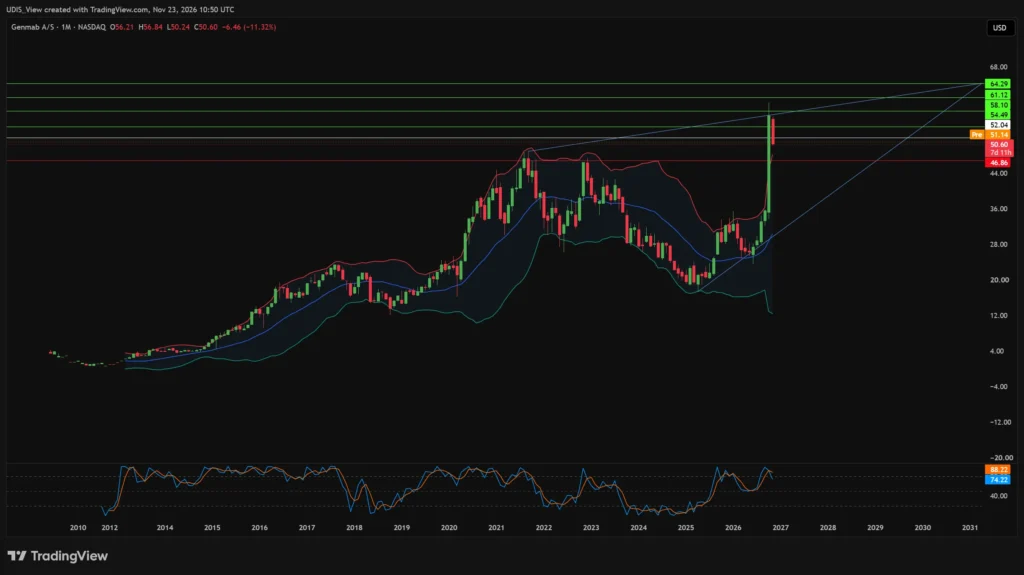
Genmab A/S Long (Buy)
Enter At: 52.04
T.P_1: 54.49
T.P_2: 58.10
T.P_3: 61.12
T.P_4: 64.29
S.L: 46.86