
1. The Strategic Pivot of January 2026
1.1 The Deal That Defined the Quarter
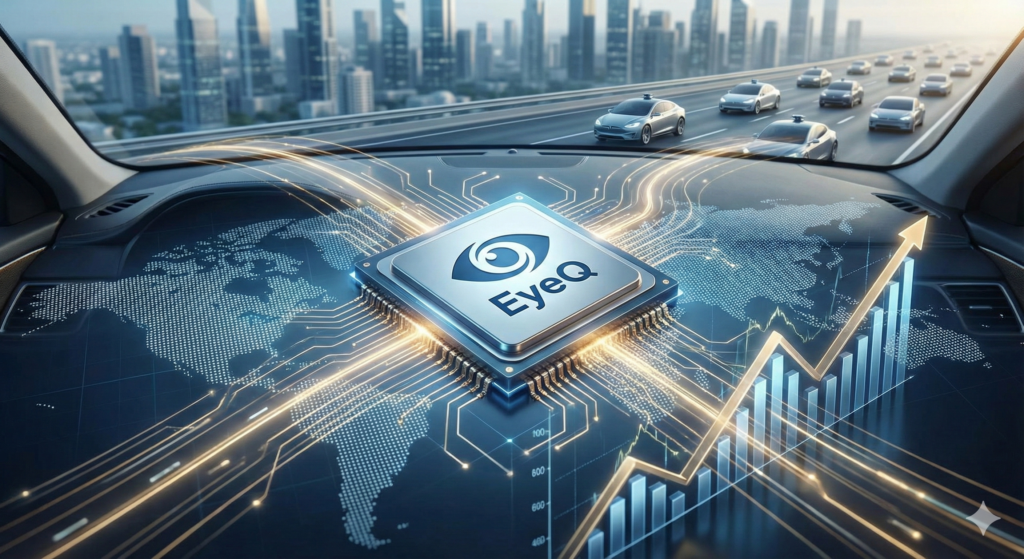
Mobileye Global Inc. commenced 2026 with a defining strategic victory. On January 5, 2026, the company confirmed a massive supply agreement. A major U.S. automaker selected the Mobileye EyeQ™6H system-on-chip (SoC) for its future platforms.
This deal is not merely a transaction. It represents a validation of Mobileye’s “Surround ADAS” architecture. The agreement covers the deployment of 9 million units. These units will power hands-free driving on highways.
The integration spans mainstream and premium models globally. This volume adds to the existing 10 million unit pipeline with Volkswagen Group. The total future delivery estimate for EyeQ6H systems now exceeds 19 million units. This massive backlog provides revenue visibility through the end of the decade.
1.2 Unveiling the “Unnamed” Partner
Mobileye’s official communications describe the client as a “top-10 global automaker” based in the U.S. Industry analysts have scrutinized this description.
The prevailing consensus points to General Motors (GM). GM has recently pivoted its autonomous strategy. The automaker has moved away from exclusive internal hardware development. Their “Ultra Cruise” program faced significant scaling challenges.
Adopting Mobileye’s proven stack aligns with GM’s revised capital efficiency goals. This partnership signals a broader industry trend. Legacy OEMs are abandoning proprietary “science projects.” They are embracing standardized, scalable platforms from specialized suppliers. This shift reduces R&D risk for automakers. It simultaneously cements Mobileye as the foundational layer of the software-defined vehicle (SDV).
1.3 Stock Market Reaction and Sentiment
The market responded decisively to the announcement. Mobileye shares surged approximately 8% in pre-market trading immediately following the news. This rally marked a reversal of sentiment.
The stock had suffered a decline of nearly 50% throughout 2025. Investors had previously punished the company for inventory corrections. The 2025 decline reflected fears of commoditization and Chinese competition. The January 2026 deal dispelled these concerns.
It demonstrated that Western OEMs prioritize performance and trust over commoditized silicon. The deal also highlighted the “Israel Discount” arbitrage. Investors realized the geopolitical risk premium was overstated. Operational continuity remained robust despite regional instability.
1.4 The Shift to Standard Equipment
A critical nuance in the deal is the “standard equipment” designation. The automaker will not treat Surround ADAS as a niche luxury option. It will integrate the system across mass-market lines. This is a pivotal shift in the ADAS adoption curve.
Historically, advanced features were high-margin options. They had low take rates, often under 10%. Making EyeQ6H standard ensures 100% penetration on fitted models. This guarantees volume for Mobileye. It also democratizes safety technology.
Regulators are increasingly mandating such features for 5-star safety ratings. Mobileye has positioned itself as the enabler of regulatory compliance.
Table 1: Strategic Implications of the January 2026 Agreement
| Feature | Details | Strategic Impact |
| Volume | 9 Million incremental units. | Validates mass-market adoption of L2+ ADAS. |
| Technology | EyeQ™6H (High) SoC. | Confirms shift to centralized compute architectures. |
| Integration | Standard equipment. | Moves ADAS from “luxury option” to “regulatory necessity.” |
| Economics | ECU Consolidation. | Delivers deflationary cost savings to the OEM. |
| Partner | Major U.S. Automaker (Likely GM). | Signals legacy OEM retreat from in-house chip design. |
2. Macroeconomic Forces and ECU Consolidation
2.1 The Deflationary Value Proposition
The global automotive sector faces severe macroeconomic headwinds in 2026. Interest rates remain elevated compared to the previous decade. Consumer purchasing power is constrained. Automakers face intense pressure to reduce the Bill of Materials (BOM).
Mobileye has astutely positioned the EyeQ6H as a deflationary tool. The chip enables “ECU consolidation.” Traditional architectures use separate microcontrollers for different functions. One chip might control lane keeping. Another controls adaptive cruise control. A third handles driver monitoring. The EyeQ6H replaces these multiple discrete components.
2.2 Cost Reduction via Integration
The EyeQ6H processes data from 11 sensors simultaneously. It handles 1 high-resolution front camera, 4 parking cameras, and multiple radars.
This integration eliminates the need for satellite processors. It reduces the wiring harness complexity. It lowers the vehicle’s weight. It reduces power consumption. The automaker saves money on hardware. They also simplify their supply chain logistics.
Mobileye argues this approach lowers costs compared to “first-generation” systems. In a high-inflation environment, cost reduction is a primary sales driver. Mobileye wins deals not just on safety, but on economics.
2.3 Resilience in a High-Rate Environment
High interest rates typically dampen auto sales. However, safety technology is demand-inelastic. Regulatory bodies like Euro NCAP and the NHTSA continuously raise standards. Automakers cannot sell cars without top safety ratings. This forces them to buy ADAS chips regardless of the economic cycle.
Mobileye’s revenue stream is therefore partially insulated from recessionary pressures. The “Surround ADAS” system offers a high value-to-cost ratio. It allows OEMs to maintain premium pricing for vehicles. This helps offset the margin compression caused by financing costs.
2.4 The Software-Defined Vehicle (SDV) Catalyst
The automotive industry is transitioning to the SDV model. OEMs want to sell post-purchase subscriptions. They aim to update vehicle features Over-the-Air (OTA). The EyeQ6H supports this architecture.
It acts as a centralized “brain” for the driving domain. Automakers can push software updates to improve performance. They can unlock new features for a fee. This capability aligns Mobileye with the OEMs’ long-term revenue goals. The chip becomes a platform for future monetization. It is not just a static component. This alignment ensures long-term partnership stability.
3. Geopolitics and Supply Chain Resilience
3.1 Analyzing the Israel Risk Premium
Mobileye is headquartered in Jerusalem. The company operates in a region characterized by geopolitical volatility. The conflict involving Israel, Hamas, and Iran escalated significantly in mid-2025. This instability creates a “risk premium” on the stock.
Investors fear supply chain disruptions. They worry about the safety of key personnel. However, a deep analysis reveals a decoupling of risk. Mobileye utilizes a fabless business model. It does not manufacture chips in Israel. Production occurs at TSMC in Taiwan and STMicroelectronics in Europe. The physical supply chain is geographically removed from the conflict zone.
3.2 Operational Continuity During Conflict
Mobileye has demonstrated remarkable resilience. The company maintained full operations during the 2025 hostilities. It secured major contracts like the VW and U.S. automaker deals during active conflict. This proves the robustness of its business continuity plans.
The R&D workforce is distributed globally. Key engineering hubs exist in Germany and the U.S. The layoffs of late 2025 primarily affected non-core roles in Israel. This streamlining paradoxically increased operational efficiency. It signaled a maturation of the corporate structure. The “Israel Discount” creates a value opportunity. The market prices in risks that do not materially affect delivery.
3.3 The U.S.-China Tech War
The semiconductor industry is the frontline of the U.S.-China geopolitical rivalry. The U.S. government restricts the export of high-end AI chips to China. This has bifurcated the market.
Western OEMs are de-risking their supply chains. They cannot rely on Chinese silicon for critical safety systems. Political pressure mandates “clean” supply chains. Mobileye is the primary beneficiary of this trend. It is the “safe harbor” for Western automakers. It offers high-performance AI that is politically aligned.
3.4 The Rise of Horizon Robotics
Horizon Robotics has emerged as Mobileye’s main competitor in China. Horizon dominates the domestic Chinese OEM market. They offer the Journey 6 series of chips. These chips claim high raw performance.
However, Chinese chips face barriers in the West. Data privacy concerns prevent their adoption in the U.S. and Europe. This creates a natural market segmentation. Horizon wins in China. Mobileye wins in the West. As Chinese OEMs expand globally, they may face regulatory headwinds. They might be forced to switch to Mobileye for export vehicles. This creates a defensive moat for Mobileye in international markets.
Table 2: Geopolitical Risk Assessment Matrix
| Risk Factor | Impact on Mobileye | Mitigation Strategy |
| Israel Regional Conflict | Moderate (Sentiment/Personnel). | Fabless manufacturing (TSMC/STMicro); Global R&D centers. |
| U.S.-China Decoupling | Positive (Western Market Share). | Positioned as the “Trusted Supplier” for NATO-aligned OEMs. |
| Supply Chain Disruption | Low (Inventory Management). | 2025 inventory correction cleared excess channel stock. |
| Trade Tariffs | Moderate (Cost Impact). | High value-add of EyeQ chips absorbs tariff costs easier. |
4. The Silicon Architecture: EyeQ6H Deep Dive
4.1 Beyond TOPS: The Efficiency Paradigm
The industry often obsesses over “TOPS” (Trillions of Operations Per Second). Competitors like Nvidia market chips with massive TOPS numbers. Mobileye takes a different approach. They focus on “efficiency per watt.”
The EyeQ6H delivers 34 DL TOPS. This number seems low compared to Nvidia’s Orin. However, raw TOPS is a misleading metric. Mobileye uses a heterogeneous architecture. They use specialized accelerators for specific tasks. This allows them to achieve equivalent performance with far less power. Low power consumption is critical for EVs. Every watt saved extends the vehicle’s range. It also eliminates the need for liquid cooling.
4.2 Architectural Breakdown: The 5 Core Engines
The EyeQ6H features five distinct computing engines. Each engine is optimized for a specific mathematical workload.
- CPU (Central Processing Unit): Handles general serial processing and logic.
- MPC (Multi-threaded Processor Cluster): More versatile than a GPU. It handles multi-threaded tasks with high efficiency.
- VMP (Vector Microcode Processor): A wide vector machine. It excels at the short integral types common in computer vision.
- PMA (Programmable Macro Array): A CGRA dataflow machine. This is the secret weapon. It allows deep learning algorithms to flow without memory bottlenecks.
- XNN (Deep Learning Accelerator): A dedicated engine for high-performance neural network inference.
4.3 The “One-Box” Solution Advantage
The efficiency of EyeQ6H enables a “One-Box” form factor. The chip can sit directly behind the windshield. It does not require a large cooling apparatus. It does not need a separate computer in the trunk.
This reduces installation complexity. It saves space in the cabin. It reduces noise from cooling fans. This form factor is highly attractive to OEMs. It simplifies the vehicle assembly process. It allows for sleeker interior designs. Nvidia’s solutions often require liquid cooling and more space. Mobileye wins on integration ease.
4.4 7nm Process Technology
The EyeQ6H is fabricated on a 7nm process node. This technology balances performance and cost. It is mature enough to be cost-effective. It is advanced enough to provide high transistor density.
Mobileye avoids the bleeding-edge cost of 3nm or 5nm nodes. This keeps the chip affordable for mass-market cars. It ensures high yields during manufacturing. This strategic choice supports the “democratization” of safety technology.
5. The Scientific Moat: REM and Crowdsourcing
5.1 The Mapping Challenge
Autonomous vehicles need High-Definition (HD) maps. These maps provide context beyond what sensors see. They tell the car where the lanes should be. They identify traffic signs obscured by trucks.
Traditional mapping is expensive. It requires fleets of dedicated survey vehicles. These vehicles must drive every road repeatedly. This approach is hard to scale globally. It is slow to update. A construction zone can render a map obsolete in hours.
5.2 REM: The Crowdsourcing Revolution
Mobileye’s Road Experience Management (REM™) solves this scaling problem. It uses consumer cars as data harvesters. Millions of vehicles equipped with EyeQ chips collect data.
They do this passively while people drive to work. They identify landmarks and road geometry. This creates a “living map.” Mobileye does not need to own a fleet. They leverage the fleets of their customers. This is a capital-efficient model. It creates a network effect. The more cars Mobileye sells, the better the map gets.
5.3 Bandwidth Efficiency: The 10kb/km Breakthrough
Sending video to the cloud is impossible. It would require massive bandwidth. It would cost too much in data fees. Mobileye processes the video on the chip. The EyeQ chip extracts semantic information.
It turns video into tiny data packets. These packets are called Road Segment Data (RSD). An RSD packet is only 10 kilobytes per kilometer. This is incredibly small. It can be sent over standard cellular networks. It costs almost nothing to transmit. This patented compression allows Mobileye to map the world effectively for free.
5.4 The “Healing” Map
Roads change constantly. Construction crews shift lanes. Cities add new signs. A static map is dangerous. REM maps “heal” themselves. When multiple consumer cars detect a change, the cloud updates the map.
This happens in near real-time. The update is then pushed to other vehicles. This “Time To Reflect Reality” is a critical safety metric. Mobileye’s update frequency is superior to survey fleets. Survey fleets might visit a road once a month. Mobileye’s fleet drives it thousands of times a day.
5.5 Global Coverage and Scalability
Mobileye has mapped millions of kilometers globally. They have coverage in Europe, the U.S., and Asia. The map is called the “Mobileye Roadbook.”
It includes driving semantics. It knows how locals drive. It knows where people typically stop at an intersection. This human-like intuition is encoded into the map. It allows the AV to drive naturally. It reduces the “robot-like” hesitation of other systems. This global asset is a massive barrier to entry. New competitors cannot replicate this data trove overnight.
6. The Safety Moat: RSS and Patent Strategy
6.1 The Liability Problem
Who is responsible when an AV crashes? This is the central legal question. Neural networks are “black boxes.” They cannot explain their decisions. This makes liability hard to prove. It hinders regulatory approval. Regulators need determinism. They need to know the car will follow the rules. They cannot rely on probabilistic “guesses.”
Mobileye realized this barrier early. They invented a solution called Responsibility-Sensitive Safety (RSS).
6.2 RSS: Digitizing the Duty of Care
RSS is a formal mathematical model. It digitizes the concept of “safe driving.” It defines specific formulas for safety. It calculates the minimum safe following distance. It calculates the safe gap for a lane change.
These are not learned behaviors. They are hard-coded constraints. The AI can propose any action it wants. But the RSS layer validates it. If the action violates a safety formula, RSS blocks it. It forces the car to execute a safe maneuver instead.
6.3 Five Rules of Safety
RSS is built on five common-sense rules:
- Don’t hit the car in front. (Longitudinal safety).
- Don’t cut in recklessly. (Lateral safety).
- Right of Way is given, not taken.
- Be cautious in areas with limited visibility.
- If you can avoid a crash without causing another one, you must.
6.4 Patent Protection and Industry Standardization
Mobileye has patented the RSS logic. This is a strategic masterstroke. It protects the specific mathematical implementation of safety. However, Mobileye also offers RSS as an open standard. They want the industry to adopt it.
If regulators adopt RSS as the standard for safety, Mobileye wins. They wrote the rules. Their chips are optimized to run these rules. This creates a “regulatory moat.” It positions Mobileye as the referee of the AV industry.
6.5 Patent Portfolio Dominance
Mobileye holds hundreds of patents. These cover vision processing, mapping, and driving policy. The portfolio is particularly strong in “imaging radar”. Imaging radar is the next frontier.
It provides LiDAR-like resolution at a fraction of the cost. Mobileye’s IP leadership here secures its future. It prevents competitors from blocking their roadmap. It also creates licensing revenue potential. The portfolio acts as a nuclear deterrent against patent litigation.
7. Cybersecurity in an Era of Cyberwarfare
7.1 The Threat Landscape
Modern vehicles are connected computers. They are vulnerable to cyberattacks. A hacker could theoretically take control of the steering. This is a terrifying prospect. It is a national security risk. Cyberwarfare is becoming a reality. State actors target critical infrastructure. Transportation networks are prime targets. The industry has responded with strict standards. Security is no longer optional. It is a mandatory requirement for doing business.
7.2 ISO/SAE 21434 Compliance
The gold standard for automotive cybersecurity is ISO/SAE 21434. This standard dictates how security is managed. It covers the entire lifecycle of the product. It requires security by design.
Mobileye has achieved full compliance with this standard. This is a rigorous process. It involves external audits. It requires big organizational changes. Compliance acts as a gatekeeper. OEMs cannot buy from non-compliant suppliers. Mobileye’s certification gives it a ticket to play.
7.3 Hardware Root of Trust
Security must start in the silicon. Software alone is not enough. Software can be hacked. The EyeQ6H features a “Hardware Root of Trust”. This is a secure area on the chip. It stores cryptographic keys.
It creates a “chain of trust.” When the car starts, the chip verifies the software signature. If the software has been tampered with, the chip refuses to boot. This prevents “man-in-the-middle” attacks. It protects the car from malicious OTA updates.
7.4 TISAX and Trusted Exchange
European automakers require TISAX certification. TISAX stands for Trusted Information Security Assessment Exchange. It is a standard for information security. Mobileye holds TISAX labels. This allows them to exchange sensitive data with German OEMs. It proves they can protect trade secrets. It proves they can handle prototype data securely. This trust is essential for deep partnerships. It binds Mobileye closely to the European automotive ecosystem.
8. Competitive Landscape and Market Dynamics
8.1 Mobileye vs. Tesla: The Philosophy War
Tesla represents the vertical integration model. They build their own chips. They write their own software. They use a camera-only approach similar to Mobileye. However, Tesla sells directly to consumers.
They charge a monthly subscription for FSD. Tesla’s price has dropped to $99/month. This puts pressure on the market. But Mobileye has a different strategy. Mobileye sells to the OEMs. They enable the OEMs to compete with Tesla. The Jan 2026 deal proves OEMs prefer Mobileye. They do not want to become Tesla. They want to beat Tesla. Mobileye is the arms dealer in this war.
8.2 Mobileye vs. Nvidia: Efficiency vs. Power
Nvidia is the giant of AI computing. Their Orin and Thor chips are powerful. They offer immense flexibility. They are popular for robotaxis and high-end luxury cars. But they are expensive. They consume a lot of power.
They are overkill for a mass-market sedan. Mobileye wins on cost. The EyeQ6H is optimized for the volume market. It is the “Toyota Corolla” of chips. Nvidia is the “Ferrari.” The volume is in the Corolla segment. Mobileye’s 19 million unit backlog confirms this.
8.3 Mobileye vs. Horizon Robotics: The Geopolitical Split
Horizon Robotics is a formidable technical rival. Their Journey 6 chip is competitive. They have strong momentum in China. But they are contained geopolitically. Western governments are wary of Chinese tech in critical infrastructure.
This limits Horizon’s growth in Europe and the U.S. Mobileye is free to operate globally. They are the “neutral” player. They can sell in China (to Zeekr). They can sell in the U.S. (to GM). This global access is a key competitive advantage.
8.4 The Qualcomm Threat
Qualcomm is entering the auto space aggressively. Their Snapdragon Ride platform competes with EyeQ. Qualcomm leverages its mobile heritage. They are strong in the “digital cockpit.” They want to merge the cockpit and ADAS domains.
Mobileye must defend against this. Their focus on “pure ADAS” performance is their shield. They argue that safety requires a dedicated processor. They emphasize their mapping data moat. Qualcomm lacks the REM map. This data advantage keeps Mobileye ahead.
9. Financial Trajectory and 2030 Outlook
9.1 Recovering from the Inventory Correction
The year 2025 was difficult financially. Revenue was suppressed by inventory destocking. Tier 1 suppliers had bought too many chips in 2024. They spent 2025 using up that stock.
This caused Mobileye’s shipments to drop. But this is a temporary cycle. The Q3 2025 results showed a return to growth. Revenue increased 4% year-over-year. The channel is now clear. Shipment volume is realigning with vehicle production. 2026 will see a rebound in recognized revenue.
9.2 The “Eyes-On” Revenue Bridge
L4 autonomy (robotaxis) is taking longer than expected. The industry has reset expectations. The focus is now on “Eyes-On, Hands-Free” (Level 2+). This is the immediate revenue opportunity.
Mobileye’s SuperVision™ product targets this segment. It commands a much higher Average Selling Price (ASP) than basic ADAS chips. A basic chip costs ~$50. A SuperVision system can cost ~$1000+. As OEMs shift to SuperVision, Mobileye’s revenue per car explodes. This mix shift drives margin expansion.
9.3 19 Million Units Pipeline
The backlog is the North Star. Mobileye has 19 million EyeQ6H units in the pipeline. This provides immense stability. It allows the company to plan R&D spending. It allows them to negotiate better rates with foundries.
It signals long-term relevance. These are long-cycle contracts. Once a chip is designed into a car, it stays there for 5-7 years. This recurring revenue is “sticky.” It is not easily displaced.
9.4 Operational Efficiency and Margins
Mobileye is a high-margin business. They sell intellectual property wrapped in silicon. Their gross margins are typically high. The recent restructuring improves operating leverage. They have trimmed non-essential headcount. They are focusing resources on the core products.
As revenue scales in 2026, operating margins should expand. The company is generating strong cash flow. This self-funds their L4 ambitions. They do not need to raise capital. This financial health is rare in the AV sector.
10. Conclusion: The Resurgent Architect
10.1 Synthesizing the Turnaround
Mobileye has successfully navigated the “trough of disillusionment.” The company faced a perfect storm in 2025. Inventory gluts, geopolitical fear, and competitive noise dragged it down. But the strategic pivot of January 2026 has reset the narrative.
The deal with the major U.S. automaker is the turning point. It validates the technology. It validates the business model. It proves that legacy OEMs need Mobileye to survive the transition to software-defined vehicles.
10.2 The Moats are Intact
The analysis confirms the strength of Mobileye’s moats. The Technical Moat (EyeQ6H efficiency) protects against commoditization. The Scientific Moat (REM mapping) protects against new entrants. The Safety Moat (RSS patents) protects against regulatory hurdles. The Geopolitical Moat (Western trust) protects against Chinese competition. These barriers are robust. They ensure Mobileye remains the dominant player in the ADAS market.
10.3 The Path Forward
Mobileye is evolving. It is no longer just a component supplier. It is a platform architect. It is building the digital foundation of the automobile. The transition to “Eyes-On” driving is the growth engine for the next decade.
Mobileye is uniquely positioned to monetize this shift. The company combines the agility of a tech firm with the discipline of an automotive supplier. This combination is powerful. As 2026 unfolds, Mobileye is poised not just to participate in the future of mobility but to define it.